2.4GHz vs 5GHz for Thick Walls UK (2026) – Which Works Better?
🧱 2.4GHz vs 5GHz for Thick Walls UK – The Key Difference
If your WiFi struggles to reach certain rooms, understanding 2.4GHz vs 5GHz for thick walls UK can make a big difference.
For a full breakdown of improving your internet, see WiFi in small flats UK.
Most modern routers offer both frequency bands — but they behave very differently, especially in homes with thick brick or concrete walls.
| FEATURE | 2.4 GHz | 5 GHz |
|---|---|---|
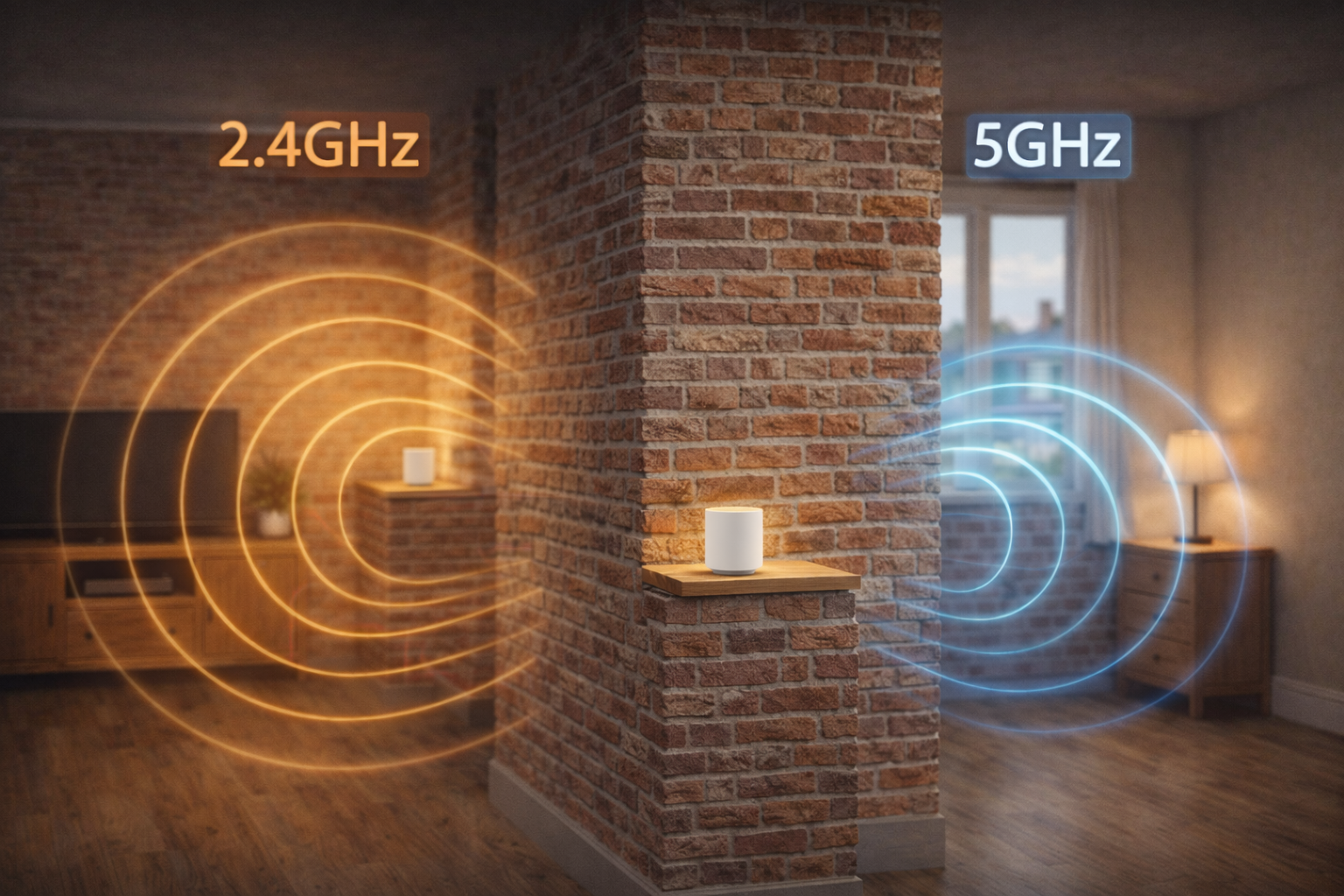
| Range | Long | Short |
| Wall Penetration | Strong | Weak |
| Speed | Slower | Faster |
| Stability | More stable | Less stable through walls |
| Best Use | Distant rooms | Nearby devices |
👉 Check Dual-Band Routers On Amazon➜
Affiliate Disclosure: This article contains affiliate links. If you click a link and make a purchase, we may earn a small commission at no extra cost to you.
📡 What Is 2.4GHz WiFi?
👉 2.4GHz is the older and more widely used WiFi band.
✔️ Pros:
- Longer range
- Better at passing through walls
- More stable over distance
❌ Cons:
- Slower speeds
- More interference from devices
👉 Best for:
- Rooms far from the router
- Homes with thick walls
⚡ What Is 5GHz WiFi?
👉 5GHz is faster and more modern.
✔️ Pros:
- Faster speeds
- Less interference
- Better for streaming and gaming
❌ Cons:
- Shorter range
- Struggles with thick walls
👉 Best for:
- Devices close to the router
- Open spaces
🧱 2.4GHz vs 5GHz for Thick Walls UK – Direct Comparison
👉 2.4GHz:
- Travels further
- Handles thick walls better
- Slower but more reliable
👉 5GHz:
- Faster speeds
- Weaker through walls
- Drops off quickly in separate rooms
To optimise performance, read best place to put router for thick walls UK for correct placement tips.
🧠 Which Should You Use for Thick Walls?
👉 In most UK homes with thick walls:
✔️ 2.4GHz is the better option for coverage
✔️ 5GHz is better for speed (but only nearby)
👉 Best approach:
- Use 2.4GHz for distant rooms
- Use 5GHz near the router
For the best overall solution, see the best WiFi routers for thick walls UK for stronger and more reliable coverage.
📍 How to Get the Best of Both Worlds
You don’t have to choose just one.
👉 Use both bands strategically:
- Connect nearby devices to 5GHz
- Use 2.4GHz for rooms behind thick walls
- Enable band steering if your router supports it
If you’re comparing solutions, this guide on mesh vs WiFi extender for thick walls UK explains which setup works best.
⚔️ Does This Solve Thick Wall WiFi Problems?
Understanding 2.4GHz vs 5GHz for thick walls UK helps — but it’s not always enough.
👉 If you still have issues:
- Improve router placement
- Use a mesh WiFi system
- Reduce obstacles where possible
If you’re considering extenders, see do WiFi extenders work through thick walls UK for the honest answer.
📶 Does Router Type Affect 2.4GHz vs 5GHz Performance?
When comparing 2.4GHz vs 5GHz for thick walls UK, the type of router you use also plays a role.
👉 Newer routers:
- Handle both bands more efficiently
- Automatically switch devices between 2.4GHz and 5GHz
- Maintain more stable connections
👉 Older routers:
- May struggle with multiple devices
- Offer weaker signal strength overall
- Don’t manage bands as effectively
👉 Important takeaway:
Even though 2.4GHz performs better through thick walls, a modern dual-band router or mesh system will give you the best overall experience.
📡 Can You Force Devices to Use 2.4GHz or 5GHz?
When dealing with 2.4GHz vs 5GHz for thick walls UK, it can help to control which band your devices use.
👉 Many routers allow you to:
- Separate 2.4GHz and 5GHz networks
- Manually choose which one to connect to
- Optimise performance based on location
👉 Why this matters:
- Devices far from the router may automatically try to use 5GHz
- This can result in weaker signal and slower speeds
- Switching to 2.4GHz can improve stability
👉 Quick tip:
If you’re experiencing slow or unstable WiFi behind thick walls, manually connecting to 2.4GHz can often provide a more reliable connection.
🏆 Final Verdict
👉 2.4GHz vs 5GHz for thick walls UK:
✔️ 2.4GHz = better range + wall penetration
✔️ 5GHz = faster but weaker through walls
For practical fixes, see how to boost WiFi signal through walls UK.
👉 Final takeaway:
If your home has thick walls, 2.4GHz will usually give you more reliable coverage — but combining both bands gives the best overall performance.
For general WiFi advice and interference guidance, refer to Ofcom.