
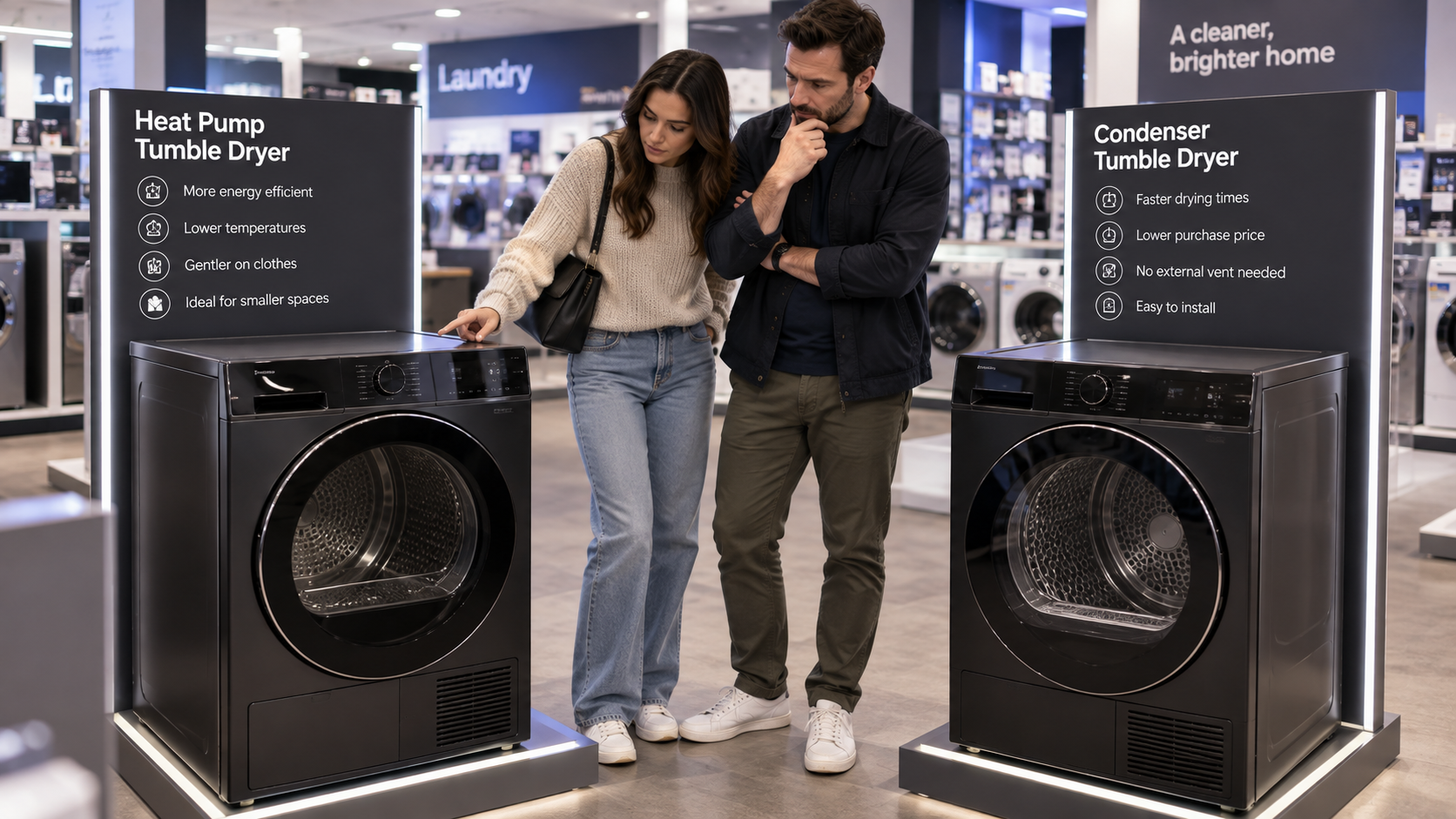
Heat Pump vs Condenser Tumble Dryer: 7 Key Differences for Small Flats
Choosing between a Heat Pump vs Condenser Tumble Dryer can feel unnecessarily confusing because both are ventless, both remove moisture from your clothes and both can work in homes where a traditional vented dryer would be awkward. The real differences are in how they handle heat, how much electricity they use, how quickly they dry, how much warmth they release into the room and how much they cost to buy.
For a small flat, those differences matter even more because the appliance may sit close to your living area and every bit of wasted heat or electricity is more noticeable. This Heat Pump vs Condenser Tumble Dryer guide breaks the decision into seven practical differences so you can work out which technology actually suits your home.
⚡ Quick Answer: Heat Pump vs Condenser Tumble Dryer
For most small flats, a Heat Pump vs Condenser Tumble Dryer comparison favours the heat-pump dryer if you use it regularly and can afford the higher initial purchase price.
Heat-pump dryers reuse warm air, consume much less electricity and dry clothes at lower temperatures. Conventional condenser dryers are usually cheaper to buy and often quicker, but they use considerably more electricity and tend to release more heat into the room.
If you only use a tumble dryer occasionally, a condenser model can still make sense.
If you dry several loads every week, the Heat Pump vs Condenser Tumble Dryer running-cost difference becomes much more important.
Heat Pump vs Condenser Tumble Dryer at a Glance
| Difference | Heat pump dryer | Condenser dryer |
|---|---|---|
| Energy use | Lower | Higher |
| Purchase price | Usually higher | Usually lower |
| Drying temperature | Lower | Higher |
| Cycle time | Usually longer | Usually shorter |
| Fabric care | Gentler | Hotter drying |
| External vent needed | No | No |
| Room heat | Usually lower | Usually higher |
| Water collection | Tank or drain on many models | Tank or drain on many models |
The simplest way to understand Heat Pump vs Condenser Tumble Dryer technology is that both machines remove moisture by condensing it, but the heat-pump dryer recovers and reuses much of the heat it has already generated.

How Does a Condenser Tumble Dryer Work?
A conventional condenser dryer uses an electric heating element to warm air before passing that hot air through the drum.
As the clothes release moisture, the warm damp air passes through a condenser. The moisture becomes water and is normally collected in a removable container, although some machines can also connect directly to a drain.
The dryer then continues generating heat as the programme runs.
That repeated heating is one of the main reasons a Heat Pump vs Condenser Tumble Dryer comparison shows such a large difference in electricity use.
A condenser tumble dryer does not normally require an external wall vent, which makes it much easier to position than an old-fashioned vented dryer.
However, it still needs suitable airflow around the appliance and should not simply be sealed inside an unsuitable cupboard.
When looking at Heat Pump vs Condenser Tumble Dryer technology, the condenser model is fundamentally the simpler but more energy-hungry approach.
How Does a Heat Pump Tumble Dryer Work?
A heat-pump tumble dryer also removes moisture from warm air, but it deals with the heat very differently.
Instead of repeatedly creating hot air and losing much of that energy, a heat-pump system recovers and reuses the warmth inside a closed-loop system.
Moisture is removed from the air, the air is reheated and it travels back through the drum.
That recycling process is the central reason the Heat Pump vs Condenser Tumble Dryer running-cost difference can be so substantial.
Heat-pump tumble dryers also operate at lower temperatures than conventional condenser dryers.
That brings two main consequences:
- they generally use much less electricity
- they often take longer to finish a cycle
The Heat Pump vs Condenser Tumble Dryer choice is therefore partly a trade-off between efficiency and speed.
Beko’s official heat pump vs condenser tumble dryer guide explains how heat-pump dryers reuse warm air while conventional condenser models rely on higher-temperature heating.
1. ⚡ Energy Use: Heat Pump Wins Clearly
Energy efficiency is the biggest difference in a Heat Pump vs Condenser Tumble Dryer comparison.
A condenser dryer repeatedly uses an electric heater to create the hot air required for drying.
A heat-pump dryer instead recovers and reuses much of the heat already inside the appliance.
That makes heat-pump machines dramatically more efficient.
Independent UK testing has found that conventional condenser dryers can use more than twice as much electricity as heat-pump dryers doing comparable work.
For a household drying several loads every week, that difference can become significant.
This is the area where the Heat Pump vs Condenser Tumble Dryer decision is least evenly matched: heat pump is the clear efficiency winner.
Why This Matters More in a Flat
People living in flats can end up relying heavily on tumble drying.
You might not have:
- a garden
- an outdoor washing line
- a utility room
- room for a large clothes horse
- enough ventilation to air-dry everything comfortably
That means the tumble dryer may run regularly throughout autumn and winter.
In that situation, the Heat Pump vs Condenser Tumble Dryer electricity-use difference matters much more than it would for someone who only uses a dryer occasionally.
If you dry three, four or five loads each week, running cost deserves serious attention.
If you use the dryer once every couple of weeks, the calculation becomes less dramatic.
For frequent users, though, the first major point in the Heat Pump vs Condenser Tumble Dryer comparison goes decisively to heat pump.
2. 💷 Purchase Price: Condenser Usually Costs Less Upfront
The second major Heat Pump vs Condenser Tumble Dryer difference is the purchase price.
Conventional condenser dryers are usually cheaper.
Heat-pump technology requires a more sophisticated heating and refrigeration-style system, so these machines have historically carried a noticeable premium.
Prices have been falling as heat-pump tumble dryers become more common, but the cheapest conventional condenser models are still generally less expensive.
The Heat Pump vs Condenser Tumble Dryer trade-off looks roughly like this:
Condenser: lower purchase price, higher running cost.
Heat pump: higher purchase price, lower running cost.
Think About Total Cost, Not Just the Till Receipt
A saving at purchase can gradually disappear if the cheaper machine uses much more electricity every year.
On the other hand, there is little point spending hundreds of pounds extra on the most efficient heat-pump dryer if you only use it once every fortnight.
That is why the Heat Pump vs Condenser Tumble Dryer decision should consider how frequently you actually dry clothes.
For frequent users, lifetime running cost matters more.
For occasional users on a strict initial budget, the conventional condenser option can still be perfectly reasonable.
Purchase price is therefore the main category where the Heat Pump vs Condenser Tumble Dryer comparison clearly favours condenser.
3. ⏱️ Drying Time: Condenser Is Usually Faster
If drying speed is your priority, the Heat Pump vs Condenser Tumble Dryer contest usually favours the conventional condenser machine.
Condenser dryers typically operate at higher temperatures.
That extra heat can remove moisture faster.
Heat-pump dryers work at lower temperatures and recycle warm air, so full-capacity programmes often take longer.
That does not mean every heat-pump cycle is extremely slow.
Modern machines increasingly offer shorter programmes for small loads, but those rapid cycles normally have much lower capacity limits than the headline drum size.

Does a Longer Cycle Mean More Electricity?
No.
This is one of the most counter-intuitive parts of the Heat Pump vs Condenser Tumble Dryer comparison.
A heat-pump dryer can run for longer while still using far less electricity overall because it uses energy much more efficiently.
A conventional condenser machine may finish faster but draw considerably more power while doing so.
Cycle duration and electricity consumption are not the same thing.
The Heat Pump vs Condenser Tumble Dryer decision should therefore never be based on programme length alone.
When Faster Drying Really Matters
A condenser dryer may suit you better if you regularly need very quick laundry turnaround.
Examples include:
- larger families completing several loads in one day
- school uniforms needed again the following morning
- sports kits washed several times each week
- households where one load must finish before another can start
For a couple or smaller household, waiting longer for a more efficient heat-pump cycle may barely affect everyday life.
So on speed, the Heat Pump vs Condenser Tumble Dryer winner is generally condenser — but speed is only one part of the story.
4. 👕 Fabric Care: Heat Pump Uses Gentler Temperatures
Lower drying temperature is another major Heat Pump vs Condenser Tumble Dryer difference.
Conventional condenser dryers use relatively high temperatures to remove moisture quickly.
Heat-pump tumble dryers normally operate at significantly lower temperatures.
That lower heat can be kinder to fabrics, particularly clothing that is repeatedly tumble dried.
The Heat Pump vs Condenser Tumble Dryer comparison therefore favours heat pump if fabric care is an important consideration.
This does not mean you can ignore washing labels.
A jumper marked do not tumble dry does not suddenly become safe because the dryer uses heat-pump technology.
But for garments that are suitable for tumble drying, gentler temperatures can reduce exposure to intense heat over time.
Moisture Sensors Still Matter
Whichever side of the Heat Pump vs Condenser Tumble Dryer debate you choose, sensor drying is worth having.
Moisture sensors can detect when laundry reaches the selected dryness level and adjust or end the cycle.
That helps reduce:
- unnecessary running
- excessive drying
- wasted electricity
- avoidable heat exposure
For everyday use, good sensor drying is usually more valuable than having dozens of specialist programmes.
On fabric care, heat pump takes another clear Heat Pump vs Condenser Tumble Dryer advantage.
5. 🌡️ Room Heat: Heat Pump Is Usually Better for Small Spaces
This may be one of the most important Heat Pump vs Condenser Tumble Dryer differences for a small flat.
A conventional condenser dryer uses high temperatures and can release considerably more residual heat into the surrounding room.
In a large utility room, you may barely notice.
In a small kitchen, hallway utility area or studio flat, you probably will.
A heat-pump tumble dryer recycles more of its heat internally and operates at lower temperatures.
That generally makes heat pump the better Heat Pump vs Condenser Tumble Dryer option when you do not want the tumble dryer warming an already compact room.
If trapped heat is already an issue in your home, our guide to cooling a studio flat UK covers practical ways to reduce heat build-up in compact living spaces.
No External Vent Does Not Mean No Ventilation
Both technologies are often described as ventless because neither normally requires the large exhaust hose used by a traditional vented tumble dryer.
That does not mean the surrounding space is irrelevant.
A condenser dryer in particular needs suitable surrounding air and somewhere for residual heat to disperse.
Neither type should be squeezed into an unsuitable sealed cupboard simply because it does not need an external vent.
The room itself should therefore be part of the Heat Pump vs Condenser Tumble Dryer decision.
If the dryer will live only a few metres from your sofa or dining table, a heat-pump model has a meaningful advantage.
For compact open-plan living, heat pump generally wins this part of the Heat Pump vs Condenser Tumble Dryer comparison.

6. 🏠 Installation: Both Are Flexible
One area where the Heat Pump vs Condenser Tumble Dryer comparison is surprisingly close is installation.
Neither normally requires an external exhaust hose through a wall.
Both convert moisture from the laundry into water.
Depending on the exact machine, that water may be:
- collected in a removable tank
- discharged through a drain hose
- handled either way
That makes both technologies much easier to position in a flat than a traditional vented dryer.
Our guide asking Are Slimline Washing Machines Worth It UK? also explains when saving a few centimetres of appliance depth can genuinely improve a compact kitchen.
Water Tank vs Direct Drain
A removable water tank gives you more freedom because the dryer does not necessarily need to sit close to plumbing.
The downside is obvious: someone has to empty it.
Direct drainage removes that job but requires a suitable waste-water connection.
When researching Heat Pump vs Condenser Tumble Dryer models, check the exact specification rather than assuming direct drainage is standard.
Some machines include the necessary hose.
Others require an accessory.
Check the Actual Appliance Dimensions
Technology does not automatically determine size.
There are relatively shallow heat-pump dryers and deep heat-pump dryers.
The same applies to conventional condenser machines.
For a small flat, measure:
- width
- height
- full appliance depth
- door-open depth
- rear clearance
- surrounding ventilation space
- nearby doors and walkways
A machine that technically fits beneath a worktop can still be frustrating if its door blocks the only route through the kitchen.
Installation is therefore almost a draw in the Heat Pump vs Condenser Tumble Dryer comparison — the exact model matters more than the drying technology.
For kitchens where appliance depth is particularly restricted, our Best Narrow Washing Machines for Small Spaces UK guide explores reduced-footprint laundry appliances.
7. 🔧 Maintenance: More Similar Than You Might Expect
Maintenance is another area where a Heat Pump vs Condenser Tumble Dryer comparison is less dramatic than many buyers expect.
Both require regular lint-filter cleaning.
Both may need a water container emptied if they are not connected to a drain.
Both depend on good airflow to dry efficiently.
Both need maintenance carried out according to the manufacturer’s instructions.
Keep the Lint Filter Clean
A blocked lint filter restricts airflow.
That can:
- increase drying time
- reduce efficiency
- affect drying performance
- increase unnecessary heat
Cleaning the filter at the interval specified by the manufacturer is one of the simplest ways to keep either technology working properly.
The best Heat Pump vs Condenser Tumble Dryer purchase can still perform badly if basic maintenance is ignored.
Heat-Exchanger Maintenance Varies
Some heat-pump dryers have user-accessible heat exchangers or secondary filters.
Others have systems designed to reduce the amount of manual cleaning required.
Conventional condenser dryers can also have condenser units requiring regular attention.
The exact maintenance routine varies by model.
That is why maintenance does not provide an automatic Heat Pump vs Condenser Tumble Dryer winner.
Check the manual for the machine you are actually considering.
💰 Heat Pump vs Condenser Tumble Dryer Running Costs
Running cost is where the two technologies separate most dramatically.
Recent independent UK testing has found average condenser-dryer energy costs substantially higher than average heat-pump running costs.
The exact pounds-and-pence figure will vary depending on:
- your electricity tariff
- dryer efficiency
- load size
- programme selection
- how often you tumble dry
The important Heat Pump vs Condenser Tumble Dryer takeaway is not one fixed annual figure.
It is that heat-pump dryers generally require dramatically less electricity.
Light User
If you use the dryer once per week or less, it can take quite a long time for lower running costs to recover a large purchase-price premium.
The Heat Pump vs Condenser Tumble Dryer choice is therefore less clear for very light users.
Moderate User
At two or three loads each week, efficiency begins to matter much more.
This is where the Heat Pump vs Condenser Tumble Dryer calculation starts becoming increasingly favourable to heat pump.
Heavy User
If the tumble dryer runs most days, electricity consumption becomes a major ownership cost.
For heavy usage, the Heat Pump vs Condenser Tumble Dryer argument strongly favours heat pump.
🏢 Which Is Better for a Small Flat?
For most Small Living Solutions readers, we would lean towards heat pump.
The reasons are practical:
- substantially lower electricity use
- lower drying temperatures
- less wasted room heat
- no external exhaust vent
- wide modern product choice
- good long-term value for frequent users
For someone tumble drying regularly, the Heat Pump vs Condenser Tumble Dryer choice is increasingly difficult to justify in favour of a conventional condenser model.
However, that does not mean condenser dryers suddenly have no purpose.
If floor space matters more than having a separate dryer, our Best Washer Dryers for Small Flats UK guide compares two-in-one alternatives for compact homes.
When a Condenser Dryer Still Makes Sense
A conventional condenser dryer can still be sensible if:
- your purchase budget is very tight
- you only tumble dry occasionally
- faster drying matters more than energy use
- you find a suitable model significantly cheaper
- you have a well-ventilated space where additional room heat is not a major issue
For those households, the Heat Pump vs Condenser Tumble Dryer decision can still favour condenser.
Someone drying once every few weeks may never recover a very large heat-pump price premium through energy savings.
The correct Heat Pump vs Condenser Tumble Dryer choice depends on actual usage, not simply which technology is newer.
When a Heat Pump Dryer Makes More Sense
Heat pump is the stronger choice if:
- you tumble dry several times every week
- electricity consumption matters
- the dryer sits close to your living space
- lower-temperature fabric care appeals to you
- you intend to keep the appliance for many years
- you can afford the higher initial purchase price
For these households, the Heat Pump vs Condenser Tumble Dryer calculation usually favours paying more initially and less during ownership.
That is particularly true for flats where indoor drying alternatives are limited.

🧺 What Capacity Should You Choose?
Capacity matters regardless of technology.
For many couples and smaller households, 8kg is a useful size.
Larger families may prefer 9kg or 10kg, particularly if towels and bedding are regularly machine dried.
Do not let the Heat Pump vs Condenser Tumble Dryer debate distract you from choosing an appropriate drum capacity.
A highly efficient 7kg heat-pump dryer can still be frustrating if your normal laundry load is too large.
Likewise, a single person rarely needs a huge 10kg machine simply because it has an impressive specification.
The best Heat Pump vs Condenser Tumble Dryer decision still starts with your actual laundry habits.
If you are planning your full laundry setup, our Best Washing Machines for Small Flats UK guide compares compact washing options for smaller homes.
💧 What About Condensation and Damp?
Both technologies are designed to remove moisture from the laundry and condense it inside the appliance rather than pumping damp air directly into your room.
A good tumble dryer should retain that moisture effectively.
However, no dryer exists completely independently of the room around it.
Installation, maintenance and condensation efficiency all matter.
A Heat Pump vs Condenser Tumble Dryer comparison generally favours heat pump for lower room heat, but neither machine should be purchased as a cure for an already damp or poorly ventilated flat.
If you already experience water collecting on windows, mould or persistent humidity, the underlying ventilation and moisture issue deserves attention too.
The Heat Pump vs Condenser Tumble Dryer choice can reduce one source of heat and energy use, but it cannot fix the entire indoor environment.
If condensation is already a problem in your home, our guide on how to reduce damp in a studio flat covers practical ways to control moisture and improve ventilation.
❌ Common Mistakes
Assuming “Condenser” and “Heat Pump” Are Complete Opposites
Technically, a heat-pump dryer also condenses moisture.
In shops, condenser dryer normally refers to the conventional electrically heated version rather than a heat-pump model.
That overlap is one reason Heat Pump vs Condenser Tumble Dryer terminology can initially seem confusing.
Comparing Only Purchase Price
The cheapest machine today may not be the cheapest machine to own.
If you tumble dry frequently, electricity cost should be part of your Heat Pump vs Condenser Tumble Dryer comparison.
Assuming Longer Means Less Efficient
Heat-pump dryers often run for longer while still consuming considerably less electricity.
Ignoring Room Heat
A conventional condenser dryer operating in a small room can be much more noticeable than the same machine installed in a large utility area.
Buying Without Measuring
Always check the complete dimensions and required installation clearances.
Forgetting the Filters
Even the best Heat Pump vs Condenser Tumble Dryer choice will perform badly if airflow is restricted by neglected filters.
❓ FAQs
Is a heat pump dryer the same as a condenser dryer?
A heat-pump dryer also condenses moisture, but it uses a heat-pump system to recover and reuse warm air.
In retail terminology, “condenser dryer” usually refers to a conventional model using an electric heating element.
Which uses less electricity?
In a Heat Pump vs Condenser Tumble Dryer comparison, the heat-pump dryer uses substantially less electricity in typical operation.
Which dries faster?
A conventional condenser tumble dryer will usually finish comparable full loads faster because it operates at higher temperatures.
Which is cheaper to buy?
Conventional condenser dryers are generally cheaper upfront.
Which is cheaper to run?
Heat-pump tumble dryers are normally much cheaper to run because they recover and reuse heat.
This is one of the clearest Heat Pump vs Condenser Tumble Dryer differences.
Do both need an external vent?
No.
Neither normally needs the large external exhaust vent associated with a traditional vented tumble dryer.
Do both have water tanks?
Many do.
Some models also support direct drainage.
For flats that still rely partly on indoor laundry drying, our Best Small Dehumidifiers for Studio Flats UK guide compares compact options for managing excess humidity.
Which is better for clothes?
Heat-pump drying generally operates at lower temperatures, making it the gentler option for suitable tumble-dryable fabrics.
Which is better in an open-plan flat?
The Heat Pump vs Condenser Tumble Dryer comparison generally favours heat pump because of lower energy use and reduced waste heat entering the room.
Is a heat pump dryer worth the extra money?
If you use the dryer regularly and intend to keep it for several years, the electricity savings can make the higher purchase price worthwhile.
If you only tumble dry occasionally, the payback takes longer.
Are heat-pump dryers noisy?
Noise depends on the individual appliance rather than drying technology alone.
Check the published decibel figure if the tumble dryer will sit near your sofa, dining area or home office.
Can either type go inside a cupboard?
Only if the exact appliance and cupboard installation comply with the manufacturer’s instructions.
A ventless tumble dryer should never automatically be assumed safe to seal inside cabinetry.
✅ Final Verdict
For most small flats, the Heat Pump vs Condenser Tumble Dryer decision comes down to one simple trade-off:
Pay less now, or use less energy later.
A conventional condenser dryer is usually cheaper to buy and quicker to dry.
If you use a tumble dryer only occasionally, have a well-ventilated room and need to keep the initial purchase price down, it can still be a perfectly rational choice.
A heat-pump tumble dryer costs more upfront but recycles heat, uses dramatically less electricity and dries clothes at gentler temperatures.
It also tends to put less wasted heat into the surrounding room, which is particularly useful when the appliance lives in a compact kitchen or open-plan flat.
For households drying several loads every week, our Heat Pump vs Condenser Tumble Dryer preference would be heat pump.
For occasional drying on a tight initial budget, condenser remains defensible.
The most useful way to approach Heat Pump vs Condenser Tumble Dryer technology is therefore not to ask which is universally superior.
Ask which combination of purchase price, running cost, drying speed and room conditions best matches how you actually live.
For a small flat where electricity use, room heat and long-term ownership costs all matter, the Heat Pump vs Condenser Tumble Dryer comparison generally comes out in favour of heat pump.