How to Reduce Condensation in a Studio Flat
6 Practical Ways to Control Moisture Before It Becomes Mould
If you are trying to work out How to Reduce Condensation in a Studio Flat, the most useful place to start is not the window itself. Condensation is the visible result of moisture in the air meeting a surface that is cold enough for water vapour to turn into liquid droplets.
That is why How to Reduce Condensation in a Studio Flat is really about controlling three things at the same time: how much moisture you create, how effectively that moisture leaves the flat and how cold the internal surfaces become.
A studio flat makes this harder because cooking, sleeping, showering and drying laundry may all happen within a relatively small volume of air. Understanding How to Reduce Condensation in a Studio Flat therefore means treating the whole moisture cycle rather than repeatedly wiping the same wet window.
The good news is that How to Reduce Condensation in a Studio Flat usually does not require major renovation. Better ventilation, steadier heating, smarter laundry habits and a few changes to everyday routines can make a significant difference.
⚡ Quick Answer
The most practical answer to How to Reduce Condensation in a Studio Flat is to reduce moisture at source and remove it before it settles on cold surfaces.
Start with these six actions:
- Use extractor fans and trickle vents properly.
- Control steam while cooking.
- Ventilate during and after showers.
- Dry laundry with moisture removal in mind.
- Keep the flat reasonably and consistently warm.
- Improve airflow around cold walls, windows and furniture.
For How to Reduce Condensation in a Studio Flat, wiping water from the glass is useful, but it only deals with the symptom. The bigger improvement comes from preventing as much of that water as possible from reaching the glass in the first place.
If condensation is appearing every morning, How to Reduce Condensation in a Studio Flat should become a daily moisture-management routine rather than a once-a-week clean-up job.
💧 What Condensation Actually Is
Condensation forms when moisture-laden air meets a sufficiently cold surface and the air next to that surface cools below its dew point.
In practical terms, How to Reduce Condensation in a Studio Flat means keeping indoor humidity under control while also avoiding unnecessarily cold internal surfaces where possible.
Windows are often where you notice the problem first because glass can become much colder than the air in the room. External walls, corners and the spaces behind large furniture can also become cold enough for moisture to collect.
This explains why How to Reduce Condensation in a Studio Flat is not simply a matter of “letting cold air out” or “making the air warmer”. Moisture production, ventilation, surface temperature and airflow all interact.
A small amount of temporary condensation can happen in many homes. The problem becomes more serious when surfaces stay wet, condensation returns frequently or mould begins to develop around windows, walls, ceilings or furniture.
For How to Reduce Condensation in a Studio Flat, repeated condensation is a signal to investigate what is producing the moisture and why it is not being removed quickly enough.

🏢 Why Studio Flats Can Develop Condensation Quickly
A studio concentrates everyday activities into one compact space.
One person can cook dinner, dry a load of washing, take a shower and sleep in the same overall living environment. Each activity adds moisture to the air.
That is why How to Reduce Condensation in a Studio Flat can be more challenging than managing moisture in a larger home where wet activities are spread across several separate rooms.
There is also less air volume available to dilute sudden moisture increases. Steam from a saucepan or wet washing can therefore have a noticeable effect on the room relatively quickly.
When thinking about How to Reduce Condensation in a Studio Flat, pay particular attention to:
- windows and frames
- external walls
- corners
- the wall behind a bed or sofa
- wardrobes against outside walls
- bathroom ceilings
- areas around kitchen units
- places with weak airflow
The best How to Reduce Condensation in a Studio Flat strategy targets these vulnerable areas while reducing the moisture entering the air in the first place.
If moisture problems go beyond wet windows, our guide on how to reduce damp in a studio flat explains the wider causes of damp, mould and excess humidity in compact homes.
🌬️ 1. Use Ventilation Properly
Effective ventilation is one of the most important parts of How to Reduce Condensation in a Studio Flat.
Ventilation replaces moisture-laden indoor air with outside air and helps prevent water vapour building up after cooking, showering, laundry and normal occupation.
If your windows have trickle vents, keep them open and unobstructed unless there is a specific safety reason not to. They are designed to provide background ventilation without requiring a window to be left wide open all day.
For How to Reduce Condensation in a Studio Flat, this steady background airflow can be more useful than allowing humidity to build for hours and then trying to clear everything at once.
Extractor fans are particularly important in kitchens and bathrooms because they remove moisture close to where it is being created.
Check that:
- the fan actually runs
- the grille is not heavily blocked with dust or grease
- the air path is not obstructed
- you use it during moisture-producing activities
- you leave it running long enough afterwards to clear lingering humid air
Opening a window can also help when appropriate, especially during a short burst of high moisture.
The aim of How to Reduce Condensation in a Studio Flat is not to leave windows wide open all winter and make the home freezing. It is to ventilate deliberately enough to remove moisture without unnecessarily losing heat for long periods.
For official guidance on extractor fans, trickle vents and managing moisture, see the GOV.UK existing home ventilation guide.
🍳 2. Control Moisture While Cooking
Cooking can release a surprising amount of water vapour into a compact flat.
If you are working on How to Reduce Condensation in a Studio Flat, treat the kitchen as one of the main moisture sources rather than waiting until the bedroom window is wet later in the evening.
Use lids on saucepans where practical. This reduces the amount of steam escaping into the room and can also help food heat more efficiently.
Run the extractor fan or cooker hood when it vents or filters effectively, and open a window briefly if extra ventilation is needed.
If your cooking area can be separated from the rest of the flat, keep the door closed while producing a lot of steam. In a fully open-plan studio that may not be possible, so extraction becomes even more important.
For How to Reduce Condensation in a Studio Flat, the key is to catch moisture at the source before it spreads through the entire living and sleeping area.
Do not assume that visible steam disappears harmlessly. Once dispersed, that moisture remains in the indoor air until ventilation removes it or it condenses somewhere colder.
🚿 3. Manage Shower and Bathroom Moisture
Bathrooms create short but intense bursts of humidity.
This makes shower management a major part of How to Reduce Condensation in a Studio Flat, particularly when the bathroom opens directly into the main living space.
Use the bathroom extractor fan during the shower and keep it running afterwards if the system is designed for that.
If there is an opening window, use it appropriately to help clear steam.
Keep the bathroom door closed while showering and while the room is still very humid. That helps stop moist air spreading into the main studio.
For How to Reduce Condensation in a Studio Flat, it is usually better to remove shower moisture from the bathroom directly than to open the bathroom door and let that warm, damp air migrate towards colder windows and walls.
Wipe obviously wet bathroom surfaces if large amounts of water remain. The less liquid water left to evaporate back into the room, the less moisture the ventilation system has to remove.
👕 4. Be Strategic About Drying Laundry Indoors
Indoor laundry is one of the biggest practical challenges in How to Reduce Condensation in a Studio Flat.
Wet clothes release their retained water into the surrounding air as they dry. In a small room, that moisture has nowhere to go unless it is ventilated or removed mechanically.
Whenever possible, dry clothes outside or use a suitable tumble dryer according to its instructions.
If clothes have to dry indoors, build ventilation into the process rather than placing a full airer in a sealed studio and hoping for the best.
For How to Reduce Condensation in a Studio Flat, useful approaches include:
- using the best-ventilated area available
- keeping a nearby extractor fan running where appropriate
- opening a window enough to allow moisture to escape
- using a dehumidifier if suitable
- spacing clothes so they dry more efficiently
- avoiding placing wet washing directly on radiators
Do not put an airer directly against a cold external wall. That combines high local humidity with a cold surface and weak airflow.
A major improvement in How to Reduce Condensation in a Studio Flat can come simply from changing where and how washing is dried.
If laundry is the main trigger for wet windows, try comparing mornings after a large indoor wash with mornings when no clothes were dried inside. That can reveal how much the laundry routine is contributing.
If indoor drying is a regular problem because space is limited, our guide to the best washer dryers for small flats UK covers compact two-in-one appliances that can reduce reliance on clothes airers.
🌡️ 5. Keep Surfaces From Becoming Unnecessarily Cold
Heating does not remove moisture from the home, but temperature affects where condensation forms.
For How to Reduce Condensation in a Studio Flat, a reasonably steady indoor temperature can help keep walls and windows warmer than they would be in a flat that becomes extremely cold between short heating bursts.
For a broader look at maintaining warmth in a compact home, see our complete guide to heating a studio flat in the UK.
Warm air can still contain too much moisture, so heating is not a substitute for ventilation. You need both moisture removal and sensible temperature control.
This is why How to Reduce Condensation in a Studio Flat should not rely on blasting the heating for twenty minutes while leaving all the moisture trapped indoors.
Very short heating periods may warm the air faster than the walls, windows and furniture. Those colder surfaces can still remain vulnerable to condensation.
The better How to Reduce Condensation in a Studio Flat approach is to combine sensible heating with ventilation, moisture reduction and airflow around colder parts of the home.
If energy bills make you reluctant to use the heating, our guide on how to heat a studio flat cheaply in the UK covers targeted heating, thermostat use and ways to reduce unnecessary heat loss.
🪟 What Should You Do With Wet Windows in the Morning?
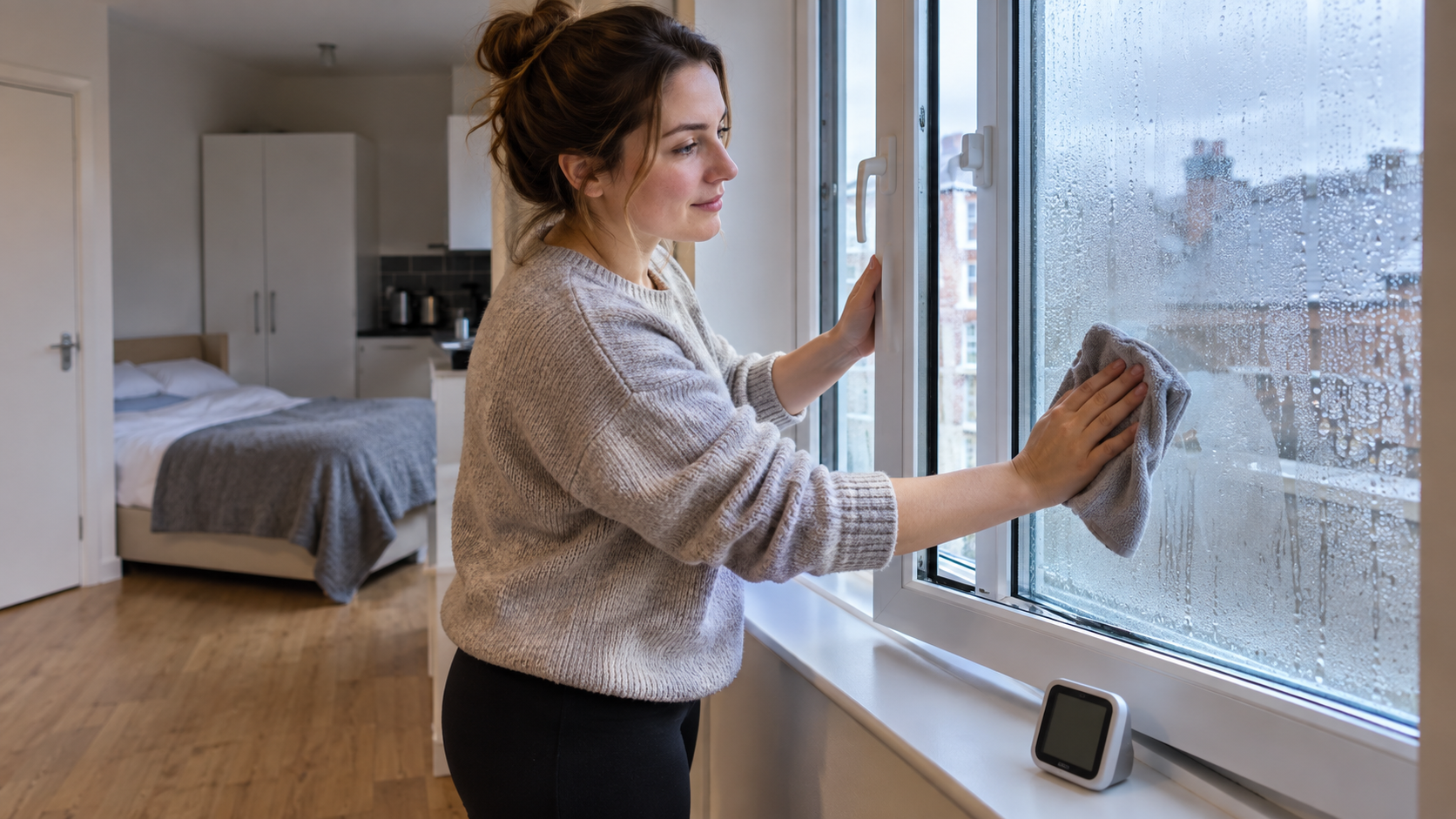
If you wake up to water on the inside of the glass, remove it rather than allowing it to sit on the frame and sill.
Wiping the window is a useful part of How to Reduce Condensation in a Studio Flat because it stops that liquid water remaining in contact with seals, paint, timber or surrounding surfaces.
Use an absorbent cloth or suitable window vacuum, then dry the sill.
Afterwards, ventilate the room so the moisture still suspended in the air can escape.
But remember: wiping is not the complete answer to How to Reduce Condensation in a Studio Flat. If the glass is soaked again every morning, investigate the underlying moisture sources as well.
📟 Should You Monitor Humidity?
A simple hygrometer can help you spot patterns.
For How to Reduce Condensation in a Studio Flat, the most useful information is often not one isolated number but how humidity changes after specific activities.
Check what happens:
- after a shower
- while cooking
- while drying washing
- overnight
- after opening a window
- while using an extractor
- while running a dehumidifier
If the reading jumps after wet activities and then stays elevated for hours, the flat may not be clearing moisture effectively.
Monitoring can therefore make How to Reduce Condensation in a Studio Flat much less guess-based.
Rather than obsessing over a single “perfect” percentage, use the readings to understand what raises humidity in your own flat and which actions bring it back down.
🧠 The Key Lesson So Far
The first half of How to Reduce Condensation in a Studio Flat comes down to one principle:
Control moisture before it reaches the coldest surfaces.
Ventilate while moisture is being produced, contain steam where possible, be deliberate about drying clothes, maintain sensible warmth and remove visible water before it can sit against vulnerable materials.
Once those habits are in place, How to Reduce Condensation in a Studio Flat becomes far easier to manage than repeatedly cleaning wet windows and mould after the problem has already developed.
💨 How to Reduce Condensation in a Studio Flat: Long-Term Control and Daily Habits
Once the main moisture sources are under control, reducing condensation becomes about keeping humidity from creeping back up and making sure air can circulate around the coldest parts of the room.
The most reliable approach is not one single product. It is a combination of ventilation, sensible heating, moisture control and enough airflow around walls, windows and furniture.
💧 6. Use a Dehumidifier When Ventilation Alone Is Not Enough
A dehumidifier can be useful for How to Reduce Condensation in a Studio Flat when indoor humidity stays high despite sensible ventilation, especially during winter or while drying clothes indoors.
The appliance removes water from the air and collects it in a tank or drains it away, which can reduce the amount of moisture available to condense on cold surfaces.
If you are unsure whether moisture removal or air filtration is actually the priority, our dehumidifier vs air purifier for small flats guide explains what each appliance can and cannot do.
A dehumidifier is most useful when you also tackle the source of the moisture. It should not become an excuse to ignore poor extraction, persistent leaks or blocked ventilation.
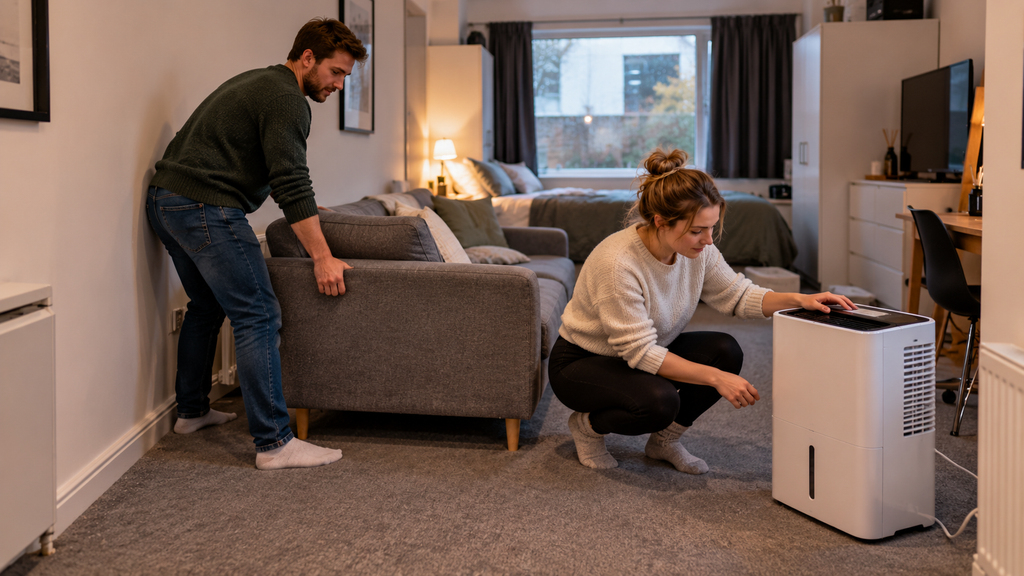
Position the unit where air can circulate around it and follow the manufacturer’s clearance instructions. Empty and clean it as recommended.
A hygrometer can help you see whether the dehumidifier is actually improving conditions rather than simply running for hours without a clear purpose.
If you need help choosing a suitable unit, our guide to the best small dehumidifiers for studio flats UK compares compact options designed for smaller living spaces.
🛋️ Pull Furniture Away From Cold External Walls
Airflow behind furniture is an important part of How to Reduce Condensation in a Studio Flat because large objects can trap cool, humid air against an external wall.
Beds, wardrobes and sofas pushed tightly against a cold wall can create hidden pockets where condensation and mould develop before you notice anything from the centre of the room.
For How to Reduce Condensation in a Studio Flat, leave a practical gap where space allows so air can move behind larger pieces of furniture.
Pay particular attention to wardrobes containing clothes. If the back panel or wall feels cold or smells musty, inspect it regularly.
In a very small studio, even a modest gap can improve How to Reduce Condensation in a Studio Flat if the alternative is furniture pressed directly against an external wall.
🪑 Do Not Overfill the Room
A studio naturally has limited space, but packing every wall with furniture can make moisture problems harder to manage.
For How to Reduce Condensation in a Studio Flat, think about airflow as part of the room layout.
Avoid blocking radiators, trickle vents, extractor grilles or the path between a window and the rest of the room.
Large piles of boxes, clothes or bedding against external walls can also reduce air movement and make it harder to spot damp early.
A less obstructed layout supports How to Reduce Condensation in a Studio Flat by allowing warmer air to reach more surfaces and helping ventilation work properly.
🧼 Deal With Mould Early
If condensation has already led to mould, deal with it promptly rather than waiting for a large patch to develop.
This matters for How to Reduce Condensation in a Studio Flat because mould is a sign that surfaces are staying damp long enough for growth to establish.
Small areas may be manageable with appropriate cleaning products and careful drying, following product instructions and avoiding unsafe chemical combinations.
If mould is extensive, repeatedly returns or appears alongside signs of a leak, damaged plaster or structural damp, the problem may need professional investigation.
For renters, How to Reduce Condensation in a Studio Flat also means reporting persistent mould, defective extraction, leaks or building defects to the landlord or managing agent rather than assuming every moisture problem is caused by lifestyle.
🔍 Know When It Might Not Be Condensation
Not every wet wall is caused by condensation.
A key part of How to Reduce Condensation in a Studio Flat is recognising when the pattern does not fit ordinary surface condensation.
Warning signs that may point to another problem include:
- a localised damp patch that remains in the same place
- staining after heavy rain
- water appearing around plumbing
- damaged plaster or skirting
- persistent damp at low level
- a musty area that stays wet even when indoor humidity is controlled
In those cases, How to Reduce Condensation in a Studio Flat may not solve the underlying problem because the moisture could be entering through a leak, building defect or another form of damp.
🏠 What Renters Can Do Without Renovating
Renters often need reversible solutions.
For How to Reduce Condensation in a Studio Flat, that can include keeping trickle vents clear, using existing extractor fans properly, moving furniture away from cold walls, drying windows, changing laundry habits and using a dehumidifier where appropriate.
You can also document recurring condensation or mould with photographs and dates.
If an extractor fan is broken, a window does not close correctly, water is entering the property or mould keeps returning despite reasonable moisture control, report it.
A good renter-focused How to Reduce Condensation in a Studio Flat plan separates what you can change day to day from defects that need the landlord or building manager to address.
For more reversible ideas suited to rented homes, our renter-friendly upgrades UK guide includes practical moisture-control options alongside other non-permanent improvements.
🌙 Why Condensation Often Appears Overnight
Many people notice wet windows first thing in the morning.
That pattern matters for How to Reduce Condensation in a Studio Flat because people release moisture into the air while breathing, while the room and window surfaces often become colder overnight.
With doors and windows closed for hours, humidity can build up while the glass temperature falls.
For How to Reduce Condensation in a Studio Flat, morning condensation can therefore improve when daytime moisture is better controlled, background ventilation is working and the room does not become excessively cold overnight.
🌡️ Should You Aim for a Specific Humidity?
A hygrometer is useful, but it should be treated as a guide rather than a pass-or-fail device.
For How to Reduce Condensation in a Studio Flat, watch for sustained high humidity and repeated spikes after showers, cooking or laundry.
The exact point at which condensation appears depends on both humidity and surface temperature, so two flats with the same humidity reading can behave differently.
That is why How to Reduce Condensation in a Studio Flat works best when you combine humidity readings with what you can actually see on windows, walls and cold corners.
❌ Common Condensation Mistakes
Even a good How to Reduce Condensation in a Studio Flat routine can be undermined by a few common habits.
The Energy Saving Trust guide to damp and condensation also explains why reducing moisture, improving ventilation and maintaining sensible warmth need to work together.
Drying Clothes in a Sealed Room
Wet washing releases moisture into the air. If the room is closed and there is no extraction or dehumidification, that moisture has nowhere useful to go.
Turning Off Every Vent to Keep Heat In
Blocking intentional ventilation can trap moisture.
For How to Reduce Condensation in a Studio Flat, the goal is to reduce uncontrolled draughts without disabling the ventilation the property needs.
Only Wiping the Windows
Drying the glass is useful, but it does not remove the moisture source.
Pushing Furniture Tight Against External Walls
This can create cold, poorly ventilated pockets that are ideal for hidden mould.
Heating the Air but Never Ventilating
Heating can raise surface temperatures, but it does not make indoor moisture disappear.
Leaving Bathroom Steam to Spread Through the Flat
Keep moisture contained and extract it as close to the source as possible.
Ignoring a Broken Extractor Fan
For How to Reduce Condensation in a Studio Flat, a working kitchen or bathroom extractor can be far more valuable than repeatedly treating the symptoms later.

📋 A Simple Daily Condensation Routine
A practical How to Reduce Condensation in a Studio Flat routine might look like this:
Morning
- wipe any water from windows and sills
- briefly ventilate if humidity is high
- check hidden cold corners
Cooking
- use pan lids
- switch on extraction
- ventilate extra steam if needed
After a shower
- keep the bathroom door closed
- run the extractor
- clear excess surface water
Laundry
- avoid drying a full load in an unventilated room
- use extraction, ventilation or a dehumidifier
Evening
- avoid blocking vents
- keep furniture slightly clear of cold walls
- check whether humidity is staying elevated
Repeating these habits is usually more effective for How to Reduce Condensation in a Studio Flat than reacting only when mould becomes visible.
❓ Frequently Asked Questions
Why are my studio flat windows wet every morning?
Moisture builds up indoors overnight while window glass becomes cold. When the glass temperature falls below the dew point of the nearby air, water forms on the surface.
For How to Reduce Condensation in a Studio Flat, improve moisture control during the day, maintain suitable background ventilation and remove morning water promptly.
Will opening windows stop condensation?
Opening windows can help remove humid indoor air, especially after cooking or showering.
However, How to Reduce Condensation in a Studio Flat does not mean leaving windows wide open all day in winter. Short, purposeful ventilation combined with extraction and sensible heating is usually more practical.
Does heating stop condensation?
Heating can help by keeping internal surfaces warmer, but it does not remove water vapour.
For How to Reduce Condensation in a Studio Flat, heating works best alongside ventilation and reduced moisture production.
Is a dehumidifier worth using in a studio flat?
It can be, especially if you dry clothes indoors or struggle to keep humidity under control during colder weather.
For How to Reduce Condensation in a Studio Flat, choose a dehumidifier that suits the room size and use its humidity controls rather than assuming it must run continuously.
Should I wipe condensation off windows every day?
Yes, if liquid water is present.
Removing it helps protect the sill, seals and surrounding surfaces, but it should be part of How to Reduce Condensation in a Studio Flat, not the only action you take.
Why is there condensation behind my wardrobe?
The wall behind the wardrobe may be colder than the rest of the room and airflow may be poor.
For How to Reduce Condensation in a Studio Flat, pull furniture slightly away from cold external walls where practical and inspect the area regularly.
Can drying clothes indoors cause mould?
It can contribute by releasing a substantial amount of moisture into the room.
If indoor drying is unavoidable, How to Reduce Condensation in a Studio Flat means pairing the drying process with ventilation, extraction or dehumidification.
Is condensation the same as damp?
Condensation is one cause of damp conditions, but damp can also result from leaks, water penetration or other building problems.
For How to Reduce Condensation in a Studio Flat, do not assume every wet patch is condensation if the pattern suggests another source.
When should I contact my landlord?
Contact the landlord or managing agent if there are broken extractor fans, defective windows, leaks, persistent mould, damaged building fabric or recurring damp that does not improve with reasonable moisture control.
That is an important part of How to Reduce Condensation in a Studio Flat for renters because building defects are not something ordinary ventilation habits can repair.
✅ Final Verdict
The most effective How to Reduce Condensation in a Studio Flat strategy is to prevent excess moisture from building up, remove it quickly when it is produced and keep air moving around the surfaces most likely to become cold.
Use extractor fans during cooking and showering. Ventilate deliberately. Be careful with indoor laundry. Keep the flat sensibly warm. Move furniture slightly away from vulnerable external walls and consider a dehumidifier if humidity remains difficult to control.
Above all, How to Reduce Condensation in a Studio Flat should be treated as an ongoing moisture-management routine rather than a battle with wet windows every morning.
When you reduce moisture at source and give it a reliable route out of the flat, condensation becomes much easier to control before it develops into persistent damp or mould.