Is It Cheaper to Leave a Heater On Low All Day? (UK Energy Guide)
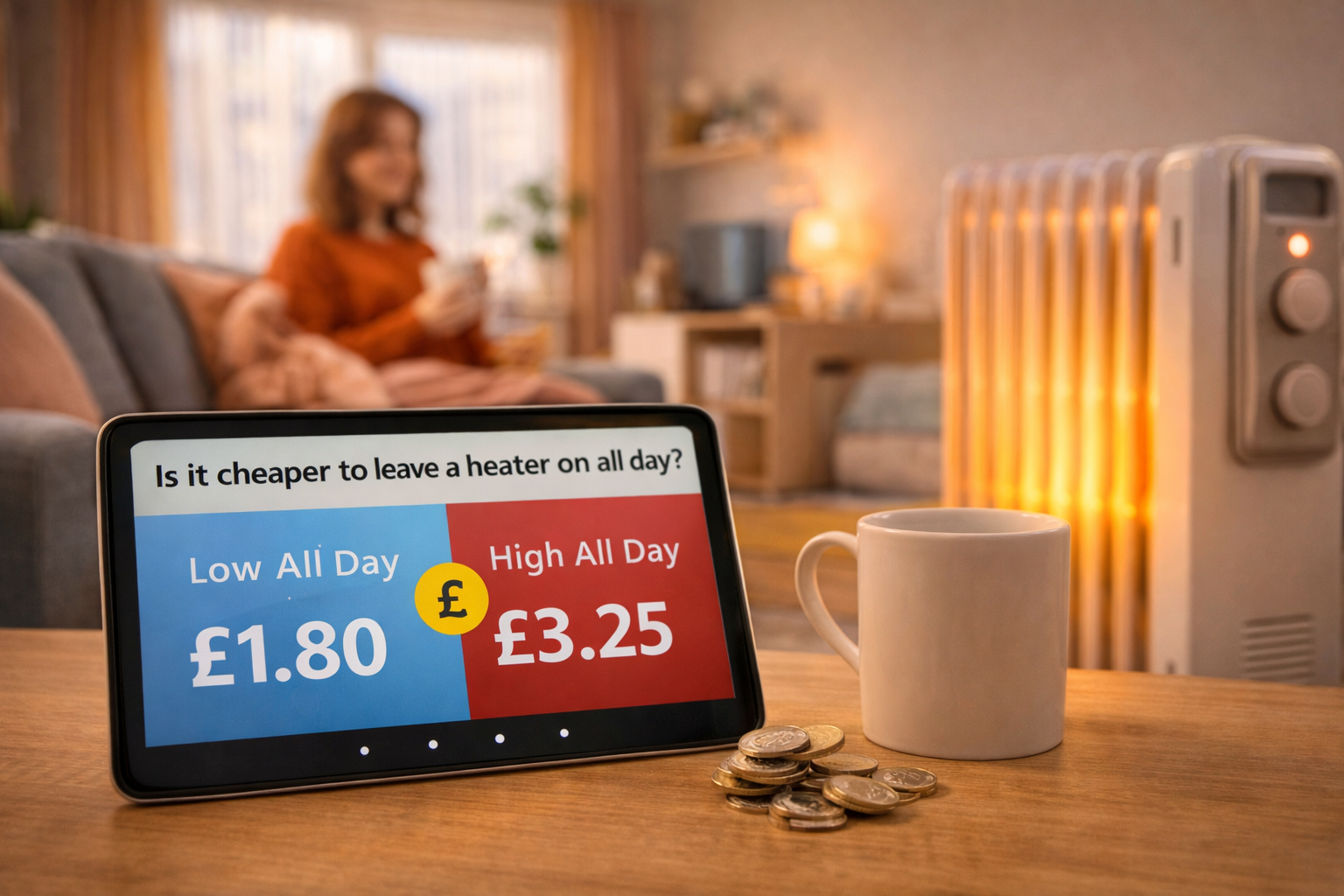
Is It Cheaper to Leave a Heater On Low All Day? (UK Cost Guide 2026)
If you live in a studio flat, you’ve probably asked yourself: is it cheaper to leave a heater on low all day, or turn it on only when you need it?
With UK electricity prices still high, heating decisions can significantly impact your monthly bills. In smaller spaces like studio flats, efficiency matters even more because even small daily waste adds up over time.
Let’s break this down properly and look at what actually costs less in the UK.
How Electric Heaters Use Electricity in the UK
Most portable electric heaters in UK studio flats are rated between 1,000W and 2,500W.
For example:
- A 2,000W heater = 2kW per hour
- If electricity costs roughly 28–34p per kWh (typical UK range depending on tariff)
- That means running a 2kW heater costs roughly 60–70p per hour
Even when set to “low,” many heaters still cycle on and off to maintain temperature, meaning they continue drawing power throughout the day.
If you leave a heater on low for 8 hours:
- 1kW average × 8 hours = 8kWh
- That’s roughly £2.20–£2.70 per day
Over a month, that could easily reach £65–£80.
Is It Cheaper to Leave a Heater On Low All Day?
For most UK studio flats, the answer is no.
Small spaces heat up quickly. Once warm, they retain heat reasonably well (especially with curtains closed and doors shut). Reheating a studio flat from cool does not require the same energy as heating a full house.
Leaving a heater running all day — even on low — usually costs more than heating only when needed.
The exception would be:
- Extremely poor insulation
- Severe damp problems
- Being home all day in very cold weather
But even then, thermostat control is smarter than constant manual “low” heat.
What Happens When You Turn the Heater Off?
A common myth is that turning a heater off means it must “work harder” later, costing more overall.
Electric heaters don’t work like boilers. They convert electricity directly into heat at a fixed efficiency. They don’t use extra energy to “reheat harder.” They simply run for longer until the target temperature is reached.
Because studio flats are small (typically 20–35m²), reheating is relatively quick compared to larger homes.
The Smarter, Cheaper Heating Strategy
Instead of leaving a heater on low all day, try this approach:
- Use a heater with a built-in thermostat.
- Use a timer plug to preheat before you wake up or return home.
- Close curtains at night to reduce heat loss.
- Seal drafts around windows and doors.
- Only heat the area you’re actively using.
If you’re choosing between heater types, ceramic models tend to heat small rooms quickly and efficiently
For a full breakdown of running costs in the UK, see our guide on how much it costs to run a heater in the UK
According to UK energy guidance from Ofgem, controlling usage time is one of the most effective ways to reduce electricity costs. (https://www.ofgem.gov.uk)
When Leaving It On Low Might Make Sense
There are limited situations where leaving a heater on low could be reasonable:
- Preventing condensation buildup
- Protecting pipes in freezing conditions
- Maintaining temperature in poorly insulated flats
However, even in these cases, a thermostat-controlled heater is more efficient than manually leaving it running continuously.
Final Verdict: Is It Cheaper to Leave a Heater On Low All Day?
For the average UK studio flat, it is not cheaper to leave a heater on low all day.
Heating your space only when needed is typically more cost-effective, especially in small rooms that warm up quickly.
Smart timing and insulation improvements will save more money than constant low heat.
If you live in a studio flat, you’ve probably wondered: is it cheaper to leave a heater on low all day, or turn it on and off when needed?
With UK energy prices still high, heating decisions matter. In a small space, even small efficiency mistakes can add up quickly.
Let’s break it down properly.
The Short Answer (For Most UK Studio Flats)
In most cases, it is not cheaper to leave a heater on low all day.
Turning your heater on only when you need it is usually more energy-efficient — especially in small studio flats that heat up quickly.
But there are exceptions.
Why Leaving a Heater On Low Sounds Logical
The theory is:
- If you keep the room warm constantly,
- The heater doesn’t need to “work as hard” later,
- So it uses less energy overall.
This logic can apply in well-insulated homes with central heating systems.
But most studio flats are:
- Small
- Quick to heat
- Often not perfectly insulated
- Using portable electric heaters
That changes the maths.
How Electric Heaters Actually Use Electricity
Electric heaters (ceramic, oil-filled, fan heaters) work at a fixed wattage.
For example:
- 2000W heater = 2kW per hour
- If electricity costs 30p per kWh (approx UK average range),
- That’s around 60p per hour to run at full power.
If you leave a 2000W heater on low all day (say 8 hours), even at half power:
- 1kW × 8 hours = 8 kWh
- Roughly £2.40 per day
Over 30 days?
That’s £72.
Now compare that to:
Turning it on for 2–3 hours in the evening only.
The difference becomes significant. Before deciding whether to leave a heater on low all day, it’s important to understand how much it costs to run a heater in the UK based on wattage and electricity rates.
When Leaving It On Low Might Make Sense
There are situations where leaving a heater on low can be reasonable:
- If your flat is extremely poorly insulated.
- If reheating takes excessive time.
- If you are home all day.
- If you’re preventing damp or condensation.
But even then, using a thermostat is smarter than manually leaving it running.
Studio Flats Heat Up Quickly
Here’s the key.
A studio flat is typically:
- 20–35 square metres.
- One main living space.
- Limited airflow separation.
This means:
It warms up faster than a 3-bedroom house.
So reheating from cold doesn’t cost nearly as much as people think.
You’re heating less air.
Less volume.
Less space.
The Smartest Approach (UK Practical Strategy)
Instead of leaving a heater on low all day:
✔ Use a timer plug.
✔ Use a heater with a thermostat.
✔ Heat only the space you’re using.
✔ Close doors and curtains.
✔ Layer up clothing first.
If you want to go further:
- Add thermal curtains.
- Seal window drafts.
- Use rugs on cold floors.
Efficiency isn’t just about heater settings.
It’s about heat retention.
So… Is It Cheaper to Leave a Heater On Low All Day?
For most UK studio flats:
No.
It’s usually cheaper to heat the space when needed rather than maintaining temperature all day.
Small spaces don’t justify constant running costs unless insulation is very poor.
Smart control beats constant low heat.
If you’re trying to reduce heating costs in a studio flat, your biggest wins come from:
- Using the right heater type
- Improving insulation
- Controlling run time
- Preventing heat loss
Heating smartly matters more than heating constantly.