
Heater Running Cost UK: How Much Does It Cost Per Hour in 2026?
What Electric Heaters Really Cost Per Hour in 2026
Understanding Heater Running Cost UK is much easier once you know two numbers: the heater’s power in kilowatts and the electricity price you pay per kilowatt-hour. For this guide, we use 26.32p per kWh as the main autumn 2026 example rate.
That means Heater Running Cost UK can be calculated with a simple formula rather than guessed from the type of heater. A 2kW heater drawing its full rated power for one hour uses 2kWh of electricity. At 26.32p per kWh, that works out at about 52.6p for that hour.
The most important point is that Heater Running Cost UK depends primarily on power draw, runtime and your tariff. A 2kW ceramic heater, 2kW convector heater and 2kW oil-filled radiator all have the same theoretical electricity cost while continuously drawing the full 2kW.
Real-world Heater Running Cost UK can be lower than that simple maximum because thermostats cycle heating elements on and off once the room approaches the selected temperature.
⚡ Quick Answer
At an electricity unit rate of 26.32p per kWh:
- 500W heater: about 13.2p per hour
- 750W heater: about 19.7p per hour
- 1kW heater: about 26.3p per hour
- 1.5kW heater: about 39.5p per hour
- 2kW heater: about 52.6p per hour
- 2.5kW heater: about 65.8p per hour
This Heater Running Cost UK snapshot gives a fast comparison before the detailed examples below.
These Heater Running Cost UK figures assume the heater draws its full rated wattage continuously. A thermostatically controlled heater may use less electricity over a longer session because it can stop drawing full heating power for part of the time.
💷 Which Electricity Rate Are We Using?
For the main Heater Running Cost UK calculations in this article, we use 26.32p per kWh.
Ofgem has published an average electricity unit rate of 26.32p per kWh for Direct Debit customers on standard variable tariffs from 1 October to 31 December 2026 across England, Scotland and Wales.
Your own Heater Running Cost UK may be different because electricity unit rates vary by tariff, payment method and region. Fixed tariffs can also differ from the price-cap average.
The standing charge is not added to each heater calculation because you pay that daily charge for having the electricity supply regardless of whether the portable heater is switched on.
For the current official figures, Ofgem publishes the latest electricity unit rates and standing charges, including regional and payment-method variations under the energy price cap.
🧮 Heater Running Cost Formula
The basic Heater Running Cost UK formula is:
Heater power in kW × hours used × electricity price per kWh = running cost
To convert watts into kilowatts, divide by 1,000.
For example:
2,000W ÷ 1,000 = 2kW
Then:
2kW × £0.2632 = £0.5264
So a 2kW heater running continuously at full power costs approximately 52.6p per hour at the example rate.
This Heater Running Cost UK formula works for any plug-in electric heater as long as you know its actual power draw or rated wattage.
📊 Electric Heater Cost Per Hour
| Heater Power | Energy Used in 1 Hour | Approx. Cost Per Hour |
|---|---|---|
| 500W | 0.5kWh | 13.2p |
| 750W | 0.75kWh | 19.7p |
| 1,000W | 1kWh | 26.3p |
| 1,500W | 1.5kWh | 39.5p |
| 2,000W | 2kWh | 52.6p |
| 2,500W | 2.5kWh | 65.8p |
The table makes the central Heater Running Cost UK relationship clear: if a heater draws twice as much power for the same amount of time, the simple electricity cost is twice as high.
That does not automatically mean a lower-wattage heater is cheaper for the whole job. A smaller heater may need to run for much longer to warm the same room.

🔌 How Much Does a 500W Heater Cost to Run?
A 500W heater uses 0.5kWh if it runs continuously for one hour.
At 26.32p per kWh, the Heater Running Cost UK for a 500W heater is approximately 13.2p per hour.
Used continuously for:
- 3 hours: about 39.5p
- 5 hours: about 65.8p
- 8 hours: about £1.05
For low-output appliances, Heater Running Cost UK stays modest per hour, but room size and runtime still matter.
A 500W heater can make sense for very localised heating or a particularly small space, but it has only one quarter of the maximum heating output of a 2kW model.
🔌 How Much Does a 750W Heater Cost to Run?
A 750W heater uses 0.75kWh per hour at full power.
The Heater Running Cost UK at our example rate is approximately 19.7p per hour.
Used continuously for:
- 3 hours: about 59.2p
- 5 hours: about 98.7p
- 8 hours: about £1.58
This power level often appears as a lower setting on larger heaters rather than as the heater’s maximum output.
🔌 How Much Does a 1kW Heater Cost to Run?
A 1kW heater uses 1kWh of electricity for every hour it continuously draws full power.
That makes Heater Running Cost UK particularly easy to calculate: at 26.32p per kWh, a 1kW heater costs approximately 26.3p per hour.
Used continuously for:
- 3 hours: about 79.0p
- 5 hours: about £1.32
- 8 hours: about £2.11
If your heater has a 1kW low setting and 2kW high setting, using the low setting halves the instantaneous power draw while the heating element is active.
🔌 How Much Does a 1.5kW Heater Cost to Run?
A 1.5kW heater uses 1.5kWh per continuous full-power hour.
The Heater Running Cost UK is therefore approximately 39.5p per hour.
Used continuously for:
- 3 hours: about £1.18
- 5 hours: about £1.97
- 8 hours: about £3.16
This sits between the common 1kW and 2kW examples and can be useful when comparing medium-output heaters.
🔌 How Much Does a 2kW Heater Cost to Run?
A 2kW heater is one of the most common examples used when discussing Heater Running Cost UK.
At full rated power, it consumes 2kWh in one hour.
At 26.32p per kWh, that gives a Heater Running Cost UK figure of approximately 52.6p per hour.
Used continuously for:
- 3 hours: about £1.58
- 5 hours: about £2.63
- 8 hours: about £4.21
If a 2kW heater actually drew full power for eight hours every day for 30 days, the simple electricity calculation would be approximately £126.34.
That is a useful upper-style comparison, but it should not be mistaken for the guaranteed monthly cost of a thermostatically controlled heater.
🔌 How Much Does a 2.5kW Heater Cost to Run?
At full power, a 2.5kW heater consumes 2.5kWh every hour.
The Heater Running Cost UK at 26.32p per kWh is approximately 65.8p per hour.
Used continuously for:
- 3 hours: about £1.97
- 5 hours: about £3.29
- 8 hours: about £5.26
A higher maximum output can warm a suitable room more quickly, but it also creates the highest instantaneous electricity cost in this comparison while the full 2.5kW is being drawn.
⏱️ Cost for 3, 5 and 8 Hours
The table below compares Heater Running Cost UK when each heater is assumed to draw its full rated power continuously.
| Heater Power | 3 Hours | 5 Hours | 8 Hours |
|---|---|---|---|
| 500W | £0.39 | £0.66 | £1.05 |
| 750W | £0.59 | £0.99 | £1.58 |
| 1,000W | £0.79 | £1.32 | £2.11 |
| 1,500W | £1.18 | £1.97 | £3.16 |
| 2,000W | £1.58 | £2.63 | £4.21 |
| 2,500W | £1.97 | £3.29 | £5.26 |
These Heater Running Cost UK examples are deliberately simple. They make it easy to compare wattage, but a real thermostat may reduce the amount of time the heating element remains energised.
📅 What Could a Heater Cost Per Month?
Monthly totals become large surprisingly quickly if you assume continuous daily operation.
For eight hours per day over 30 days, the simple Heater Running Cost UK figures are approximately:
| Heater Power | 8 Hours Per Day | 30-Day Cost |
|---|---|---|
| 500W | £1.05 | £31.58 |
| 750W | £1.58 | £47.38 |
| 1,000W | £2.11 | £63.17 |
| 1,500W | £3.16 | £94.75 |
| 2,000W | £4.21 | £126.34 |
| 2,500W | £5.26 | £157.92 |
Monthly Heater Running Cost UK can therefore vary dramatically with wattage and actual hours of heating.
Again, this Heater Running Cost UK table assumes full rated power for all eight hours, every day.
It is best treated as a transparent mathematical comparison rather than a prediction of your exact bill.
🌡️ Why Your Heater May Not Draw Full Power All the Time
This is where Heater Running Cost UK becomes more nuanced than simply multiplying the wattage by the number of hours the heater is switched on.
A thermostat monitors temperature and can stop or reduce heating once the target is reached. The heater may then switch back on when the room cools.
For example, a 2kW heater might be switched on for five hours without actually drawing 2kW continuously for all five hours.
The actual Heater Running Cost UK will depend on how much time the heating element is active.
That can be affected by:
- outdoor temperature
- insulation
- draughts
- room size
- ceiling height
- thermostat setting
- doors opening
- heat escaping into other rooms
- how quickly the heater warms the space
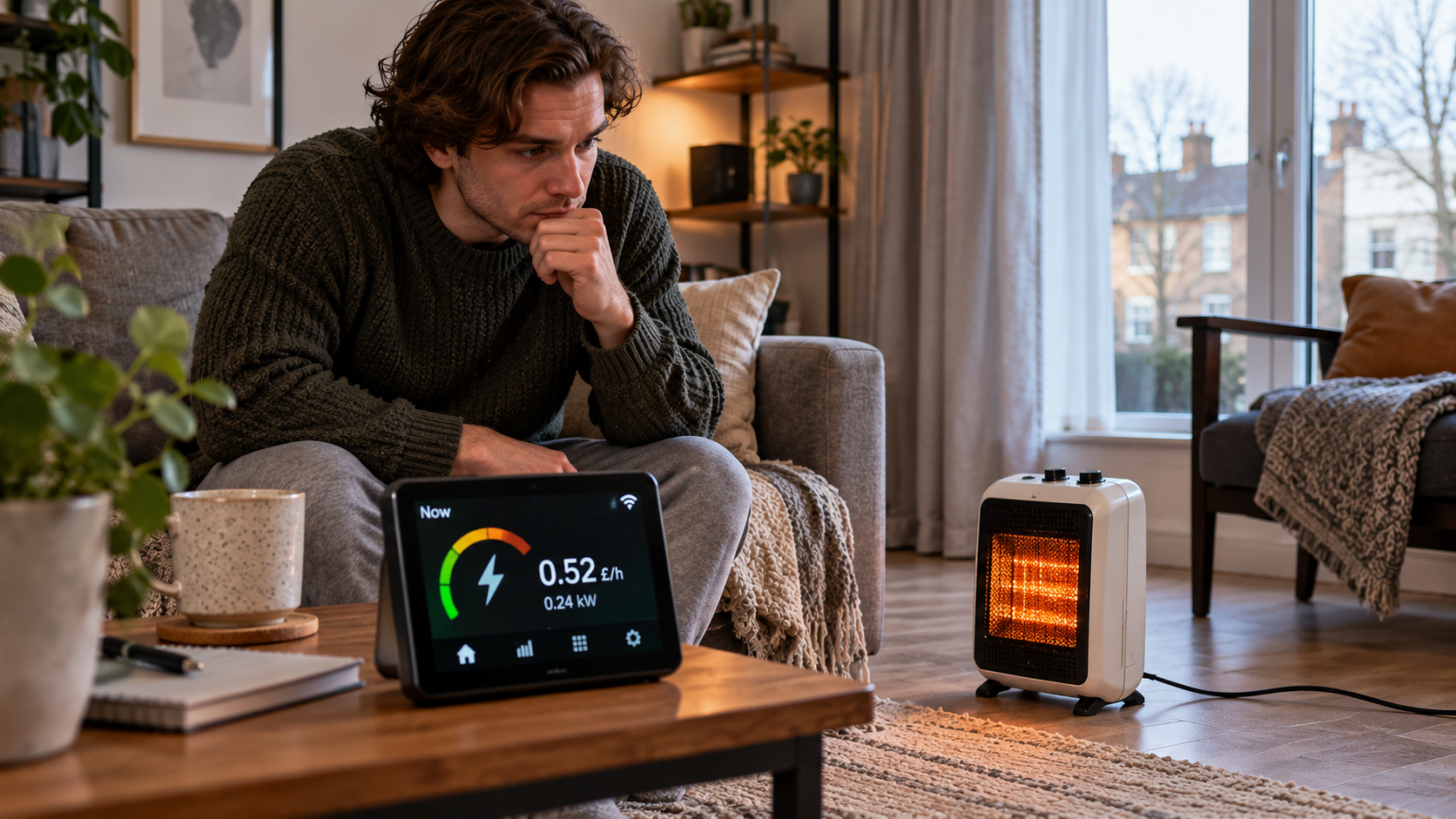
This is why a smart meter or plug-in energy monitor can be useful: it can show actual electricity use rather than relying only on the maximum wattage printed on the heater.
🔥 Do Different Types of Electric Heater Cost Different Amounts?
Not automatically.
If two resistive electric heaters are both genuinely drawing 2kW, the basic Heater Running Cost UK for that moment is the same because both are consuming 2kWh for each continuous hour at that power.
So at the same electricity price:
- 2kW ceramic heater at full power: about 52.6p per hour
- 2kW convector heater at full power: about 52.6p per hour
- 2kW oil-filled radiator at full power: about 52.6p per hour
- 2kW fan heater at full power: about 52.6p per hour
Comparing Heater Running Cost UK by heater type only makes sense when you also consider actual runtime and thermostat behaviour.
Where Heater Running Cost UK can differ is in real use.
Different heater designs distribute heat differently, warm rooms at different perceived speeds and use thermostats or power settings in different ways. Those differences can change how long the heater needs to draw full power to keep you comfortable.
The useful question is therefore not simply, “Which 2kW heater costs less per hour at full power?”
At the same actual 2kW draw, none has a magic electricity-price advantage.
The better Heater Running Cost UK question is: how much electricity will this heater actually consume while keeping this particular room comfortable?
For a direct comparison of two popular technologies, our oil filled radiator vs ceramic heater UK guide explains how their warm-up speed, heat delivery, noise and real-world runtime differ even when their maximum wattage is similar.
🧠 The Key Number to Remember
For this guide’s 26.32p/kWh example rate:
Every 1kW of continuous electric heating costs about 26.3p per hour.
That makes Heater Running Cost UK quick to estimate in your head.
A 500W heater is roughly half that.
A 1.5kW heater is roughly one and a half times that.
A 2kW heater is roughly double.
And a 2.5kW heater is roughly two and a half times that.
Once you know your own electricity unit rate, you can replace 26.32p with the figure on your tariff and calculate a much more personalised Heater Running Cost UK figure.
🏠 How to Reduce Heater Running Cost UK Without Sitting in the Cold
Reducing Heater Running Cost UK does not necessarily mean choosing the lowest-wattage heater or turning the room temperature down until it becomes uncomfortable. The biggest savings usually come from heating the right space, using the thermostat properly and avoiding unnecessary runtime.
The most useful way to think about Heater Running Cost UK is to focus on total electricity consumed over the whole heating session, not just the wattage printed on the front of the appliance.
🎯 Heat the Room You Are Actually Using
Portable electric heaters can make sense when you only need to warm one occupied room for a limited period.
If the rest of the home does not need heating at that moment, targeted heating can reduce the amount of space you are trying to warm.
That can lower Heater Running Cost UK compared with unnecessarily heating rooms nobody is using, although the cheapest approach depends on your main heating system, tariff and property.
Keep internal doors closed where appropriate so the heat stays in the room you are trying to warm.
If you are heating a compact one-room home, our complete guide to heating a studio flat in the UK looks at room size, heater choice, heat loss and practical ways to stay comfortable without unnecessarily heating unused space.
🌡️ Use the Thermostat Rather Than Running Maximum Heat Constantly
Once a room reaches a comfortable temperature, a thermostat can cycle the heating element on and off.
That means Heater Running Cost UK can be lower than the simple maximum-power calculation if the heater spends part of the session maintaining temperature rather than heating continuously.
Turning the thermostat to its highest position does not usually make a resistive heater produce more heat than its rated maximum power. It simply changes when the thermostat stops calling for heat.
A sensible thermostat setting can therefore help control Heater Running Cost UK without requiring you to repeatedly switch the heater on and off manually. For many households, understanding this thermostat behaviour is essential to estimating Heater Running Cost UK realistically.
🔽 Use Lower Power Settings When They Are Enough
Many portable heaters offer more than one power level.
A 2kW heater might also have a 1kW setting.
While the heating element is active, the lower setting approximately halves the instantaneous electricity use, so Heater Running Cost UK falls from roughly 52.6p per hour at 2kW to about 26.3p per hour at 1kW using our example tariff.
However, the lower setting may need to operate for longer.
The real question is whether it can maintain your chosen room temperature efficiently enough for the space.
🪟 Reduce Draughts and Heat Loss
A heater has to replace heat that escapes from the room.
Cold air entering around windows and doors can increase runtime and therefore increase Heater Running Cost UK.
Simple measures can include:
- closing curtains after dark
- using draught excluders where appropriate
- keeping external doors closed
- closing unused-room doors
- making sure windows are properly shut
- avoiding blocking the heater’s airflow
Do not drape clothes, curtains or other materials over portable heaters.
🧱 Insulation Changes the Maths
Two identical 2kW heaters can produce very different bills in two different homes.
In a well-insulated room, the thermostat may switch the element off more frequently after the target temperature is reached.
In a draughty room with poor heat retention, the same heater may need to run much more often.
That is why Heater Running Cost UK cannot be predicted perfectly from wattage alone.
Wattage tells you the maximum simple cost while the heater is drawing that power. The building determines how frequently that power may be needed.
📏 Does Room Size Affect Running Cost?
Indirectly, yes.
The electricity price per kWh does not change because the room is larger, but a larger or colder room generally requires more heat energy to reach and maintain the same temperature.
That can increase Heater Running Cost UK through longer runtime or more frequent thermostat cycling.
A small heater may appear cheap per hour but prove ineffective in a room that is too large for its output.
Likewise, using an unnecessarily powerful heater in a tiny space does not guarantee lower overall costs.
If you are still deciding which heater type and output suit a compact room, our guide to the best heater for a studio flat UK compares portable heating options with room size, noise and floor space in mind.
🔥 Is a Low-Wattage Heater Always Cheaper?
Only if it does not need to run much longer.
A 500W heater costs around 13.2p per continuous hour at 26.32p/kWh.
A 2kW heater costs around 52.6p per continuous hour.
But if the 500W heater runs for four hours while the 2kW heater achieves the same useful heating in one hour, the theoretical energy consumed is identical: 2kWh.
This is an important Heater Running Cost UK point because low wattage and low total cost are not automatically the same thing.
🛢️ Are Oil-Filled Radiators Cheaper to Run?
An oil-filled radiator does not receive cheaper electricity.
If it is drawing 2kW, the basic Heater Running Cost UK at that moment is the same as another resistive electric heater drawing 2kW.
Oil-filled radiators store heat in the oil and metal body and release it gradually, which changes how the warmth feels and how the thermostat may cycle.
That can affect real-world electricity consumption in a particular room, but it does not make each kilowatt-hour cheaper.
If you are considering this type of heater for longer heating sessions, compare our guide to the best oil filled heaters for studio flats UK for compact models with different wattages, thermostats and controls.
🌬️ Are Fan Heaters Expensive to Run?
A fan heater’s cost depends mainly on its wattage and runtime.
A 2kW fan heater drawing its full rated power has the same basic Heater Running Cost UK as a 2kW convector or oil-filled radiator drawing 2kW.
Fan heaters can feel warm quickly because they move heated air towards you.
That can make them useful for short bursts of heating, but leaving one running for long periods can still consume substantial electricity.
🏺 Are Ceramic Heaters Cheaper to Run?
Ceramic heaters are often marketed around efficient or rapid heating, but the electricity maths remains the same.
If electricity use is your main concern, our guide answering do ceramic heaters use a lot of electricity explains how wattage, thermostat cycling and daily runtime affect the final cost.
A 1.5kW ceramic heater drawing 1.5kW has the same instantaneous Heater Running Cost UK as any other heater genuinely drawing 1.5kW.
Its controls, thermostat, fan behaviour and how quickly you feel comfortable can influence total runtime.
Those real-world factors are more useful than assuming the word “ceramic” automatically means lower electricity cost.
For a closer look at current compact models, our guide to the best ceramic heaters for studio flats UK compares different wattages, sizes, thermostats and heating styles for small rooms.
📟 Use a Smart Meter or Energy Monitor
A simple calculation tells you the maximum theoretical cost from the heater’s rated power.
A smart meter display or suitable energy-monitoring plug can help you see what is actually happening.
This is one of the clearest ways to understand Heater Running Cost UK in your own home because you can compare electricity use before and after switching the heater on.
Remember that a whole-home smart meter display shows total household electricity demand, not necessarily the heater alone.
Other appliances may be running at the same time.
🧮 Calculate Your Own Heater Cost
You do not need to use the 26.32p example if your tariff is different.
Find your electricity unit rate on your bill or tariff information.
Then use:
watts ÷ 1,000 × hours × electricity unit price = cost
For example, if your electricity rate is 24p/kWh and your heater draws 1.5kW for two continuous hours:
1.5 × 2 × £0.24 = £0.72
That gives a personalised Heater Running Cost UK figure of 72p for that full-power session.
💷 Why Your Smart Meter Cost May Not Match the Table Exactly
The tables in this article assume a specific tariff and continuous rated-power draw.
Your real Heater Running Cost UK can differ because:
- your tariff may be higher or lower
- the thermostat may cycle
- the heater may have multiple power settings
- other appliances may affect a whole-home smart meter display
- the heater may not draw exactly its labelled maximum at every moment
Small rounding differences are normal.
⏲️ Does Leaving a Heater On Low All Day Save Money?
Not automatically.
Running a lower setting for many hours can still use more electricity than running a higher setting for a shorter period.
For example, a 1kW heater drawing full power for eight hours uses 8kWh.
A 2kW heater drawing full power for two hours uses 4kWh.
In that simplified example, the higher-power heater uses half as much total electricity because it ran for much less time.
So Heater Running Cost UK depends on total energy use, not whether the dial says “low” or “high”.
Thermostat cycling makes real homes more complicated, but the principle remains useful.
For a deeper look at this specific question, see our guide on whether it is cheaper to leave a heater on low all day or only heat the room when warmth is actually needed.
🕒 Is It Cheaper to Switch the Heater Off When You Leave?
If a portable electric heater is not needed, switching it off stops it consuming electricity for heating.
Leaving a room heater operating unnecessarily increases Heater Running Cost UK.
Portable heaters should also be used in accordance with the manufacturer’s safety instructions and should not be treated as appliances that can automatically be left running unattended.
For safe portable-heater use, Electrical Safety First advises keeping heaters away from combustible materials, avoiding extension leads and never leaving a portable heater unattended while it is operating.
🧥 Heat Yourself as Well as the Room
Before increasing the thermostat, simple comfort measures may reduce how much room heating you need.
These include:
- warmer clothing
- socks or slippers
- using an appropriate blanket
- closing curtains
- moving away from draughty windows
The objective is not to tolerate an uncomfortably cold home. It is to avoid paying to raise the entire room temperature when a smaller comfort adjustment would already make you comfortable.
That can help reduce Heater Running Cost UK during shorter heating periods.

❌ Common Heater Running Cost Mistakes
Understanding Heater Running Cost UK is easier when you avoid a few common assumptions.
Assuming the Advertised Wattage Is the Exact Cost
Wattage is power, not money.
You still need your electricity unit rate and runtime.
Comparing Heater Types Without Comparing Wattage
Calling one heater “ceramic” and another “oil-filled” does not tell you their electricity cost.
Compare actual wattage and likely runtime.
Assuming a 2kW Heater Uses 2kW Every Minute It Is Switched On
A thermostat-controlled heater may cycle.
The rated power is still useful for calculating the maximum simple Heater Running Cost UK, but it does not prove the heating element runs continuously throughout the session.
Forgetting Your Own Tariff
The 26.32p rate in this guide is an Ofgem average example for the October–December 2026 price-cap period.
Your own rate may differ.
Adding the Standing Charge to the Heater
You pay the electricity standing charge whether the heater runs or not.
It belongs to the household electricity bill rather than being a variable cost created specifically by the heater.
Assuming Smart Meter Pounds Equal Heater-Only Cost
A whole-home display includes other electricity consumption.
Check what else is running before attributing the entire increase to the heater.
❓ Frequently Asked Questions
How much does it cost to run a heater for one hour UK?
Using 26.32p/kWh, a 1kW heater costs about 26.3p for one continuous full-power hour, while a 2kW heater costs about 52.6p.
Your actual Heater Running Cost UK depends on your tariff and whether the heater draws full power for the entire hour.
How much does a 2kW heater cost per hour?
At 26.32p/kWh, approximately 52.6p per continuous full-power hour.
If the thermostat cycles off for part of the hour, actual electricity consumption can be lower.
How much does a 1kW heater cost per hour?
Approximately 26.3p per continuous full-power hour using the example rate in this guide.
How much does a 500W heater cost per hour?
Approximately 13.2p at 26.32p/kWh.
How much does an electric heater cost for eight hours?
At continuous full power, approximately:
- 500W: £1.05
- 1kW: £2.11
- 1.5kW: £3.16
- 2kW: £4.21
- 2.5kW: £5.26
These figures are simple Heater Running Cost UK comparisons rather than guaranteed bills.
Is a 2kW heater expensive to run?
At the example electricity rate, continuous 2kW operation costs about 52.6p an hour.
Whether that is expensive overall depends on how long it runs and what alternative heating would cost for the same comfort.
Which electric heater is cheapest to run?
There is no universal heater type that automatically buys cheaper electricity.
The lowest Heater Running Cost UK comes from using the least total kWh while still achieving the heating you need.
That depends on wattage, runtime, thermostat behaviour, room size and heat loss.
Is a 1kW heater cheaper than a 2kW heater?
Per minute of continuous full-power use, yes.
A 1kW heater draws half the electricity of a 2kW heater.
But if it needs to operate for much longer, the total cost gap can shrink or disappear.
Does turning the thermostat down save electricity?
It can.
A lower target temperature can reduce the amount of time the heater needs to call for heat, which can reduce Heater Running Cost UK.
The actual saving depends on the room and conditions. This is another reason Heater Running Cost UK should be treated as a real-use calculation rather than a fixed number printed on the heater.
Can a smart meter tell me exactly what my heater costs?
A smart meter records household energy use, and the in-home display can show changes in total consumption.
It can help you estimate Heater Running Cost UK, but other appliances running simultaneously can affect the displayed figure.
A compatible plug-in energy monitor can isolate an individual plug-in appliance more directly.
✅ Final Verdict
The key to understanding Heater Running Cost UK is simple: electricity is charged by the kilowatt-hour.
At the 26.32p/kWh example used in this guide, every 1kW of continuous heating costs about 26.3p per hour.
That means a 500W heater costs about 13.2p per continuous hour, while a 2kW heater costs about 52.6p.
But the number printed on the heater is only the beginning.
Real Heater Running Cost UK depends on how long the heating element actually runs, how often the thermostat cycles, your electricity tariff and how quickly the room loses heat.
Do not assume one resistive heater type has a secret electricity-cost advantage over another heater drawing the same power.
Instead, choose a heater suitable for the room, use the thermostat properly, reduce unnecessary heat loss and focus on total kWh consumed.
For the most accurate Heater Running Cost UK figure in your own home, take your heater’s wattage, your electricity unit rate and your actual runtime, then check the result against your smart meter or energy monitor where possible.
That gives you something far more useful than a generic claim that one heater is simply “cheap to run”. It also makes Heater Running Cost UK easier to compare from one heater, room or tariff to another.