7 Best Espresso Machines for Small Kitchens UK 2026
Proper Espresso Without Sacrificing Your Kitchen Worktop
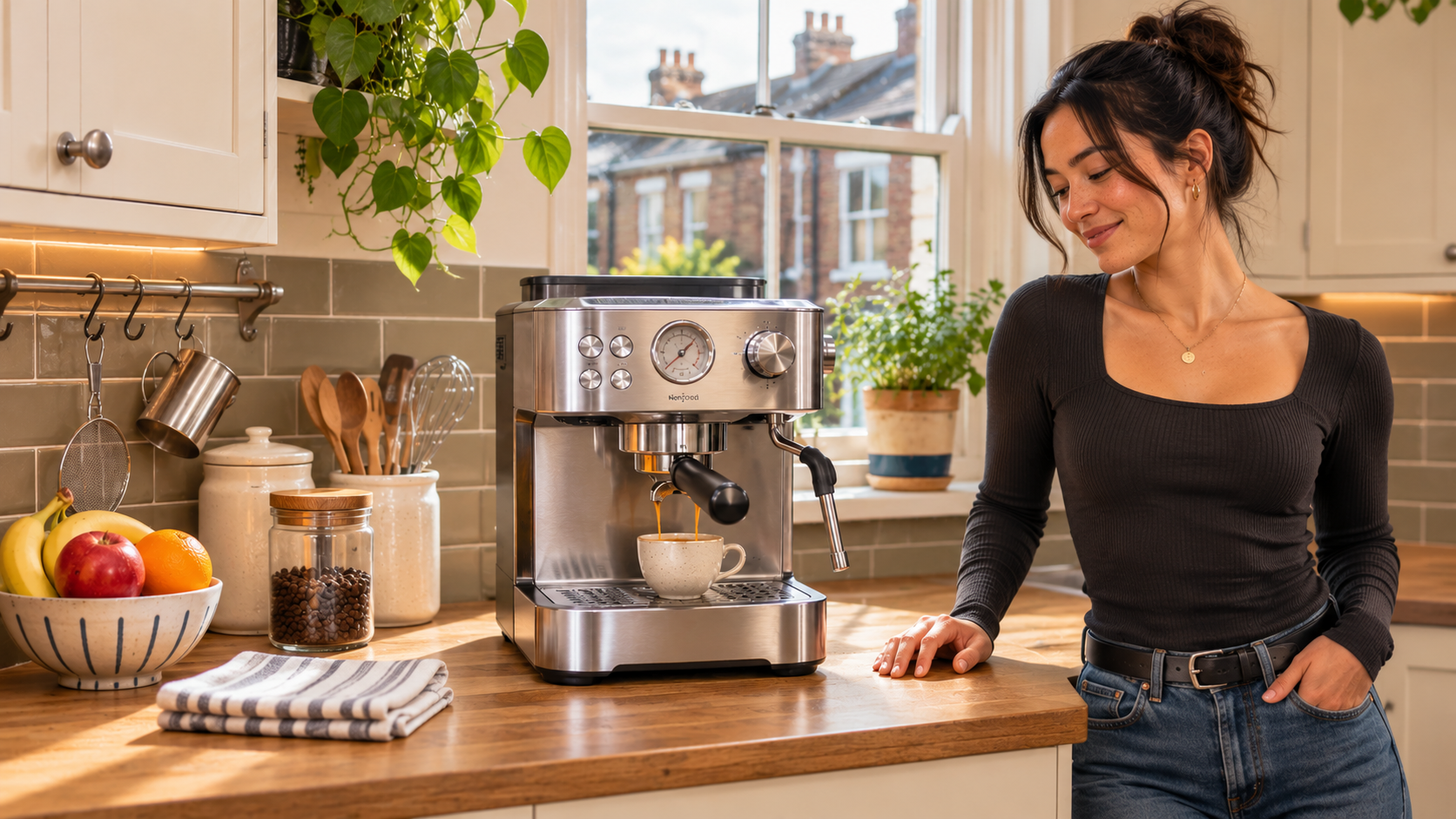
Choosing Espresso Machines for a small UK kitchen involves more than finding the narrowest body. You’ll need space to lock in a portafilter, reach the water tank, steam milk and clean up afterwards. A machine that looks tiny in photographs can still feel awkward during everyday use.
We’ve compared seven Espresso Machines that make espresso using ground coffee, rather than repeating the fully automatic bean-to-cup models from our earlier guides.
Our overall winner is the De’Longhi Dedica Style EC685.M. Its 14.9cm width, Thermoblock heating and adjustable manual frother offer a particularly good balance of space-saving design and useful features.
These Espresso Machines suit different habits and budgets, but each has a credible reason to earn a place on a smaller kitchen worktop.
If you would prefer a machine that grinds fresh beans automatically, our bean-to-cup coffee machines guide compares convenient alternatives for different kitchen sizes and budgets.
⚡ Quick Picks
De’Longhi Dedica Style EC685.M — Best Overall (Top Pick)

Breville Pixl VCF196 — Best for Beginners
Beko CaffeExperto CEP5302B — Best for Narrow Worktops

De’Longhi Stilosa EC260.CR — Best Value

CASABREWS CM5418 — Best for Pressure-Gauge Control

Chefman CraftBrew — Best Touchscreen Controls
AMZCHEF EM3131-WT — Best Budget Slimline Alternative
Affiliate disclosure: This article contains Amazon affiliate links. If you click one of these links and make a qualifying purchase, I earn a commission at no extra cost to you. As an Amazon Associate I earn from qualifying purchases.
🏆 OUR TOP PICK — De’Longhi Dedica Style EC685.M
The De’Longhi Dedica Style EC685.M takes our top position among Espresso Machines for small kitchens because its narrow 14.9cm body really does preserve counter space. It combines a traditional portafilter, 15-bar pump, Thermoblock heating and adjustable manual milk frother in a stainless-steel design.
Simple shot controls, compatibility with ground coffee and suitable ESE pods, and a removable 1.1-litre water tank make it a manageable everyday machine. The removable drip tray also provides clearance for taller cups.
You’ll still need somewhere to store a tamper, coffee and milk jug. Nevertheless, the Dedica offers one of the strongest all-round compromises between proper espresso preparation and compact dimensions.
CHECK LATEST PRICE ON AMAZON →
📊 Espresso Machines Comparison Table
| Espresso Machine | Width × Depth | Milk System | Best For | Check Latest Price |
|---|---|---|---|---|
| De’Longhi Dedica Style EC685.M | 14.9 × 33cm | Adjustable manual frother | Best Overall | CHECK LATEST PRICE ON AMAZON → |
| Breville Pixl VCF196 | 19.5 × 33cm | CoolTouch steam wand | Best for Beginners | CHECK LATEST PRICE ON AMAZON → |
| Beko CaffeExperto CEP5302B | 14.5 × 42.5cm | Manual steam wand | Best for Narrow Worktops | CHECK LATEST PRICE ON AMAZON → |
| De’Longhi Stilosa EC260.CR | 20.5 × 34.3cm | Manual frother | Best Value | CHECK LATEST PRICE ON AMAZON → |
| CASABREWS CM5418 | Approx. 13.9 × 31.2cm | Manual steam wand | Best for Pressure-Gauge Control | CHECK LATEST PRICE ON AMAZON → |
| Chefman CraftBrew | Approx. 22.6 × 27.4cm | Manual steam wand | Best Touchscreen Controls | CHECK LATEST PRICE ON AMAZON → |
| AMZCHEF EM3131-WT | Approx. 12 × 30.5cm | Manual steam wand | Best Budget Slimline Alternative | CHECK LATEST PRICE ON AMAZON → |
Dimensions describe the body, not the extra working room needed for a portafilter, grinder and milk jug. All seven Espresso Machines use ground coffee; none has an integrated bean grinder. Confirm the exact UK listing specifications before ordering.
🥇 De’Longhi Dedica Style EC685.M — Best Overall
The De’Longhi Dedica Style is our strongest all-round recommendation for people comparing Espresso Machines in a narrow kitchen. At 14.9cm wide, 33cm deep and 30.5cm high, it fits on stretches of counter where broader machines would crowd out food preparation.
Thermoblock heating helps it reach brewing temperature quickly, while uncomplicated buttons handle single and double espresso. It accepts ground coffee and compatible ESE pods, giving beginners flexibility without requiring a capsule machine.
The adjustable Cappuccino System uses a manual frother, so milk texturing requires practice but avoids a separate automatic milk reservoir. Its 1.1-litre tank and removable drip tray help simplify filling and cleaning.
Fresh beans require a separate grinder, and the portafilter needs working room. Among compact Espresso Machines, however, this remains an exceptionally practical design from an established manufacturer.
✅ What We Like
- Slim 14.9cm width for crowded worktops.
- Quick-heating Thermoblock and simple controls.
- Adjustable manual milk frother.
- Ground-coffee and compatible ESE pod options.
⚠️ What Could Be Better
- No integrated grinder.
- Manual milk frothing takes practice.
- Accessories need separate storage.
👤 Who Is It Best For?
The Dedica suits buyers wanting traditional Espresso Machines rather than pods or fully automatic brewing, especially in a narrow galley kitchen or flat where every centimetre matters.
CHECK LATEST PRICE ON AMAZON →
☕ Breville Pixl VCF196 — Best for Beginners
The Breville Pixl makes a traditional espresso workflow feel less intimidating. Measuring 19.5cm wide, 33cm deep and 29cm high, it’s a manageable option among Espresso Machines for smaller kitchens.
Preset single and double shots reduce guesswork. Temperature control, pre-infusion and Thermoblock heating support straightforward preparation.
Its CoolTouch steam wand can texture milk for flat whites and cappuccinos. Breville includes a 52mm portafilter, a 350ml milk jug and a scoop/tamper, which are useful when you’re starting out. Check the manual for cleaning guidance; only specified removable components are dishwasher-safe.
The Pixl has no built-in grinder, so fresh beans require a separate appliance. It’s also wider than the Dedica but still relatively compact. Where more technical Espresso Machines encourage constant adjustment, the Pixl makes repeatable everyday shots its priority.
✅ What We Like
- Beginner-friendly single and double shot presets.
- Thermoblock heating with pre-infusion.
- CoolTouch steam wand and included milk jug.
- Convenient 19.5cm width.
⚠️ What Could Be Better
- No integrated grinder.
- Fewer advanced controls.
- Steam wand needs cleaning after use.
👤 Who Is It Best For?
Choose the Pixl if you’re new to portafilter Espresso Machines and prefer clear controls, supplied accessories and approachable milk preparation over extensive manual settings.
CHECK LATEST PRICE ON AMAZON →
📏 Beko CaffeExperto CEP5302B — Best for Narrow Worktops
The Beko CaffeExperto has the narrowest manufacturer-confirmed width here: just 14.5cm. That’s attractive among Espresso Machines when the gap beside your kettle is unusually tight.
Its 15-bar pump, colour touch display and dual coffee nozzle provide useful everyday functions. You can prepare espresso from ground coffee and use the manual steam wand for milk-based drinks. Beko also includes a 1.1-litre water tank and automatic rinse and descaling features.
There’s a significant trade-off: the body is 42.5cm deep. It saves width, not necessarily total worktop area. Make sure there’s still space to turn the portafilter and access the tank without moving everything around it.
When shopping for narrow Espresso Machines, the Beko deserves serious consideration because it combines a remarkably slim body with touchscreen selection rather than relying solely on basic knobs.
✅ What We Like
- Exceptionally narrow 14.5cm body.
- Colour touch display and dual nozzle.
- Manual milk frothing.
- Rinsing and descaling functions.
⚠️ What Could Be Better
- Long 42.5cm depth.
- No built-in bean grinder.
- Touch controls may be unnecessary for some users.
👤 Who Is It Best For?
The Beko is best for buyers considering Espresso Machines for a narrow but adequately deep section of worktop, particularly those who value simple digital controls.
CHECK LATEST PRICE ON AMAZON →
💷 De’Longhi Stilosa EC260.CR — Best Value
The De’Longhi Stilosa keeps things uncomplicated: a portafilter, 15-bar pump, stainless-steel boiler and manual cappuccino system. At 20.5cm wide and 34.3cm deep, it isn’t the slimmest of our Espresso Machines, but it remains a realistic fit for many UK kitchens.
It works with ground coffee and compatible ESE pods. A removable 1-litre tank makes refilling straightforward, while the adjustable drip tray helps accommodate different cup heights. Simple manual controls let you concentrate on learning the right coffee dose and frothing technique.
Compared with the Dedica, you trade the narrower body and Thermoblock convenience for a more basic setup. You’ll still need a separate grinder for whole beans and a safe place to put your hot portafilter.
For budget-conscious buyers researching Espresso Machines, the Stilosa offers familiar manual brewing features without the complexity of a touchscreen or extensive drink menu.
✅ What We Like
- Straightforward traditional espresso preparation.
- Compatible with ground coffee and suitable ESE pods.
- Manual milk frother.
- Removable tank and adjustable drip tray.
⚠️ What Could Be Better
- Wider than the narrowest alternatives.
- Basic controls and heating arrangement.
- No built-in coffee grinder.
👤 Who Is It Best For?
The Stilosa suits newcomers comparing affordable Espresso Machines who prefer a recognisable manufacturer, simple controls and a hands-on morning routine.
CHECK LATEST PRICE ON AMAZON →
🎯 CASABREWS CM5418 — Best for Pressure-Gauge Control
The CASABREWS CM5418 stands out for its visible pressure gauge, which offers feedback while brewing. That doesn’t replace tasting and adjusting coffee, but it gives beginners something to observe as they learn how Espresso Machines respond to different grind sizes and doses.
The manufacturer describes a slim body approximately 13.9cm wide and 31.2cm deep, with a manual steam wand, removable water tank and single/double shot options. Its 20-bar-rated pump, pre-infusion and temperature-control system are intended to support consistent extraction.
A 51mm portafilter is supplied, so check accessory sizes before buying extra baskets or tampers. Importantly, a 20-bar pump rating doesn’t mean the coffee should actually extract at 20 bar.
The pressure gauge gives this model a clear reason to feature among compact Espresso Machines. However, check current UK seller and warranty arrangements before purchasing.
✅ What We Like
- Brewing-pressure gauge provides useful feedback.
- Narrow body with compact depth.
- Manual wand and single/double shot settings.
- Pre-infusion and temperature-control features.
⚠️ What Could Be Better
- Separate grinder required for fresh beans.
- The gauge takes practice to interpret.
- Confirm UK support and accessory availability.
👤 Who Is It Best For?
Choose the CASABREWS if you’re learning espresso and want one of the Espresso Machines that shows pressure information without taking up an especially wide worktop.
CHECK LATEST PRICE ON AMAZON →
📱 Chefman CraftBrew — Best Touchscreen Controls
The Chefman CraftBrew provides digital controls without requiring a particularly deep coffee station. Its touchscreen-style interface and adjustable shot volume help distinguish it from simpler dial-controlled Espresso Machines.
The UK model measures approximately 22.6cm wide and 27.4cm deep. It’s wider than the De’Longhi Dedica but shallower than many alternatives, which could actually make it easier to position on certain worktops.
It has a 15-bar pump, 1.5-litre removable water tank and single/double shot baskets. The manual steam wand allows you to prepare cappuccinos and lattes after pulling espresso, while a descaling reminder helps with routine maintenance.
The digital settings may be unnecessary for someone who only wants one quick shot. Like the others, it also needs ground coffee or a separate grinder. Still, for buyers comparing Espresso Machines by control layout and depth, this is a distinctive choice.
✅ What We Like
- Touch controls with adjustable shot volume.
- Relatively shallow 27.4cm body.
- Generous 1.5-litre water tank.
- Manual steam wand and descaling reminder.
⚠️ What Could Be Better
- Wider than several selected models.
- Extra controls can feel unnecessary.
- No integrated bean grinder.
👤 Who Is It Best For?
The CraftBrew is suited to people seeking Espresso Machines with digital controls who have more space across the worktop than from front to back.
CHECK LATEST PRICE ON AMAZON →
💰 AMZCHEF EM3131-WT — Best Budget Slimline Alternative
The AMZCHEF EM3131-WT makes our shortlist as a very narrow budget-oriented option. The available model information puts the white machine at approximately 12cm wide and 30.5cm deep, potentially useful where broader Espresso Machines won’t fit.
It prepares espresso from ground coffee, with single and double shot options and a manual steam wand. Its removable water tank is listed at approximately 1.5 litres. Although the pump is advertised at 20 bar, that figure alone doesn’t prove superior espresso quality.
Its appeal is a slim body, basic brewing and milk frothing. You will still need space for the portafilter and a milk jug, so don’t judge its footprint by width alone.
AMZCHEF has a less established UK support history than some competing brands. Confirm the precise listing, supplied accessories, warranty and return terms before buying. Despite those qualifications, this model earns a place among lower-cost Espresso Machines for tight spaces.
✅ What We Like
- Exceptionally slim reported 12cm width.
- Single/double espresso preparation.
- Manual milk frothing.
- Approximately 1.5-litre tank.
⚠️ What Could Be Better
- Check the exact UK model and included parts.
- No integrated grinder.
- Longer-term servicing is less established.
👤 Who Is It Best For?
This AMZCHEF model suits budget-conscious readers looking for Espresso Machines that fit a narrow gap and who are comfortable checking the seller details before ordering.
CHECK LATEST PRICE ON AMAZON →
🧠 How We Chose the Best Espresso Machines
We assessed how well each model could work in an ordinary small kitchen. Width matters, but so do depth, water-tank access, safe steam-wand clearance and space to handle the portafilter.
All seven shortlisted Espresso Machines use ground coffee for traditional espresso preparation. This keeps our Espresso Machines guide distinct from our bean-to-cup articles. We compared available manufacturer specifications, included controls, milk frothing, maintenance and value rather than pretending to have completed hands-on laboratory tests.
Our rankings balance everyday usability with slim bodies, beginner-friendly operation, digital controls and pressure feedback. We also considered warranty confidence and the practicality of finding compatible accessories.
🔎 Top Things to Search on Amazon
When browsing Espresso Machines on Amazon UK, search by the feature you actually need rather than relying on the word “compact” alone:
- Slim portafilter espresso machine — for narrow counters and manual brewing.
- Espresso machine with steam wand — for cappuccinos and lattes.
- Beginner espresso machine single double shot — for simpler preset controls.
- Espresso machine with pressure gauge — for extraction feedback.
- Small espresso machine ESE pods — for compatible paper-pod options.
Check the exact model number, dimensions, grinder requirements, voltage, accessories and current seller information. The best Espresso Machines for smaller homes should leave enough room to work comfortably, not merely look tidy in a product photograph.
📏 Measure Your Kitchen Before Choosing
Buying Espresso Machines for a small UK kitchen starts with a tape measure, not a specification sheet full of features. Record the width, depth and height of the space where your machine will sit. Then look at how you actually move around that worktop when cooking, washing up or making breakfast.
The same measuring principles apply to larger appliances, and our guide to slimline fridges for small kitchens explores narrow refrigeration options that help maximise space in compact UK homes.
Several Espresso Machines in our shortlist are under 20cm wide, including the De’Longhi Dedica, Breville Pixl and Beko CaffeExperto. But width is only one consideration: the Beko is relatively deep, while the Chefman suits a shallower counter.
Measure the distance beneath wall cabinets, too. You’ll need to lift out water tanks, reach controls and sometimes warm cups on top. Follow the manufacturer’s clearance guidance.
For a useful real-world example, De’Longhi’s official Dedica Style specifications confirm a body measuring just 14.9cm wide and 33cm deep.
Small-kitchen tip: Mark the machine’s footprint with masking tape and stand in front of it as if you were preparing a coffee. Clearance in front can matter more than width.
📐 Allow Room for the Portafilter and Accessories
Unlike fully automatic bean-to-cup appliances, traditional Espresso Machines need working space around them. You have to fill a basket, attach the portafilter, remove the used coffee and occasionally manoeuvre a milk jug around a hot steam wand.
The machine’s quoted measurements normally describe its body, not the area needed to rotate a portafilter handle or set down accessories. An otherwise narrow appliance can become frustrating when positioned hard against a wall or kettle.
Keep a small area clear for a tamper, coffee container and used grounds. A knock box is optional.
When several appliances compete for the same limited worktop, our air fryer vs microwave guide for small flats can help you decide which everyday kitchen appliances deserve the available space.
Consider the location of the sink as well. You’ll regularly rinse milk jugs, wipe the drip tray and clean the portafilter. With Espresso Machines in tight galley kitchens, an easy route between machine and sink makes a genuine difference.
Our advice: Choose a stable, level position with enough room to operate the machine safely. Never let its handle or power cable block a walkway.
☕ Manual, Semi-Automatic and Bean-to-Cup: What’s Different?
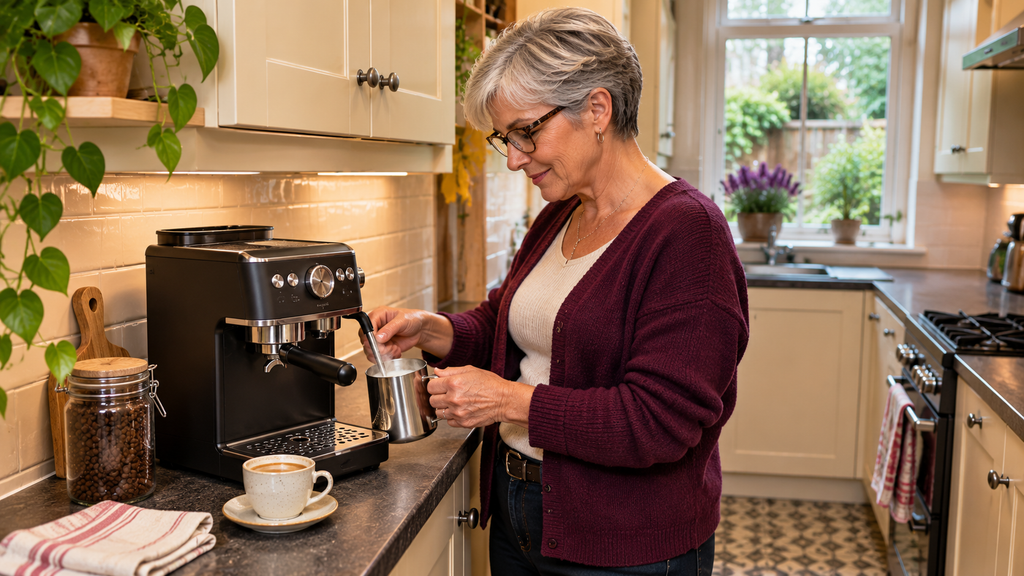
Product listings sometimes group all Espresso Machines together, even though the brewing experience can be very different. Our seven picks use a portafilter and ground coffee rather than handling every stage internally.
With these Espresso Machines, you fill the filter basket and attach it to the group head. Depending on the model, you start and stop extraction manually or use preset single- and double-shot controls. The milk-frothing wand is also operated separately.
A fully automatic bean-to-cup machine normally grinds, doses and brews from whole beans with less involvement. That’s useful for convenience, but it isn’t the focus of this article.
A portafilter offers greater involvement but also means extra washing-up and practice. If you want one-button cappuccinos with no handling of coffee grounds, consider a fully automatic alternative instead.
🫘 Ground Coffee, Grinders and Filter Baskets
Most compact Espresso Machines don’t contain a bean grinder. That helps keep their bodies slim, but means you’ll need to buy ground coffee or allocate room for a separate grinder.
Freshly ground beans can provide more flexibility over extraction. However, grinding for espresso requires a grinder capable of making fine, repeatable adjustments; a basic blade grinder isn’t an equivalent substitute.
If storing coffee beans, filter baskets and accessories is becoming difficult, our guide to storage solutions for studio flats includes practical ideas for organising smaller living spaces without adding unnecessary clutter.
Pressurised and Non-Pressurised Baskets
Some beginner-friendly Espresso Machines supply pressurised filter baskets designed to work with a wider range of pre-ground coffees. Non-pressurised baskets offer greater control but usually demand a capable grinder and more consistent preparation.
Check which baskets come with your exact model before buying extra accessories. The diameter of the portafilter matters too: tampers, replacement baskets and dosing tools are not universally interchangeable.
If counter space is extremely limited, starting with suitable pre-ground espresso coffee can be reasonable. Store it sealed, use it while fresh and follow the machine’s basket instructions. You can decide later whether a separate grinder is worth the extra equipment.
For enthusiasts, Espresso Machines with portafilters make learning dose and grind part of the appeal.
🎯 Brewing Pressure: Is 20 Bar Better Than 15 Bar?
You’ll see Espresso Machines advertised with 15-bar or 20-bar pumps. These are usually pump capability figures, not a promise that the coffee should brew at that pressure throughout extraction.
In traditional espresso preparation, approximately nine bars at the coffee puck is a familiar reference point, but real performance depends on the whole brewing system. A machine boasting a larger number isn’t automatically capable of making better coffee.
The CASABREWS CM5418 includes a pressure gauge, which can provide useful feedback. It’s not a substitute for tasting the result, though. Grind size, coffee freshness, basket choice and tamping all affect what happens during a shot.
When comparing Espresso Machines, prioritise controlled temperature, consistent extraction and a practical portafilter over the biggest pressure number on the box.
🌡️ Heating Systems, Temperature and Pre-Infusion
Coffee extraction benefits from reasonably consistent water temperature. Different Espresso Machines use systems such as Thermoblock heaters or boilers to heat the brewing water.
The De’Longhi Dedica and Breville Pixl use Thermoblock-based heating, while the De’Longhi Stilosa has a stainless-steel boiler. These approaches have different design trade-offs; neither guarantees good espresso without sensible coffee preparation.
Some Espresso Machines include pre-infusion, where water initially wets the grounds before fuller extraction. This may help with more even wetting, but the practical result still depends on the coffee and basket.
Allow the machine to complete its heating cycle before brewing. Warming a cold cup can help retain heat. Follow the machine’s instructions rather than running repeated empty shots unnecessarily.
🥛 Steam Wands and Making Milk Drinks
All seven selected Espresso Machines provide manual milk frothing. They don’t dispense finished cappuccinos from a detachable automatic milk carafe, so expect to learn how to position a jug and manage steam.
The Breville Pixl includes a CoolTouch wand intended to make handling easier, while the De’Longhi models offer their own manual frothing arrangements. The precise feel and technique vary by model.
Start with a suitably sized stainless-steel jug and cold milk. Keep the wand tip positioned according to the manufacturer’s instructions, avoid overfilling, and stop before the milk becomes uncomfortably hot to handle. Steam can burn, so clean and purge the wand safely after use.
You can explore the steam wand and included accessories in Breville’s official Pixl espresso machine specifications, which explain its CoolTouch technology and milk-frothing features.
For people who mostly drink espresso, the wand may be an occasional extra. If you make several lattes daily, however, think about the extra time and sink space needed for frothing and washing the jug.
Among small-kitchen Espresso Machines, manual milk preparation saves the footprint of an automatic milk system but transfers more of the work to you.
For households making several milk-based coffees each day, our guide to under-counter fridges for small kitchens explores refrigeration options that keep fresh milk accessible without dominating a compact kitchen.
💧 Water Tanks and Everyday Refilling
Water capacity is useful, but it shouldn’t outweigh the way a machine fits. Several Espresso Machines in this guide have reservoirs of around one litre, while others offer larger tanks.
One person preparing a couple of espressos each day may find a smaller tank perfectly practical. A household making several milk drinks may appreciate fewer trips to the tap.
Check whether the reservoir lifts upwards or pulls out from the rear. A machine placed beneath low cupboards can be awkward to refill even if its body fits neatly. Removable tanks are generally easier to carry to the sink, provided you can reach them.
Use fresh drinking water and follow the manufacturer’s guidance on water hardness and filters. For Espresso Machines in hard-water regions of the UK, appropriate descaling is particularly important for long-term performance.
🧼 Cleaning and Descaling Without the Hassle
Owning Espresso Machines means dealing with wet grounds, coffee oils, drips and milk residue. The good news is that routine maintenance is manageable if you make it part of your daily coffee habit.
After brewing, empty and rinse the basket as directed, wipe the group-head area where appropriate and clean the drip tray when necessary. After steaming milk, follow the maker’s instructions for wiping and purging the wand. Never touch hot metal parts carelessly.
Periodically clean the water tank and check any removable components. Check the manual before putting any parts in a dishwasher.
If washing coffee cups, milk jugs and other kitchenware already creates a daily pile-up, our guide to integrated dishwashers for small kitchens explores appliances that can reduce washing-up while maintaining a tidy fitted kitchen.
Descaling in a UK Home
Limescale can accumulate more quickly where water is hard. Espresso Machines may have a descaling indicator or an instructed cleaning interval. Use the recommended product and procedure for the exact model; household vinegar isn’t a universal substitute.
For Espresso Machines, the best cleaning routine is the one you’ll actually follow. Keep cleaning tools nearby but off a crowded counter.
🔇 Noise, Power and Placement
Espresso Machines make noise when pumps run, steam is released and metal accessories are handled. These sounds can be noticeable in a studio flat or an open-plan living area.
A separate grinder may create more noise than the espresso machine itself. If you prepare coffee early, consider your household’s routine before choosing a grinding location or storing a noisy appliance beside a bedroom wall.
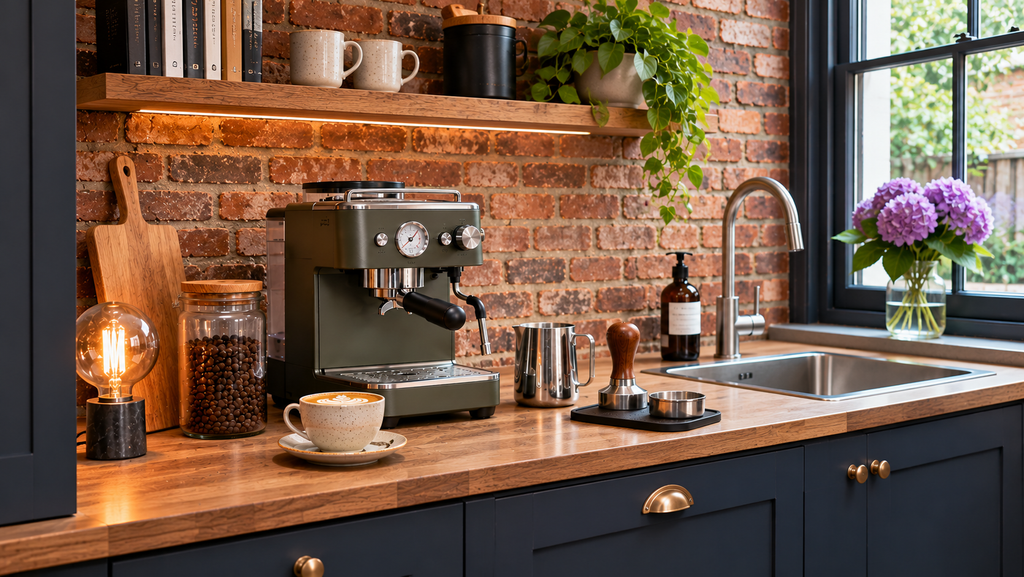
Place your coffee station near a suitable socket, away from the direct splash zone of the sink. Avoid extension leads or trailing cables where they create hazards, and follow electrical and ventilation instructions supplied with the machine.
For compact homes, Espresso Machines with simple controls make mornings easier.
💷 Running Costs and Value for Money
The purchase price is only one part of comparing Espresso Machines. Coffee, milk, cleaning products, replacement accessories and possibly a grinder affect the overall cost.
As an illustrative calculation, a £20 bag containing 1kg of beans works out at 36p for an 18g dose. Your actual cost depends on coffee prices, the basket you’re using and how much you put into it. Milk and electricity are additional.
If you rely on pre-ground coffee, you may avoid the cost and space of a grinder. If you want greater control over extraction, budget realistically for one instead of buying the cheapest unsuitable grinder.
A better-known brand can also make it easier to identify compatible accessories and service options, although support varies by model and retailer. For smaller brands, check the warranty and seller details.
Choose Espresso Machines for useful features, manageable space and upkeep.
⚠️ Common Mistakes to Avoid
A few overlooked details can turn promising Espresso Machines into frustrating purchases.
Forgetting the Handle Clearance
A narrow body still needs room for turning the portafilter. Measure the usable area with a mug, tamper and milk jug in mind.
Assuming a Grinder Is Included
Our seven picks use ground coffee and don’t include an integrated grinder. Plan for coffee storage or a separate suitable grinder.
Treating Pump Pressure as Coffee Quality
A 20-bar label isn’t proof of better espresso than a 15-bar label. Look at the complete brewing setup, not one number.
Ignoring Accessories
Check included baskets, portafilter size, milk jug and tamper. Buying replacements without verifying compatibility wastes money.
Overlooking Milk-Wand Safety
Steam wands get hot and must be cleaned correctly. Leave clearance from children, loose cloths and crowded items.
Forgetting Maintenance
Espresso Machines need appropriate descaling, particularly in hard-water areas, as well as day-to-day cleaning.
Buying Based on Reviews Alone
Check the exact model and UK seller. Marketplace listings can group variants, and badges, prices and availability may change.
Before adding another appliance to your kitchen, explore our compact kitchen appliance deals guide for more space-conscious options and practical buying considerations.
❓ Frequently Asked Questions
Which Espresso Machine Is Best for a Small Kitchen?
We recommend the De’Longhi Dedica Style EC685.M for its 14.9cm width, Thermoblock heating and adjustable frother. Other Espresso Machines may suit you better if you prefer touchscreen controls or a different depth.
Do Espresso Machines Need a Separate Grinder?
Not always, because you can use suitable pre-ground coffee. If you want to grind fresh beans and fine-tune extraction, a separate espresso-capable grinder is usually required for these seven portafilter models.
Can I Make a Latte or Cappuccino?
Yes. All seven Espresso Machines in our shortlist have manual steam wands. You’ll pull an espresso shot and texture milk separately, following the manufacturer’s instructions.
Is a 20-Bar Machine Better Than a 15-Bar Machine?
Not automatically. Pump ratings don’t directly measure coffee quality. Grinder suitability, dose, temperature and extraction consistency matter more.
Can I Use Coffee Pods?
The De’Longhi Dedica and Stilosa support compatible ESE paper pods. That is different from Nespresso-style capsules. Always check the exact model’s compatibility before purchasing.
Are Small Espresso Machines Hard to Clean?
Routine cleaning is manageable, but there will be used grounds, a drip tray and a steam wand to maintain. Follow the manual for the correct descaling and cleaning procedures.
What Should a Beginner Buy?
The Breville Pixl is our beginner-friendly pick because of its straightforward shot presets and included accessories. The Dedica remains our overall choice for a particularly narrow worktop.
How Much Space Do I Need for Accessories?
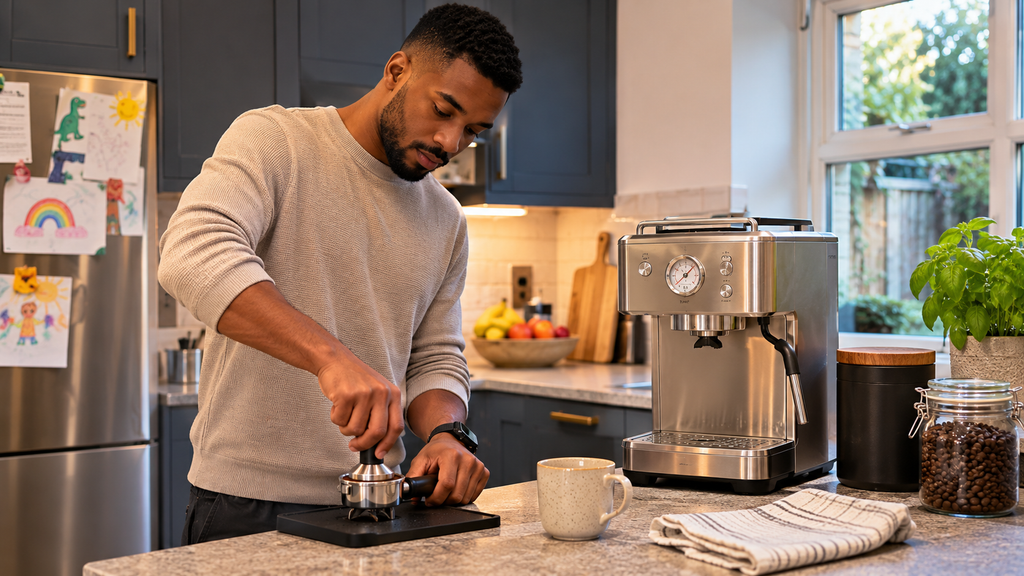
Allow space for at least a tamper, portafilter, coffee container and, if making milk drinks, a jug. A grinder adds another appliance. Don’t rely solely on the machine’s quoted width.
Are These Espresso Machines Suitable for UK Homes?
The models were selected from UK Amazon listings, but confirm the exact seller, plug and voltage information, warranty and availability when buying. Avoid assuming that every imported listing uses a UK-compatible configuration.
🏆 Final Verdict: Which Espresso Machine Should You Buy?
The best Espresso Machines for small UK kitchens aren’t necessarily those with the most settings. A compact footprint, accessible controls, safe working clearance and a cleaning routine you can sustain matter more.
Our original ranking remains unchanged:
- De’Longhi Dedica Style EC685.M — Best Overall: The strongest balance of narrow width, everyday functions and established brand support.
- Breville Pixl VCF196 — Best for Beginners: Straightforward presets and useful starter accessories.
- Beko CaffeExperto CEP5302B — Best for Narrow Worktops: Very slim body, provided you have enough counter depth.
- De’Longhi Stilosa EC260.CR — Best Value: Traditional espresso preparation without unnecessary extras.
- CASABREWS CM5418 — Best for Pressure-Gauge Control: Helpful visual feedback for people learning extraction.
- Chefman CraftBrew — Best Touchscreen Controls: Digital operation and a relatively shallow body.
- AMZCHEF EM3131-WT — Best Budget Slimline Alternative: A potentially narrow lower-cost choice; verify the exact listing.
Our top recommendation is the De’Longhi Dedica Style EC685.M. It offers a practical entry into traditional espresso without demanding a large kitchen. If digital controls matter more, consider the Breville Pixl or Chefman instead; if width is your biggest constraint, compare the Dedica and Beko carefully.
Ultimately, choose Espresso Machines based on where they’ll live, how you’ll prepare coffee and how much hands-on work you enjoy. A machine that fits your routine will be more useful than one that simply looks impressive online.