7 Best Bean-to-Cup Coffee Machines for Small Kitchens UK 2026
Freshly Ground Coffee Without Taking Over Your Kitchen
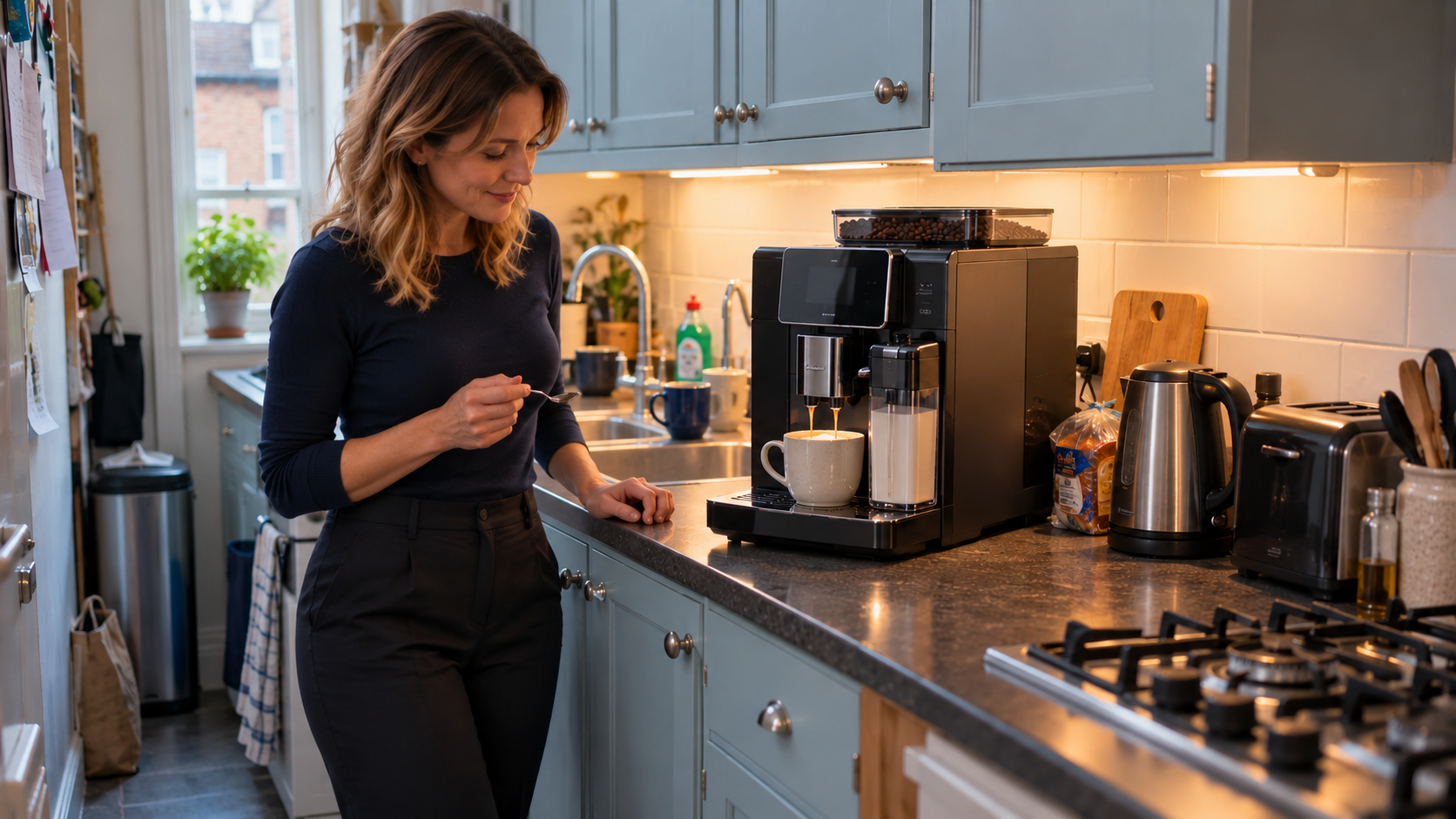
Choosing between the best Bean-to-Cup Coffee Machines can be difficult when your kitchen has limited countertop space. You want freshly ground espresso, rich coffee and perhaps a creamy cappuccino, but you probably don’t want a bulky appliance dominating the worktop.
Fortunately, modern Bean-to-Cup Coffee Machines offer plenty of options for smaller UK homes. Some are narrow, fully automatic models that handle grinding and brewing at the touch of a button, while others combine an integrated grinder with more hands-on espresso preparation.
For this guide, we’ve selected seven machines covering different budgets, coffee preferences and kitchen layouts. We’ve prioritised dimensions, ease of use, milk systems, cleaning requirements and everyday practicality rather than simply choosing the most expensive models.
Our overall winner is the Philips 3300 Series LatteGo, which combines a narrow 24.6cm body with automatic milk preparation and straightforward cleaning.
Whether you live in a compact flat, have a narrow galley kitchen or simply want to reclaim some worktop space, these Bean-to-Cup Coffee Machines and grinder-equipped alternatives are worth considering.
⚡ Quick Picks
Philips 3300 Series LatteGo — Best Overall

De’Longhi Magnifica Start — Best Value

Philips 5500 Series LatteGo — Best Premium Compact Pick
No products found.
Ninja Luxe Café Premier — Best for Coffee Variety

Siemens EQ700 — Best Smart Premium Machine

Breville Barista Max — Best for Hands-On Barista Control

AMZCHEF Espresso Machine with Grinder — Best Budget Barista-Style Pick
Affiliate disclosure: This article contains Amazon affiliate links. If you click one of these links and make a qualifying purchase, I earn a commission at no extra cost to you. As an Amazon Associate I earn from qualifying purchases.
🏆 OUR TOP PICK: Philips 3300 Series LatteGo
The Philips 3300 Series LatteGo earns our top recommendation among the Bean-to-Cup Coffee Machines because it combines fully automatic coffee preparation with a relatively narrow design and an easy-to-clean milk system.
Measuring approximately 24.6cm wide, it fits into many compact UK kitchen layouts without demanding as much horizontal space as larger barista-style machines. Its integrated ceramic grinder, automatic espresso preparation and LatteGo milk system make everyday cappuccinos and lattes simple to prepare.
The 1.8-litre water tank and 275g bean hopper provide useful capacity for regular home use, while SilentBrew technology is designed to reduce operating noise.
It isn’t the cheapest option, and its 43.3cm depth still needs checking against your worktop. However, for buyers who want one of the best Bean-to-Cup Coffee Machines for daily convenience without unnecessary complexity, the Philips 3300 offers the strongest overall balance.
CHECK LATEST PRICE ON AMAZON →
📊 Bean-to-Cup Coffee Machines Comparison Table
| Product | Best For | Key Spec | Main Advantage | Possible Drawback | Check Latest Price |
|---|---|---|---|---|---|
| Philips 3300 Series LatteGo | Best Overall | 24.6cm wide, LatteGo, 12 grinder settings | Narrow body and easy automatic milk drinks | Relatively deep | CHECK LATEST PRICE ON AMAZON → |
| De’Longhi Magnifica Start | Best Value | 24cm wide, integrated grinder, steam wand | Simple fully automatic espresso | Manual milk preparation | CHECK LATEST PRICE ON AMAZON → |
| Philips 5500 Series LatteGo | Premium Compact | 20 hot and iced drinks, LatteGo | Excellent drink variety in a narrow design | Premium price | CHECK LATEST PRICE ON AMAZON → |
| Ninja Luxe Café Premier | Coffee Variety | 3 brewing styles, 25 grinder settings | Espresso, filter and cold brew | Needs portafilter handling | CHECK LATEST PRICE ON AMAZON → |
| Siemens EQ700 | Smart Premium | Touchscreen, Home Connect, automatic milk | Premium automation and customisation | Larger countertop footprint | CHECK LATEST PRICE ON AMAZON → |
| Breville Barista Max | Barista Control | 58mm portafilter, 30 grinder settings | Hands-on espresso preparation | More effort and cleaning | CHECK LATEST PRICE ON AMAZON → |
| AMZCHEF Espresso Machine with Grinder | Budget Barista-Style | Integrated-grinder espresso design | Potential lower-cost alternative | Exact model and support need verification | CHECK LATEST PRICE ON AMAZON → |
Important: The Ninja Luxe Café Premier and Breville Barista Max are grinder-equipped semi-automatic machines rather than conventional one-touch automatic bean-to-cup appliances. The precise specifications of the selected AMZCHEF listing should be confirmed before publication.
🥇 Philips 3300 Series LatteGo — Best Overall
The Philips 3300 Series LatteGo takes first place because it offers the combination most people want from Bean-to-Cup Coffee Machines: freshly ground coffee, automatic milk preparation and minimal daily effort.
Its 24.6cm width is particularly useful for small kitchens where every section of countertop matters. Although the machine measures approximately 43.3cm deep and 37.1cm high, its narrow profile leaves more room beside it for other appliances and food preparation.
The built-in ceramic grinder offers 12 adjustment settings, allowing you to fine-tune coffee preparation to suit your beans and taste preferences.
The machine offers five programmed coffee selections, including espresso, regular coffee, cappuccino, latte macchiato and iced coffee, alongside hot water.
What particularly distinguishes the Philips 3300 from many competing Bean-to-Cup Coffee Machines is the LatteGo milk system.
Rather than using a complicated arrangement of milk tubes, LatteGo has two main detachable parts. This makes it relatively straightforward to remove and clean after preparing milk-based drinks.
Philips also includes SilentBrew technology, designed to reduce the noise associated with coffee preparation. Although the machine certainly isn’t silent, this feature may be appealing in open-plan homes or studio flats.
The 275g bean hopper and 1.8-litre water tank provide a sensible balance between capacity and physical size.
The main limitation is countertop depth. You’ll need enough room for the machine itself, along with access for refilling and cleaning.
✅ What We Like
- Narrow 24.6cm body suits many compact kitchen layouts.
- Fully automatic grinding and coffee preparation.
- LatteGo system prepares milk-based drinks automatically.
- Two-part milk system is straightforward to remove and rinse.
- Ceramic grinder with 12 adjustment settings.
- SilentBrew technology is designed to reduce operating noise.
- Practical 275g bean hopper and 1.8-litre water tank.
⚠️ What Could Be Better
- Its 43.3cm depth requires careful worktop measurement.
- Fewer speciality drinks than the premium Philips 5500.
- Costs more than basic automatic espresso machines.
- Milk components still require regular cleaning.
👤 Who Is It Best For?
Choose the Philips 3300 if you want one of the most convenient Bean-to-Cup Coffee Machines for a small kitchen, particularly if you regularly drink cappuccinos, lattes and espresso.
It’s an excellent fit for couples, busy households and anyone who wants café-style coffee without turning every morning into a barista session.
CHECK LATEST PRICE ON AMAZON →
💷 De’Longhi Magnifica Start — Best Value
The De’Longhi Magnifica Start is one of the most sensible Bean-to-Cup Coffee Machines for buyers who want freshly ground espresso without paying for elaborate touchscreens or automatic milk containers.
Its biggest advantage is simplicity.
The ECAM222.20.B model combines an integrated grinder with automatic espresso preparation and a manual steam wand, providing the core functions needed for everyday coffee.
At approximately 24cm wide, 44cm deep and 36cm high, it’s slightly narrower than the Philips 3300, although it occupies a similar amount of countertop depth.
The Magnifica Start allows users to prepare espresso and other black-coffee options through its touch controls, while adjustable settings provide flexibility over coffee intensity and preparation.
A 250g bean hopper and 1.8-litre water tank should be sufficient for most small households without requiring constant refilling.
Unlike the Philips LatteGo models, this version uses a traditional manual milk frother.
That means you’ll need to steam the milk yourself if you want cappuccinos or lattes.
For someone who enjoys a little involvement in coffee preparation, that may be an advantage. However, buyers seeking automatic milk drinks should choose a different model.
The Magnifica Start earns its position because it concentrates on useful everyday features rather than expensive extras.
Among Bean-to-Cup Coffee Machines for smaller homes, it’s particularly appealing if you mainly drink espresso or longer black coffees.
✅ What We Like
- Very narrow 24cm body.
- Fully automatic grinding and black-coffee preparation.
- Straightforward touch controls.
- Integrated grinder with adjustable settings.
- Manual steam wand for occasional milk-based drinks.
- 1.8-litre water tank and 250g bean hopper.
- Established De’Longhi automatic coffee-machine range.
⚠️ What Could Be Better
- Milk frothing isn’t automatic.
- The 44cm depth may be awkward in shallow kitchens.
- Fewer speciality drink presets than premium machines.
- Steam wand needs cleaning after milk preparation.
👤 Who Is It Best For?
The De’Longhi Magnifica Start is ideal for people who mainly drink espresso, regular coffee or americanos and only occasionally prepare milk-based drinks.
It’s also a sensible introduction to Bean-to-Cup Coffee Machines for buyers who prefer simple controls and practical features over premium extras.
CHECK LATEST PRICE ON AMAZON →
✨ Philips 5500 Series LatteGo — Best Premium Compact Pick
The Philips 5500 Series LatteGo is our premium compact recommendation for households wanting more coffee choices without sacrificing too much additional countertop space.
Many premium Bean-to-Cup Coffee Machines become considerably larger as they add features, but the standard Philips 5500 design retains a relatively narrow 24.6cm body.
Its biggest selling point is drink variety.
The 5500 Series offers 20 hot and iced coffee recipes, making it particularly appealing to households where everyone enjoys something different.
You might want an espresso in the morning, a cappuccino after lunch and an iced coffee during warmer weather.
With the Philips 5500, these options are available from one appliance rather than requiring separate coffee-making equipment.
The automatic LatteGo milk system is another advantage. Like the Philips 3300, it uses a detachable two-part arrangement without traditional milk tubes.
This helps keep cleaning relatively straightforward despite the machine’s extensive drink selection.
The standard 5500-series design also includes a ceramic grinder with 12 settings, a 275g bean hopper and a 1.8-litre water tank.
SilentBrew and QuickStart technologies support quieter and more convenient everyday preparation.
Where the Philips 5500 loses ground against our overall winner is value.
If you mainly drink one or two types of coffee, the less expensive Philips 3300 may already provide everything you need.
However, for buyers comparing premium Bean-to-Cup Coffee Machines with varied drink programmes, the Philips 5500 offers considerable functionality without an excessively wide housing.
✅ What We Like
- 20 hot and iced coffee recipes.
- Narrow 24.6cm standard chassis.
- Fully automatic coffee and milk preparation.
- Easy-to-remove LatteGo milk system.
- Ceramic grinder with 12 settings.
- SilentBrew and QuickStart technologies.
- Strong choice for households with different coffee preferences.
⚠️ What Could Be Better
- Higher price positioning than simpler models.
- Extra drink presets may be unnecessary for some users.
- Still requires approximately 43.3cm countertop depth.
- Automatic milk and brewing components require maintenance.
👤 Who Is It Best For?
Choose the Philips 5500 if you want premium convenience and a wider range of coffee drinks without moving to a particularly wide appliance.
It’s especially suitable for couples and families who enjoy different coffee styles throughout the day.
CHECK LATEST PRICE ON AMAZON →
☕ Ninja Luxe Café Premier — Best for Coffee Variety
The Ninja Luxe Café Premier stands out because it combines three different brewing styles within one appliance: espresso, filter coffee and cold brew.
Unlike conventional fully automatic Bean-to-Cup Coffee Machines, the Ninja uses a guided semi-automatic approach.
It features an integrated grinder with 25 settings, built-in weighing functionality and Barista Assist technology designed to make espresso preparation more approachable.
The machine helps guide the user through grinding and brewing, while the Dual Froth System automates much of the milk preparation process.
This gives it an interesting position between traditional hands-on espresso equipment and fully automatic home coffee machines.
The ability to produce different coffee styles is particularly useful in smaller homes where owning separate espresso, filter and cold-brew appliances would create unnecessary clutter.
Its dimensions also make it an interesting alternative.
At approximately 33.6cm wide and 34.4cm deep, the Ninja is wider than the Philips and De’Longhi models but less deep.
That difference could make it a better fit for kitchens with relatively shallow worktops but sufficient horizontal space.
However, buyers should understand that the Ninja isn’t a conventional one-touch bean-to-cup appliance.
You’ll still handle a portafilter and take part in the preparation process.
Compared with completely automatic Bean-to-Cup Coffee Machines, it therefore involves more effort and potentially more cleaning.
For people who enjoy coffee preparation, those extra steps may be part of the appeal.
✅ What We Like
- Combines espresso, filter coffee and cold brew.
- Integrated grinder with 25 adjustment settings.
- Built-in scale supports more consistent dosing.
- Barista Assist provides helpful preparation guidance.
- Dual Froth System automates milk texturing.
- Shallower design than some narrow automatic machines.
- Can replace several separate coffee appliances.
⚠️ What Could Be Better
- Wider than the Philips and De’Longhi options.
- Not a completely automatic bean-to-cup machine.
- Requires portafilter handling and cleaning.
- Additional accessories need storage space.
- More involved than simply pressing a coffee button.
👤 Who Is It Best For?
The Ninja Luxe Café Premier is ideal for people who enjoy experimenting with espresso, filter coffee and cold brew but want some assistance with grinding and milk preparation.
It’s particularly appealing if you want several brewing styles from one machine and don’t mind a more hands-on routine.
CHECK LATEST PRICE ON AMAZON →
📱 Siemens EQ700 — Best Smart Premium Machine
The Siemens EQ700 is our premium smart recommendation for buyers who value advanced controls, extensive drink choices and automatic coffee preparation.
Among the Bean-to-Cup Coffee Machines in this comparison, the Siemens offers one of the more sophisticated user experiences.
The TQ717GB3 features a colour touchscreen interface, automatic milk preparation and Home Connect functionality.
Its range of coffee programmes and personalisation options makes it particularly attractive for households where different people prefer different drink strengths and recipes.
Unlike semi-automatic machines, the Siemens handles the grinding and brewing process automatically.
The integrated milk system also removes much of the manual work involved in preparing cappuccinos and lattes.
However, the EQ700 is significantly larger than our top three recommendations.
Measuring approximately 35.2cm wide and 46.7cm deep, it demands noticeably more countertop space than a Philips 3300 or De’Longhi Magnifica Start.
For a kitchen with a dedicated coffee station, this may not be an issue.
In a studio flat or narrow galley kitchen, however, the extra width and depth could make everyday food preparation more difficult.
This is why the Siemens ranks below several simpler Bean-to-Cup Coffee Machines despite offering more advanced features.
A premium specification is only useful if the appliance fits comfortably into your home.
✅ What We Like
- Fully automatic grinding and brewing.
- Premium touchscreen controls.
- Integrated automatic milk preparation.
- Home Connect smart functionality.
- Extensive drink selection and customisation.
- Suitable for households with varied coffee preferences.
- Sophisticated all-in-one coffee preparation.
⚠️ What Could Be Better
- Wide 35.2cm body requires more worktop space.
- Considerable 46.7cm depth.
- Premium pricing.
- Advanced features may be unnecessary for basic coffee drinkers.
- Less practical for particularly narrow kitchens.
👤 Who Is It Best For?
Choose the Siemens EQ700 if you want premium automation, smart controls and a wide range of personalised coffee drinks.
It’s best suited to kitchens with enough space for a dedicated coffee station rather than the smallest studio-flat layouts.
CHECK LATEST PRICE ON AMAZON →
🎯 Breville Barista Max — Best for Hands-On Barista Control
The Breville Barista Max is designed for people who enjoy making espresso rather than simply pressing a button and waiting for a drink.
It differs from fully automatic Bean-to-Cup Coffee Machines because the user remains involved in grinding, preparing and extracting the coffee.
The integrated Tap & Go grinder provides 30 adjustment settings, allowing you to experiment with different beans and grinding preferences.
A traditional 58mm portafilter gives the machine a more authentic barista-style workflow, while Breville’s Temp IQ Shot Control system is designed to help maintain consistent brewing temperatures.
The machine also includes a manual steam wand for heating and texturing milk.
This gives you more direct control over milk preparation than automatic frothing systems, which may be appealing if you want to improve your cappuccino or latte-making skills.
The 2.8-litre water tank is generous compared with several fully automatic alternatives.
However, the Barista Max has practical disadvantages in a small kitchen.
You’ll need room to handle the portafilter, tamp coffee, empty used grounds and clean the accessories.
Although the grinder is integrated, preparing espresso can still involve more equipment and countertop activity than using a fully automatic machine.
For coffee enthusiasts, this is a worthwhile trade-off.
For someone who wants the fastest possible morning routine, other Bean-to-Cup Coffee Machines in our comparison are likely to be more convenient.
✅ What We Like
- Integrated grinder with 30 settings.
- Traditional 58mm portafilter.
- Manual control over espresso preparation.
- Temp IQ Shot Control system.
- Steam wand for hands-on milk texturing.
- Large 2.8-litre water tank.
- Suitable for developing home barista skills.
⚠️ What Could Be Better
- Requires more manual preparation than automatic machines.
- Grinding and tamping can create additional mess.
- Portafilter and accessories need cleaning and storage.
- Not ideal for rushed mornings.
- Requires a reasonable amount of usable worktop space.
👤 Who Is It Best For?
The Breville Barista Max is ideal for people who enjoy the process of making coffee and want to experiment with grind size, extraction and milk texture.
It’s a stronger choice for aspiring home baristas than buyers searching for completely automatic Bean-to-Cup Coffee Machines.
CHECK LATEST PRICE ON AMAZON →
💰 AMZCHEF Espresso Machine with Grinder — Best Budget Barista-Style Pick
The AMZCHEF Espresso Machine with Grinder completes our shortlist as a potential budget-oriented alternative to more established coffee-machine brands.
For buyers comparing Bean-to-Cup Coffee Machines, integrated-grinder espresso machines can be appealing because they combine two important functions within one appliance.
The AMZCHEF candidate is marketed around espresso preparation, built-in grinding and touchscreen-style controls.
That could make it attractive to people who want to explore freshly ground espresso without immediately investing in a premium machine.
However, it’s important to distinguish between a grinder-equipped espresso machine and a fully automatic bean-to-cup model.
Having a built-in grinder doesn’t necessarily mean the machine automatically prepares an espresso from beginning to end.
Depending on the exact product version, users may still need to handle a portafilter, manage coffee extraction and froth milk separately.
This is particularly important with less familiar Amazon marketplace brands, where different machines can have similar names despite offering different functions.
The selected AMZCHEF listing also has less independently established product information than the machines from Philips, De’Longhi, Siemens, Ninja and Breville.
As a result, we would be more cautious about assuming long-term reliability, replacement-part availability or after-sales support.
The AMZCHEF earns its place as a possible entry-level grinder-equipped option, but it sits below the established alternatives for overall buying confidence.
Before purchasing, confirm the exact model, dimensions, brewing method, warranty and seller details.
✅ What We Like
- Integrated-grinder design may reduce the need for separate equipment.
- Touchscreen-style interface may appeal to some buyers.
- Potential lower-cost entry into freshly ground espresso.
- Offers an alternative to established premium coffee brands.
- Worth considering for buyers who enjoy hands-on espresso preparation.
⚠️ What Could Be Better
- Exact model specifications require confirmation.
- May not offer fully automatic coffee preparation.
- Long-term reliability information is limited.
- Warranty and replacement-part availability need checking.
- Less established UK service history than leading manufacturers.
👤 Who Is It Best For?
The AMZCHEF is worth investigating if you’re shopping on a restricted budget and want a grinder-equipped espresso machine rather than a conventional one-touch automatic model.
However, buyers prioritising dependable support and straightforward everyday use may be better served by established Bean-to-Cup Coffee Machines such as the De’Longhi Magnifica Start.
CHECK LATEST PRICE ON AMAZON →
🧠 How We Chose the Best Bean-to-Cup Coffee Machines
Our selection focuses on the features that matter most when choosing Bean-to-Cup Coffee Machines for smaller UK homes.
Rather than simply ranking the most expensive products highest, we considered how practical each machine would be to own, operate and maintain in an ordinary kitchen.
Kitchen dimensions were particularly important. A narrow machine can preserve valuable preparation space, but depth and height also affect whether it fits beneath wall cupboards and beside other appliances.
Brewing convenience was another major factor. Fully automatic Bean-to-Cup Coffee Machines received preference where other qualities were comparable because they handle grinding and coffee preparation with minimal effort.
We also included grinder-equipped semi-automatic alternatives where they offered a meaningful advantage, such as the Ninja’s multiple brewing styles or the Breville’s hands-on barista controls.
Milk preparation matters for anyone who regularly drinks cappuccinos and lattes. Automatic systems are convenient, while manual steam wands provide more direct control but require practice.
Cleaning and maintenance were also considered. Removable milk containers, accessible drip trays, cleaning routines and descaling requirements can all influence long-term convenience.
Finally, we considered coffee variety, control settings, brand support and overall value.
The aim is to help readers choose Bean-to-Cup Coffee Machines that suit their actual kitchen space and daily coffee habits rather than paying extra for features they may rarely use.
🔎 Top Things to Search on Amazon
When shopping for Bean-to-Cup Coffee Machines on Amazon UK, useful searches include:
- best bean-to-cup coffee machine UK
- compact bean-to-cup coffee machine
- fully automatic coffee machine with milk frother
- small bean-to-cup coffee machine
- Philips LatteGo coffee machine
- De’Longhi Magnifica Start
- coffee machine with built-in grinder
- automatic espresso machine for small kitchen
- easy-clean bean-to-cup coffee machine
- bean-to-cup coffee machine with cappuccino maker
- premium automatic coffee machine
- budget coffee machine with grinder
Before purchasing any Bean-to-Cup Coffee Machines, check the exact model number, dimensions, grinder type, milk system, water tank, warranty and cleaning requirements.
Also check whether the machine is genuinely fully automatic or uses a semi-automatic portafilter system, as this can make a significant difference to everyday convenience.
📏 Size and Dimensions: Will It Fit Your Kitchen?
One of the most important considerations when choosing Bean-to-Cup Coffee Machines is how much space they occupy on your kitchen worktop.
Many UK kitchens have standard worktops approximately 60cm deep, but that doesn’t mean the entire surface is available for a coffee machine.
You’ll need to account for wall sockets, splashbacks, overhead cupboards and neighbouring appliances.
A machine that’s only 24cm wide might seem compact, but if it’s 44cm deep, it can still occupy a significant portion of your preparation area.
Here are the approximate dimensions of the six established models in our comparison:
| Coffee Machine | Width | Depth | Height |
|---|---|---|---|
| Philips 3300 LatteGo | 24.6cm | 43.3cm | 37.1cm |
| De’Longhi Magnifica Start | 24cm | 44cm | 36cm |
| Philips 5500 LatteGo | 24.6cm | 43.3cm | 37.1cm |
| Ninja Luxe Café Premier | 33.6cm | 34.4cm | 37.2cm |
| Siemens EQ700 | 35.2cm | 46.7cm | 38cm |
| Breville Barista Max | Approx. 35cm | Approx. 32cm | Approx. 41cm |
These are indicative measurements. Always confirm the dimensions of the exact model before buying.
The Philips 3300, Philips 5500 and De’Longhi Magnifica Start are particularly attractive when countertop width is limited.
However, a wider but shallower machine like the Ninja may work better in some kitchen layouts.
The same measurements matter when choosing larger appliances, and our guide to slimline fridges for small kitchens compares narrow models designed for tighter UK layouts.
Our advice: Measure the width, depth and height of your available space, then allow additional clearance for filling the water tank, accessing the bean hopper and cleaning the machine.
📐 Countertop Footprint: Making Every Centimetre Count
The best Bean-to-Cup Coffee Machines for small kitchens aren’t necessarily the narrowest.
Width matters, but total countertop footprint can be equally important.
For example:
- A machine measuring 24cm wide × 44cm deep occupies approximately 1,056cm².
- A machine measuring 34cm wide × 34cm deep occupies approximately 1,156cm².
Despite their different shapes, the overall areas aren’t dramatically different.
The first might suit a narrow section of countertop, while the second could work better where depth is restricted.
Think about how you’ll actually use your kitchen.
If the coffee machine sits beside your kettle and toaster, will you still have enough room to prepare meals?
Can you remove the drip tray without moving other appliances?
Can you refill the water tank without pulling the machine forward?
These small details make a noticeable difference over time.
For studio flats and compact homes, Bean-to-Cup Coffee Machines with accessible controls and straightforward maintenance can be more practical than larger machines with extensive features.
It’s also worth considering whether you need a separate milk jug, tamper or other accessories.
Fully automatic machines generally keep more of the preparation process contained within the appliance, while semi-automatic models may require extra storage.
If your kitchen lacks a dedicated preparation area, a foldable dining table for a studio flat could provide occasional extra surface space without permanently crowding your home.
Our advice: Choose a machine that fits comfortably into your daily kitchen routine, not one that only fits when everything else has been moved.
⚙️ Built-In Grinders: What Should You Look For?
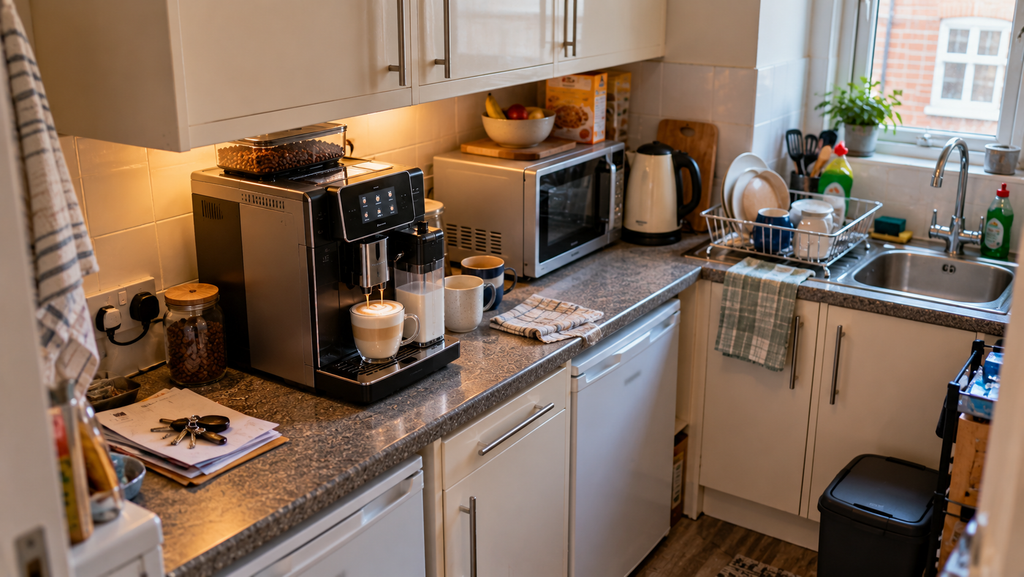
A built-in grinder is one of the biggest advantages of Bean-to-Cup Coffee Machines.
Instead of buying a separate grinder and coffee maker, you get freshly ground beans and brewing functionality in one appliance.
This is particularly useful in small kitchens, where every additional gadget competes for limited space.
Keeping coffee equipment organised is easier when everything has its place, and our guide to storage solutions for studio flats includes practical ideas for reducing clutter in compact homes.
Ceramic vs Steel Grinders
Different manufacturers use different grinder materials.
Philips uses ceramic grinders in its 3300 and 5500 ranges, while other manufacturers use steel grinding components.
Both can produce good results.
Grind consistency, adjustment options and machine calibration generally matter more than the grinder material alone.
Grinder Adjustment Settings
Some Bean-to-Cup Coffee Machines offer a handful of grinding adjustments, while others provide more extensive control.
The Philips 3300 and 5500 have 12 settings, the Ninja Luxe Café Premier offers 25, and the Breville Barista Max provides 30.
More settings can be helpful if you enjoy experimenting with espresso extraction.
However, a larger number doesn’t automatically mean better coffee.
For most everyday drinkers, a reliable grinder with sensible adjustment options is more useful than dozens of settings they’ll rarely change.
Do You Need a Separate Grinder?
For most people buying a fully automatic machine, no.
The integrated grinder handles preparation as part of the brewing process.
This saves both money and countertop space compared with purchasing separate equipment.
Our advice: Prioritise grinder consistency and easy adjustment rather than choosing a machine solely because it advertises the most settings.
If you’re trying to make better use of limited worktop space, our guide to compact kitchen appliances explores more space-saving options for everyday cooking and food storage.
☕ Automatic vs Semi-Automatic: Know the Difference
Not all Bean-to-Cup Coffee Machines and grinder-equipped espresso machines work in the same way.
This distinction matters because it determines how much work you’ll need to do before enjoying your coffee.
Fully Automatic Coffee Machines
A fully automatic machine grinds beans, prepares the coffee dose and brews espresso with minimal user involvement.
Our fully automatic selections include:
- Philips 3300 Series LatteGo
- De’Longhi Magnifica Start
- Philips 5500 Series LatteGo
- Siemens EQ700
Some also prepare milk automatically, while others use a manual steam wand.
These are generally the most convenient options for busy mornings.
Semi-Automatic Espresso Machines
Semi-automatic machines require more involvement.
The Ninja Luxe Café Premier and Breville Barista Max both include integrated grinders, but they still use portafilter-based brewing systems.
You may need to handle the coffee basket, prepare the grounds and clean the portafilter afterwards.
The Ninja offers more guidance and automated assistance, while the Breville provides a more traditional hands-on experience.
These machines can be appealing, but they shouldn’t be confused with conventional one-touch Bean-to-Cup Coffee Machines.
Which Is Better for a Small Kitchen?
If convenience is your priority, fully automatic machines usually make more sense.
If you enjoy making espresso as a hobby, a semi-automatic machine can be rewarding.
Our advice: Decide whether you want to make coffee or simply press a button and enjoy it. That choice will narrow your options considerably.
🥛 Milk Systems: Automatic Frothing or Manual Steam Wand?
Milk preparation is one of the biggest differences between Bean-to-Cup Coffee Machines.
If you mainly drink black coffee, you may not need an automatic milk system.
However, if cappuccinos, lattes and flat whites are part of your daily routine, milk preparation can have a major influence on convenience.
For households regularly making fresh-milk cappuccinos and lattes, our guide to under-counter fridges for small kitchens explores refrigeration options that can fit beneath existing worktops.
Automatic Milk Systems
The Philips 3300, Philips 5500 and Siemens EQ700 include automatic milk preparation.
These machines handle milk frothing without requiring you to learn traditional steam-wand techniques.
The Philips LatteGo system is particularly practical because it uses a removable two-part container without conventional milk tubes.
That makes it relatively straightforward to rinse after use.
Manual Steam Wands
The De’Longhi Magnifica Start and Breville Barista Max use manual steam wands.
These allow you to control milk heating and texture yourself.
For coffee enthusiasts, this can be enjoyable.
However, producing consistent microfoam takes practice, and the steam wand requires cleaning after each use.
The Ninja Alternative
The Ninja Luxe Café Premier uses a Dual Froth System that automates much of the milk-texturing process.
This provides an interesting middle ground between hands-on espresso preparation and automatic milk drinks.
Our advice: If you regularly prepare milk-based drinks, choose Bean-to-Cup Coffee Machines with automatic milk systems. If you mostly drink espresso, a simpler machine with a steam wand may offer better value.
🎯 Espresso Quality: What Makes a Good Cup?
The quality of coffee produced by Bean-to-Cup Coffee Machines depends on more than the machine’s price.
Fresh beans, grind size, extraction settings, water quality and brewing temperature all contribute to flavour.
Fresh Coffee Beans
Grinding beans immediately before brewing helps preserve flavour and aroma compared with coffee that has been ground and stored for long periods.
Choose beans you enjoy and store spare supplies in a cool, dry location.
Grind Size
If the grind is too coarse, espresso may taste weak or under-extracted.
If it’s too fine, extraction can become excessively slow and produce unwanted bitterness.
Most automatic machines allow adjustments, although manufacturers may recommend changing grinder settings only while the grinder is operating.
Always follow the instructions for your model.
Coffee Strength
Many Bean-to-Cup Coffee Machines allow you to adjust aroma or strength.
Depending on the appliance, this may change the amount of ground coffee used or other brewing parameters.
Start with the recommended settings before making gradual adjustments.
Water Quality
Water affects both coffee flavour and machine maintenance.
Hard water can cause mineral deposits inside heating and brewing components.
In many areas of the UK, regular descaling or an approved water filter may be particularly important.
Our advice: Don’t assume a more expensive machine automatically makes better-tasting coffee. Good beans and the correct settings can make a substantial difference.
🧋 Drink Options: How Many Do You Actually Need?
Premium Bean-to-Cup Coffee Machines often advertise extensive drink menus.
That sounds appealing, but it’s worth considering how many options you’ll genuinely use.
The Philips 3300 offers popular drinks including espresso, coffee, cappuccino, latte macchiato and iced coffee.
The Philips 5500 expands the selection to 20 hot and iced recipes.
The Siemens EQ700 offers a broad range of speciality coffee programmes and personalisation options.
Meanwhile, the Ninja Luxe Café Premier focuses on versatility by combining espresso, filter coffee and cold-brew styles.
If you drink the same espresso every morning, the additional programmes on a premium machine may offer limited benefit.
However, if several people in your household enjoy different drinks, more choices can be worthwhile.
Bean-to-Cup Coffee Machines with automatic milk preparation may also save time when multiple cappuccinos or lattes are needed.
Our advice: Choose the machine that makes your favourite drinks well rather than paying extra for an impressive menu you’ll rarely explore.
🧽 Cleaning and Maintenance: What to Expect
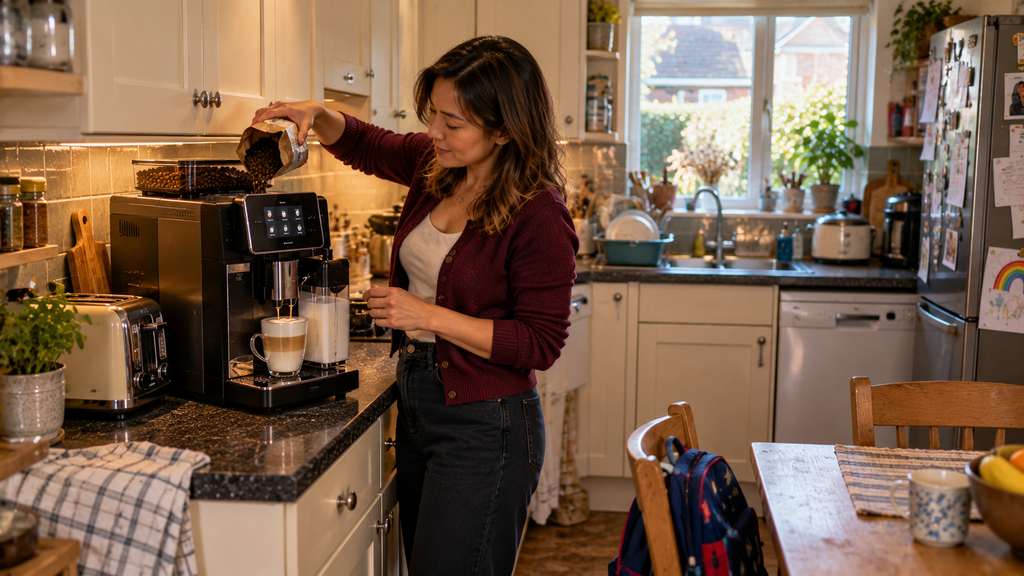
Cleaning requirements are particularly important when choosing Bean-to-Cup Coffee Machines for small kitchens.
A machine that seems effortless during brewing can become frustrating if its maintenance routine is complicated.
If everyday washing-up is already a challenge in your kitchen, our guide to integrated dishwashers for small kitchens explores space-conscious options for managing dishes and kitchen clutter.
Drip Trays and Grounds Containers
Fully automatic machines collect used coffee grounds and water from brewing or rinsing cycles.
These containers need regular emptying and cleaning.
Milk System Cleaning
Milk components should be cleaned after use according to the manufacturer’s instructions.
Milk residue can accumulate in containers, tubes and frothing components if left unattended.
The Philips LatteGo system is particularly appealing because its two main parts are easy to separate.
Brew Group Maintenance
Some automatic machines have removable brew groups that require periodic rinsing.
Others use different cleaning systems.
Always follow the instructions supplied with the appliance.
Descaling
Mineral deposits can build up inside the machine over time.
The frequency of descaling depends on water hardness, usage and whether a suitable filter is installed.
Use the cleaning products recommended by the manufacturer.
Avoid assuming vinegar is suitable, because some brands specifically advise against it.
Our advice: When comparing Bean-to-Cup Coffee Machines, check how the milk system, drip tray and brewing components are cleaned before making your purchase.
💧 Water Tanks: Capacity and Accessibility
Water tank capacity affects how frequently Bean-to-Cup Coffee Machines need refilling.
The Philips 3300, Philips 5500 and De’Longhi Magnifica Start all have approximately 1.8-litre reservoirs.
The Breville Barista Max has a larger 2.8-litre tank.
A larger tank can be convenient if several people regularly make coffee throughout the day.
However, it may also contribute to the overall size of the appliance.
For one or two coffee drinkers, a 1.8-litre reservoir is often sufficient.
Remember that some automatic machines use water for internal rinsing cycles as well as brewing drinks.
Water hardness also affects how frequently a coffee machine needs maintenance, and De’Longhi’s official coffee machine care guide explains how water testing, cleaning and descaling help keep automatic machines performing pro
Where Is the Tank Located?
The position of the reservoir matters just as much as its capacity.
A machine with a rear-loading tank might be inconvenient when positioned against a wall.
Side-loading or front-access reservoirs may be easier to manage in restricted spaces.
Check the exact machine’s design before buying.
Our advice: For small kitchens, convenient refilling is often more useful than having the largest possible water tank.
🫘 Bean Hoppers: How Much Capacity Do You Need?
Bean hoppers store the whole coffee beans used by Bean-to-Cup Coffee Machines.
The Philips 3300 and 5500 have approximately 275g capacity, while the De’Longhi Magnifica Start holds around 250g.
These sizes are generally practical for everyday household use.
A larger hopper reduces refilling frequency, but it isn’t always necessary.
Coffee beans gradually lose freshness after exposure to air, heat and moisture.
For the best results:
- Store spare beans in suitable airtight packaging or containers.
- Avoid placing coffee directly beside heat-producing appliances.
- Fill the hopper with an amount you’ll use reasonably soon.
- Keep the bean container clean and dry.
- Follow the manufacturer’s guidance concerning oily or flavoured beans.
Some grinders may struggle with excessively oily or coated beans.
If you’re unsure, check the machine’s instructions before using speciality blends.
Our advice: A hopper around 250–275g offers a sensible balance between convenience and freshness for many households.
🔇 Noise Levels: Are Bean-to-Cup Machines Loud?
Bean-to-Cup Coffee Machines typically make noise during grinding, brewing, milk preparation and automatic cleaning.
The grinder is often one of the loudest parts.
This may be particularly noticeable in a studio flat where the kitchen, living area and sleeping space are close together.
Philips uses SilentBrew technology in its 3300 and 5500 ranges, designed to reduce operating noise.
However, quieter doesn’t mean silent.
The perceived noise can vary depending on the machine’s construction, the beans, the worktop and nearby surfaces.
Ways to Reduce Noise
- Position the machine on a stable, level surface.
- Keep loose utensils and cups away from vibrating components.
- Ensure removable trays and covers are correctly fitted.
- Follow the manufacturer’s guidance on placement and clearance.
- Consider whether the kitchen shares a wall with a bedroom.
If you regularly make coffee very early in the morning, operating noise is worth considering before buying.
Our advice: For compact flats and open-plan living spaces, quieter Bean-to-Cup Coffee Machines may be worth prioritising over models with additional features you won’t use.
💷 Running Costs: How Much Does Fresh Coffee Really Cost?
The initial purchase price is only one part of owning Bean-to-Cup Coffee Machines.
Ongoing expenses include coffee beans, milk, cleaning products, filters, electricity and occasional maintenance.
Coffee Beans
Here’s a simple illustrative example.
If you purchase 1kg of coffee beans for £20 and use approximately 10g per drink, you’ll get around 100 servings.
That works out at approximately 20p in beans per coffee.
Actual costs vary depending on the price of your beans, machine settings and the amount used per drink.
Milk
Lattes and cappuccinos cost more because they require milk.
The amount depends on the recipe and cup size.
Filters and Descaling
Some machines use replaceable water filters, while others require regular descaling with approved cleaning products.
These add to ongoing ownership costs.
Electricity
Bean-to-Cup Coffee Machines use electricity for grinding, heating water, pumping and steaming.
The actual cost depends on frequency of use, machine design and electricity tariffs.
A machine’s maximum wattage doesn’t represent how much power it continuously consumes.
Repairs and Replacement Parts
It’s also worth considering long-term ownership.
Established manufacturers may offer more developed service networks and parts availability.
With less familiar brands, check warranty coverage and support before ordering.
Our advice: Bean-to-cup coffee can have a relatively low ingredient cost per drink compared with buying café coffee, but remember to account for the machine’s purchase price and maintenance.
⚠️ Common Mistakes to Avoid When Buying
Even experienced coffee drinkers can make practical mistakes when choosing Bean-to-Cup Coffee Machines.
Buying an appliance without checking its dimensions can cause problems beyond coffee machines, as our guide to the best fridge freezers for studio flats explains when comparing width, depth, storage capacity and everyday access.
Buying Based on Appearance Alone
An appliance may look compact in promotional photographs but occupy a significant amount of counter space.
Always measure before purchasing.
Confusing Automatic and Semi-Automatic
A built-in grinder doesn’t necessarily mean fully automatic operation.
Check whether the machine requires a portafilter, tamping or manual extraction.
Ignoring Milk Cleaning
Automatic milk systems are convenient, but they still need regular cleaning.
Look at how easily the milk components can be removed.
Choosing Too Many Features
Premium Bean-to-Cup Coffee Machines may include extensive drink menus and smart controls.
If you only drink espresso, you may not need them.
Forgetting Overhead Clearance
Bean hoppers and water tanks may need access from above.
Check that the machine can be refilled beneath your cupboards.
Overlooking Water Hardness
Limescale management is important, particularly in hard-water regions.
Follow the manufacturer’s recommended maintenance routine.
Ignoring Brand Support
Check warranty details, spare-part availability and servicing options.
This is especially important with less established manufacturers.
Forgetting Extra Accessories
Semi-automatic machines may require tampers, milk jugs and cleaning tools.
These occupy space even if the machine has a built-in grinder.
Avoiding these mistakes will help you find Bean-to-Cup Coffee Machines that remain convenient long after the initial purchase.
❓ Frequently Asked Questions
Are Bean-to-Cup Coffee Machines Worth Buying?
Bean-to-Cup Coffee Machines can be worthwhile if you regularly enjoy freshly ground coffee and want an integrated grinder.
Fully automatic models also simplify brewing, while some offer automatic milk preparation.
However, occasional coffee drinkers may find simpler appliances more economical.
What Is the Best Bean-to-Cup Coffee Machine for a Small Kitchen?
Our overall recommendation is the Philips 3300 Series LatteGo.
Its 24.6cm width, automatic brewing and convenient milk system make it a strong all-round choice.
The De’Longhi Magnifica Start is another appealing option for buyers who prefer simpler controls and don’t mind manually frothing milk.
How Much Counter Space Does a Bean-to-Cup Machine Need?
Dimensions vary by model.
Several narrow Bean-to-Cup Coffee Machines measure around 24–25cm wide but extend more than 40cm deep.
Allow enough additional clearance for ventilation, refilling and cleaning according to the manufacturer’s instructions.
Do Bean-to-Cup Machines Make Proper Espresso?
Yes. Genuine espresso-capable bean-to-cup machines grind coffee beans and use a pressurised brewing system to prepare espresso.
However, grind-and-brew filter coffee makers should not be confused with espresso machines simply because they also use whole beans.
Are Bean-to-Cup Machines Better Than Pod Machines?
Bean-to-cup machines offer freshly ground coffee and greater flexibility in bean selection.
Pod machines are often smaller and simpler, although they require compatible capsules.
The better option depends on available space, budget and personal preferences.
Can Bean-to-Cup Machines Make Cappuccinos Automatically?
Yes, if they include an automatic milk system.
Models such as the Philips 3300 LatteGo, Philips 5500 LatteGo and Siemens EQ700 can prepare milk-based drinks automatically.
Other machines require manual frothing.
How Often Should You Clean a Bean-to-Cup Machine?
Milk-contact components should be cleaned according to the manufacturer’s after-use instructions.
Drip trays and grounds containers need regular attention, while brew groups and internal components may require periodic maintenance.
Descaling frequency depends on water hardness and usage.
Can You Use Ground Coffee Instead of Whole Beans?
Some Bean-to-Cup Coffee Machines include a separate compartment for pre-ground coffee.
Others are designed primarily for whole beans.
Always check the machine’s instructions before adding pre-ground coffee.
Never pour ground coffee into the whole-bean hopper unless the manufacturer explicitly permits it.
Are Bean-to-Cup Coffee Machines Noisy?
Most machines make noticeable noise while grinding beans.
Some models use noise-reduction technology, but no machine should be assumed to operate silently.
Noise may matter more in studio flats and open-plan homes.
How Long Do Bean-to-Cup Coffee Machines Last?
Lifespan depends on build quality, usage, maintenance and the availability of replacement parts.
Regular cleaning and descaling can help protect performance, but no particular lifespan is guaranteed.
Which Coffee Beans Are Best?
Medium and medium-dark espresso roasts are popular starting points, although taste is subjective.
Choose beans suitable for your machine and follow the manufacturer’s advice concerning very oily or flavoured varieties.
Is an Expensive Bean-to-Cup Machine Always Better?
Not necessarily.
Premium Bean-to-Cup Coffee Machines may offer more recipes, advanced controls and automatic milk systems.
However, a simpler machine can provide better value if you mainly drink espresso or regular coffee.
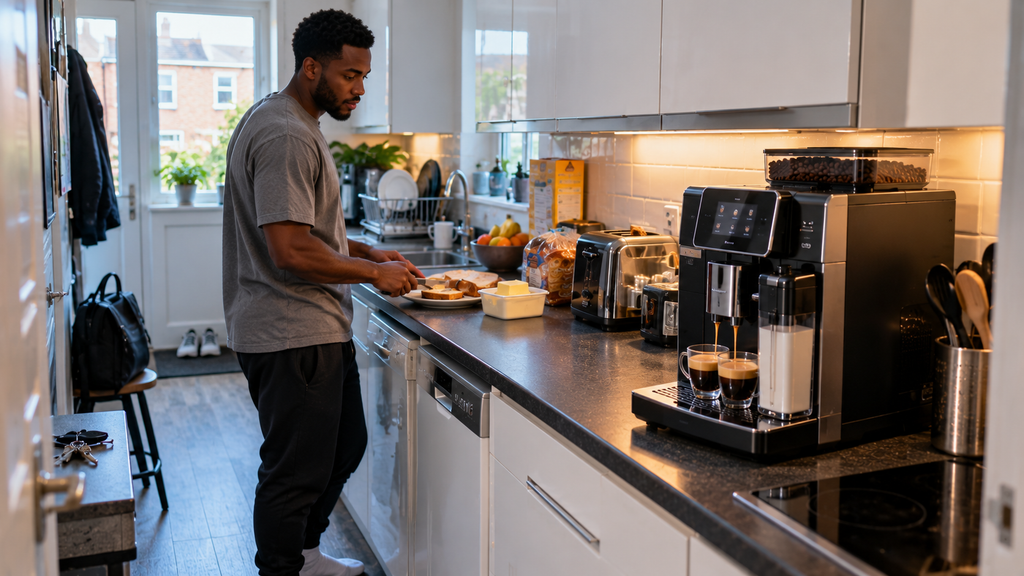
🏆 Final Verdict: Which Bean-to-Cup Coffee Machine Should You Buy?
For most smaller UK homes, the Philips 3300 Series LatteGo is our top pick.
Its narrow design, integrated grinder, automatic milk preparation and relatively straightforward cleaning make it a practical choice for everyday coffee.
If you’re shopping on a tighter budget, the De’Longhi Magnifica Start is the strongest alternative to consider.
If you want more drink options while keeping a narrow countertop footprint, the Philips 5500 Series LatteGo is an appealing premium upgrade.
Ultimately, the best Bean-to-Cup Coffee Machines aren’t necessarily the most expensive or feature-packed models.
Choose the machine that fits your kitchen comfortably, prepares the drinks you genuinely enjoy and makes your daily coffee routine easier.