7 Best Premium Espresso Machines UK for Small Kitchens 2026
Better Coffee, Serious Features, Sensible Counter Space
Choosing Premium Espresso Machines for a small UK kitchen means balancing performance with the space needed to use them properly. A narrow body helps, but so do accessible water tanks, manageable portafilters and clearance for steaming milk. An impressive machine that dominates your only food-preparation area isn’t necessarily a sensible upgrade.
We compared seven Premium Espresso Machines covering compact standalone brewers, traditional barista equipment and grinder-equipped systems. For Premium Espresso Machines, our priority is useful engineering rather than the largest touchscreen or longest drink menu. All seven use a portafilter, keeping this article distinct from our fully automatic bean-to-cup guides.
The Sage Bambino Plus SES500BSS takes our top spot. At just 19.4cm wide, it combines rapid heating with hands-free milk texturing. The other Premium Espresso Machines suit different budgets, techniques and available spaces.
If you prefer coffee preparation without handling a portafilter, our bean-to-cup coffee machines guide compares more automated options for smaller UK kitchens.
⚡ Quick Picks
Sage Bambino Plus SES500BSS — Best Overall (Top Pick)

Sage Barista Express BES875UK — Best Integrated Grinder

Gaggia Classic White RI9481/13 — Best Traditional Barista Control

Ninja Luxe Café Pro ES701UK — Best Automated Milk System

Ninja Luxe Café Premier ES601UK — Best All-in-One Versatility

Fellow Espresso Series 1 — Best for Precision Brewing
Breville Barista Max VCF126 — Best Value Premium Machine

Affiliate disclosure: This article contains Amazon affiliate links. If you click one of these links and make a qualifying purchase, I earn a commission at no extra cost to you. As an Amazon Associate I earn from qualifying purchases.
🏆 OUR TOP PICK — Sage Bambino Plus SES500BSS
The Sage Bambino Plus wins our Premium Espresso Machines comparison because its useful features fit into a genuinely narrow body. Measuring 19.4cm wide and 36.2cm deep, it preserves considerably more sideways worktop space than grinder-equipped alternatives. Three-second ThermoJet heating, PID temperature control, low-pressure pre-infusion and a 54mm portafilter give it genuine brewing capability.
Hands-free milk texturing is the standout convenience. Choose milk temperature and texture, then let the wand steam the jug, or practise manually. This is especially appealing if you make cappuccinos and flat whites every morning.
There is no integrated grinder, so allow space and budget for a separate espresso-capable grinder or use suitable ground coffee. Among Premium Espresso Machines for small homes, the Bambino offers the clearest balance of footprint, espresso features and convenience.
CHECK LATEST PRICE ON AMAZON →
📊 Premium Espresso Machines Comparison Table
| Espresso Machine | Width × Depth | Grinder | Best For | Check Latest Price |
|---|---|---|---|---|
| Sage Bambino Plus SES500BSS | 19.4 × 36.2cm | Separate | Best Overall | CHECK LATEST PRICE ON AMAZON → |
| Sage Barista Express BES875UK | 31.8 × 35.1cm | Built-in | Best Integrated Grinder | CHECK LATEST PRICE ON AMAZON → |
| Gaggia Classic White RI9481/13 | Approx. 23 × 24cm | Separate | Best Traditional Barista Control | CHECK LATEST PRICE ON AMAZON → |
| Ninja Luxe Café Pro ES701UK | 33.7 × 35.5cm | Built-in | Best Automated Milk System | CHECK LATEST PRICE ON AMAZON → |
| Ninja Luxe Café Premier ES601UK | 33.6 × 34.4cm | Built-in | Best All-in-One Versatility | CHECK LATEST PRICE ON AMAZON → |
| Fellow Espresso Series 1 | 31.5 × 43.8cm | Separate | Best for Precision Brewing | CHECK LATEST PRICE ON AMAZON → |
| Breville Barista Max VCF126 | Approx. 31 × 31cm | Built-in | Best Value Premium Machine | CHECK LATEST PRICE ON AMAZON → |
These are body dimensions, not complete working clearances. Portafilter handles, water tanks and steam jugs may require additional room. For Premium Espresso Machines, confirm the exact UK seller variant before ordering.
🥇 Sage Bambino Plus SES500BSS — Best Overall
The Sage Bambino Plus is among the few Premium Espresso Machines that truly respect limited worktop width. At 19.4cm across, it’s much easier to position beside ordinary kitchen essentials than most all-in-one models. Sage specifies three-second ThermoJet heating, PID temperature control and low-pressure pre-infusion followed by nine-bar extraction.
Its 54mm portafilter uses ground coffee, while simple buttons select single or double shots. A removable 1.9-litre water tank avoids constant refilling, provided there is enough space to access it. Automatic milk texturing lets you select foam texture and temperature, but manual steaming remains available for practising latte art.
The main compromise is the missing grinder. Unlike larger Premium Espresso Machines, the Bambino keeps brewing and grinding separate. That works brilliantly when you already own a suitable grinder, but increases equipment costs if you’re starting from scratch.
✅ What We Like
- Exceptionally slim body with fast heating.
- Hands-free or manual milk texturing.
- Proper temperature control and pre-infusion.
- Simple controls and generous water tank.
⚠️ What Could Be Better
- Requires a separate grinder for whole beans.
- Water-tank and portafilter access need clearance.
- Fewer advanced extraction settings than enthusiast models.
👤 Who Is It Best For?
Ideal for people considering Premium Espresso Machines for narrow flats or galley kitchens, especially cappuccino drinkers who value a compact machine over a built-in grinder.
CHECK LATEST PRICE ON AMAZON →
☕ Sage Barista Express BES875UK — Best Integrated Grinder
Among Premium Espresso Machines, the Sage Barista Express puts a grinder and portafilter espresso machine into one body. Measuring 31.8cm wide, 35.1cm deep and 40.4cm high, it’s considerably larger than the Bambino, but removes the need to dedicate a second worktop position to grinding.
Its integrated conical burr grinder has 16 settings, while a pressure gauge gives visual extraction feedback. PID temperature control, pre-infusion, a 54mm portafilter and manual steam wand support traditional espresso preparation. You can adjust the grind, dose and shot rather than relying on a fully automatic brewing cycle.
Among Premium Espresso Machines with grinders, the Barista Express offers an approachable route into hands-on technique. The 40.4cm height deserves attention, however: check space above the bean hopper before placing it underneath wall cabinets. You’ll also have coffee grounds and a steam wand to clean.
✅ What We Like
- Grinder and espresso station share one footprint.
- Pressure gauge and adjustable grind settings.
- Temperature control and manual milk steaming.
- Useful supplied accessories for learning.
⚠️ What Could Be Better
- Taller and wider than standalone brewers.
- Regular grinder and portafilter cleaning.
- Manual preparation has a learning curve.
👤 Who Is It Best For?
A strong choice among Premium Espresso Machines for keen beginners who want fresh-ground coffee, a single combined appliance and room to develop proper barista skills.
CHECK LATEST PRICE ON AMAZON →
🛠️ Gaggia Classic White RI9481/13 — Best Traditional Barista Control
Among Premium Espresso Machines, the Gaggia Classic White approaches espresso with old-school, mechanical simplicity. Metal construction, rocker switches, a professional-style 58mm portafilter and a manual steam wand put the brewing process in your hands. It appeals to enthusiasts who prefer technique over touchscreen recipes.
Around 23cm wide, its compact body is easier to place than some grinder-equipped Premium Espresso Machines. However, the portafilter projects forwards and a separate grinder needs somewhere to live. Allow working space rather than measuring only the machine’s footprint.
Version warning: The RI9481/13 Classic White family includes different boiler revisions. Gaggia sells an E24 version with a brass boiler, but the Amazon ASIN supplied has not been confirmed as E24. Ask the seller to identify the exact version and boiler before purchasing; do not assume all Classic White machines share the same internal construction.
✅ What We Like
- Traditional switches and hands-on operation.
- Compact metal body and professional-style portafilter.
- Manual steam wand for skill development.
- No complicated drinks interface.
⚠️ What Could Be Better
- Requires a separate grinder.
- Boiler revision needs explicit confirmation.
- Less convenient than assisted machines.
👤 Who Is It Best For?
Enthusiasts comparing Premium Espresso Machines for traditional barista control, especially those who already own a grinder and enjoy dialling in their own shots.
CHECK LATEST PRICE ON AMAZON →
🥛 Ninja Luxe Café Pro ES701UK — Best Automated Milk System
The Ninja Luxe Café Pro brings espresso, filter-style coffee and cold-brew-style drinks into one guided station. At 33.7cm wide and 35.5cm deep, it is not particularly narrow. Its advantage for smaller homes is consolidating several coffee-preparation functions.
The Pro combines an integrated grinder, built-in tamper and advanced hands-free Dual Froth system. Barista Assist guidance helps users select settings instead of calculating every step themselves. An XL frothing jug is particularly useful for households making several milk drinks, while the portafilter still offers an espresso-focused workflow.
This is one of the more automated Premium Espresso Machines on our list, yet cleaning remains important: grinder, portafilter, drip tray and milk-contact parts all need attention. It’s also a heavy machine, so placing it permanently is preferable to lifting it out of a cupboard daily.
✅ What We Like
- Advanced automated milk frothing.
- Grinder and integrated tamper included.
- Espresso and additional coffee styles.
- Guided preparation reduces guesswork.
⚠️ What Could Be Better
- Wide, heavy body for compact kitchens.
- Several components need cleaning.
- Higher price for functions not everyone needs.
👤 Who Is It Best For?
Households choosing Premium Espresso Machines mainly for lattes, cappuccinos and convenient drink variety, with enough worktop width for a permanent multi-function station.
CHECK LATEST PRICE ON AMAZON →
🔄 Ninja Luxe Café Premier ES601UK — Best All-in-One Versatility
The Ninja Luxe Café Premier is one of the Premium Espresso Machines that also makes filter-style coffee and cold-brew-style drinks, but at a less advanced feature level than the Pro. Its integrated grinder and assisted tamper reduce separate equipment, while Barista Assist guidance simplifies selecting grind settings and preparing shots.
The machine is approximately 33.6cm wide and 34.4cm deep. Its hands-free Dual Froth system makes milk drinks easier without needing manual steam-wand practice. This versatility is useful if one person wants espresso and another prefers a longer cup of coffee.
Premier and Pro aren’t merely colour variants. Premier has assisted tamping, whereas Pro offers integrated tamping and a more advanced milk arrangement. The Premier can be the more practical of these Premium Espresso Machines if you value multiple drink styles but don’t need every upgraded feature. Its width remains a significant trade-off in a narrow kitchen.
✅ What We Like
- Several coffee styles from one appliance.
- Integrated grinder and assisted tamping.
- Hands-free milk frothing.
- Guided settings for approachable operation.
⚠️ What Could Be Better
- Broad footprint and considerable weight.
- More cleaning than a simple espresso brewer.
- Pro adds automation some buyers may want.
👤 Who Is It Best For?
For households weighing up Premium Espresso Machines where drink variety matters and one versatile device is preferable to a collection of separate coffee makers.
CHECK LATEST PRICE ON AMAZON →
🎛️ Fellow Espresso Series 1 — Best for Precision Brewing
Among Premium Espresso Machines, the Fellow Espresso Series 1 is the specialist choice for people who want to shape extraction in detail. It offers guided recipes, precise temperature management and adjustable pressure and flow throughout a shot, including pre-infusion. Shot feedback can also suggest adjustments for future brewing.
A temperature-sensing steam wand supports assisted milk preparation, making the machine less intimidating than its advanced settings might suggest. You can follow presets initially and explore custom profiles later. There is no built-in grinder.
Size is the critical caveat. Fellow specifies a body 31.5cm wide and 43.8cm deep, extending to approximately 54.6cm with a portafilter in place. Removing the water tank may require generous overhead clearance. Among Premium Espresso Machines, this is therefore an enthusiast choice rather than a tiny-kitchen convenience purchase.
Confirm that the supplied Amazon variant has UK-compatible voltage, plug, warranty and service arrangements before ordering. Imported specifications should never be assumed.
✅ What We Like
- Programmable pressure and flow profiles.
- Helpful shot feedback and guided recipes.
- Temperature-sensing assisted steaming.
- Serious scope for experimenting with coffee.
⚠️ What Could Be Better
- Deep body and substantial handle clearance.
- Separate espresso-capable grinder required.
- UK seller specification needs confirmation.
👤 Who Is It Best For?
Experienced buyers considering Premium Espresso Machines for greater extraction control, provided their counter is deep enough and UK product support is clear.
CHECK LATEST PRICE ON AMAZON →
💷 Breville Barista Max VCF126 — Best Value Premium Machine
Of the Premium Espresso Machines selected, the Breville Barista Max offers a substantial set of barista features without demanding an additional grinder. Its integrated conical burr grinder has 30 settings, while Temp IQ Shot Control, pre-infusion and manual shot options help users practise brewing repeatable espresso.
The 2.8-litre water tank reduces frequent refilling, and a traditional steam wand handles cappuccinos and flat whites. Available product dimensions put it at approximately 31cm wide and deep, but around 41cm tall. Measure cabinet clearance carefully, particularly when accessing the bean hopper.
It lacks some of the advanced controls and automatic milk features offered by other Premium Espresso Machines, which explains its seventh-place ranking. Nevertheless, it is an attractive starting point for anyone who wants grinding, brewing and steaming in one relatively accessible package. Factor in regular grinder maintenance and safe space for the hot portafilter.
✅ What We Like
- Integrated grinder with 30 settings.
- Temp IQ temperature control and pre-infusion.
- Generous water tank.
- Manual milk and shot controls.
⚠️ What Could Be Better
- Tall for some overhead cupboards.
- Requires regular grinder cleaning.
- No advanced automated milk system.
👤 Who Is It Best For?
Budget-aware buyers comparing Premium Espresso Machines who want an all-in-one barista station without paying for the most elaborate automation.
CHECK LATEST PRICE ON AMAZON →
🧠 How We Chose These Machines
We evaluated Premium Espresso Machines using manufacturer specifications, UK model information and the practical constraints of smaller kitchens. Width, depth, water access, separate-grinder requirements, milk systems, brewing control and cleaning all contributed to our rankings.
All seven use a portafilter at some point during espresso preparation, distinguishing this guide from our fully automatic bean-to-cup articles. We have not claimed hands-on laboratory testing. Premium Espresso Machines should be judged by useful performance and fit, not simply their advertised pressure or premium appearance.
🔎 Top Things to Search on Amazon
When shopping for Premium Espresso Machines on Amazon UK, try these focused searches:
- Compact premium espresso machine steam wand — for narrow standalone brewers.
- Espresso machine integrated grinder UK — for a combined coffee station.
- Espresso machine automatic milk frothing — for cappuccino convenience.
- Manual espresso machine 58mm portafilter — for traditional technique.
- Espresso machine pressure profiling — for extraction experimentation.
- Premium espresso machine small kitchen dimensions — for footprint comparisons.
Check each model’s dimensions, variant, supplied accessories, plug, voltage, warranty and seller before purchasing. The best Premium Espresso Machines make daily coffee preparation more enjoyable without making an already small kitchen harder to use.
📏 Measure the Whole Coffee Station, Not Just the Machine
Buying Premium Espresso Machines for a small kitchen starts with three measurements: usable worktop width, depth and the clearance beneath wall cupboards. A machine can look wonderfully compact in a photograph yet become awkward when you turn its portafilter, lift out the water tank or add beans to a hopper.
Our narrowest choice, the Sage Bambino Plus, measures 19.4cm across. The Gaggia Classic White is also comparatively slim, but both require room for a separate grinder if you want to use fresh beans. The Ninja models, Sage Barista Express and Breville Barista Max put grinding and brewing into one larger body.
Pay particular attention to depth. The Fellow Espresso Series 1 has a body depth of approximately 43.8cm, and its portafilter needs extra space in front. Do not treat that as a suitable option for a shallow counter merely because it looks neat.
Before ordering Premium Espresso Machines, mark the proposed footprint on the worktop with masking tape. Try standing where you would prepare a drink. Check access to your sink, cupboard doors, sockets and the area where you normally chop food.
The same space-saving approach applies to larger appliances, and our guide to slimline fridges for small kitchens compares narrower refrigeration options for compact UK homes.
Small-kitchen tip: Manufacturer dimensions describe the machine itself; leave the operational clearance specified in its manual.
🫘 Built-In Grinder or Separate Grinder?
The grinder decision is often more important than a touchscreen. Premium Espresso Machines with an integrated burr grinder offer one obvious advantage: your coffee preparation equipment shares a single permanent location. That is a strong argument for the Sage Barista Express, Ninja Luxe Café models and Breville Barista Max.
An integrated setup reduces the number of appliances on display, but it does not eliminate the need to clean ground coffee from the counter. Premium Espresso Machines cannot compensate for an inconsistent grinder or rushed preparation. You still remove the portafilter, knock out used grounds and maintain the grinder.
Standalone Premium Espresso Machines such as the Bambino Plus, Gaggia Classic and Fellow Series 1 give you flexibility to choose or upgrade your own grinder. This can be a benefit for enthusiasts, especially when changing beans or refining espresso technique. It can also mean a higher total price and more worktop space than expected.
For good espresso, choose a grinder capable of fine, consistent adjustments. A basic blade grinder is not an equivalent substitute. If you are starting with suitable pre-ground coffee, check whether your machine includes pressurised baskets and follow its preparation guidance.
For ideas on keeping coffee beans, tampers, cleaning tools and spare accessories organised, our guide to storage solutions for studio flats explores practical ways to reduce everyday clutter in smaller homes.
Our advice: Assess the entire grinder-and-machine arrangement, not the machine’s advertised width in isolation.
⚙️ What Does Paying a Premium Actually Get You?
More expensive does not always mean more useful. With Premium Espresso Machines, the worthwhile upgrades tend to be better control over brewing temperature, more consistent preparation, stronger build quality and features that solve a genuine inconvenience.
The Bambino Plus prioritises fast heat-up and assisted milk texturing without a bulky grinder. The Barista Express combines grinding and hands-on preparation. The Gaggia focuses on traditional manual operation. The Ninja Pro and Premier guide more of the process, while the Fellow targets users who want detailed control over extraction.
When comparing Premium Espresso Machines, think about which part of your daily routine you would like to improve. If making milk consistently is difficult, assisted frothing could matter more than advanced pressure profiling. If you enjoy dialling in different coffees, manual control and grinder quality may be more rewarding.
Premium Espresso Machines should make your preferred coffee easier or more satisfying, rather than giving you settings you never touch. Avoid paying for extra drink modes simply because they look impressive on a specification sheet.
🎯 Pressure, Temperature and Pre-Infusion Explained
Espresso relies on hot water passing through a prepared bed of coffee under pressure. It is tempting to compare Premium Espresso Machines by the biggest pump-pressure number, but a 15-bar or 20-bar rating tells you little about the quality of the finished drink.
Many traditional espresso recipes use roughly nine bars during extraction as a reference. What matters in practice is how consistently the machine maintains its brewing conditions and how well the coffee has been ground, dosed and distributed.
Temperature stability also matters. Some Premium Espresso Machines use electronic control to manage brew temperature; others emphasise a more traditional approach. Pre-infusion briefly wets the coffee before fuller extraction and can support more even brewing, though it does not rescue an unsuitable grind.
The Sage machines provide approachable controls, while the Fellow allows much deeper exploration of pressure and flow. Premium Espresso Machines still depend on good coffee preparation, whatever their technology. Neither approach guarantees a delicious shot without good beans and practice. Start with the maker’s recommended settings, taste the result and change one variable at a time.
☕ Learn the Basics of a Good Espresso Shot
Even the most advanced Premium Espresso Machines benefit from a repeatable routine. When preparing coffee with Premium Espresso Machines, start with fresh coffee suitable for espresso, a clean basket and an appropriate dose. Distribute the grounds evenly and tamp according to your equipment’s instructions.
Lock the portafilter into the group head securely, position the cup and start extraction. Watch the shot and taste it rather than assuming the colour of the crema proves quality. If a coffee tastes unpleasantly sharp or thin, your recipe may need adjusting. If it tastes harsh and overly bitter, different grind or extraction settings might help.
A common starting point for a double espresso is around 18g of ground coffee producing approximately 36g of liquid coffee. Treat that as an example, not a universal rule: baskets, roasts and individual preferences vary.
For grinder-equipped Premium Espresso Machines, note which grind setting and dose worked with a particular coffee. On a machine without a grinder, remember that changing pre-ground coffee may change the result.
🥛 Manual Steam Wand or Automatic Milk Texturing?
If you usually drink cappuccinos and flat whites, milk preparation deserves equal attention. Premium Espresso Machines with traditional steam wands let you control how air and heat are introduced, but you will need to practise. The Gaggia Classic, Sage Barista Express and Breville Barista Max favour that more hands-on approach.
The Sage Bambino Plus offers automatic texturing as well as manual control. Both Ninja Luxe Café models provide assisted milk preparation, with the Pro designed to offer more advanced automation than the Premier. The Fellow combines enthusiast-oriented brewing with assisted steaming features.
Ninja’s official Luxe Café comparison explains the differences between the Premier and Pro, including their milk-frothing presets, tamping systems and drink settings.
When comparing Premium Espresso Machines with different milk systems, think about who uses the machine. One keen coffee hobbyist may enjoy learning milk technique, while a household with different confidence levels might appreciate automated settings.
Keep the steam wand clear of loose items, use an appropriately sized jug and follow the manual when cleaning. Steam and metal components become hot. In a compact kitchen, Premium Espresso Machines with automated steaming are convenient only if there is still space to position and remove the jug safely.
If you regularly prepare milk-based coffees, our guide to under-counter fridges for small kitchens explores practical refrigeration options for keeping fresh milk accessible without taking up additional worktop space.
🚰 Tanks, Hoppers and Overhead Cupboard Clearance
A generous water tank sounds useful, but the way it is accessed matters more in a small room. With Premium Espresso Machines placed under wall cabinets, you may need to pull a rear tank upwards or slide the entire appliance forward to refill it.
Integrated grinders present a similar problem. Check how the bean hopper opens and whether you can reach it without lifting the machine off the counter. With Premium Espresso Machines that have built-in grinders, this is a regular part of ownership. The Barista Express and Barista Max are relatively tall, so measure the underside of cupboards before deciding where either will live.
Also check whether a drip tray comes out forwards and whether the machine needs side or rear ventilation space. Follow the manufacturer’s minimum clearances rather than relying on what a styled product photograph shows.
For Premium Espresso Machines, a workable permanent position is usually better than storing a heavy appliance in a cupboard and moving it each morning.
🧼 Cleaning, Descaling and Grinder Maintenance
The appeal of Premium Espresso Machines can fade if daily cleaning becomes a chore. Every portafilter machine produces used coffee grounds and drips. Milk-based drinks add a steam wand and jug, while machines with integrated grinders have additional coffee pathways to maintain.
After brewing, empty the basket and clean the portafilter according to the manual. Wipe the brewing area and empty the drip tray when necessary. After steaming, follow the maker’s instructions for safely wiping and purging the wand. Do not put components in a dishwasher unless the documentation explicitly permits it.
In hard-water areas of the UK, limescale can build up more quickly. Premium Espresso Machines may provide reminders, filters or guided descaling cycles, but the correct product and frequency depend on the model and water conditions. Avoid improvising with household vinegar unless specifically approved.
Keep a small cloth, cleaning brush and suitable descaler in a nearby cupboard. That makes maintenance easier without turning your coffee station into another cluttered shelf.
For households struggling with limited washing-up space, our guide to integrated dishwashers for small kitchens compares appliances that can help manage everyday kitchenware while maintaining a tidy fitted layout.
🔇 Noise, Heat and Electrical Practicalities
Premium Espresso Machines are not silent. Pumps run, grinders operate, milk steaming creates noise and portafilters knock against work surfaces. In a studio flat, the grinder may be the most disruptive part of an early morning routine.
A stable, level countertop helps prevent vibration and movement. Do not squeeze the machine against items that could overheat or interfere with ventilation. Keep the power lead away from the sink and avoid trailing cables across walkways.
Check that your exact Amazon listing is intended for UK mains power, with an appropriate plug and manufacturer-supported warranty. This matters particularly for specialist machines such as the Fellow Series 1, where imported versions may differ. Never assume a listing photograph confirms electrical compatibility.
If children share the kitchen, leave the steam wand, hot portafilter and cup-placement area safely away from their reach. More advanced Premium Espresso Machines do not remove ordinary hot-water and steam hazards.
If your espresso machine must share limited counter space with cooking equipment, our air fryer vs microwave comparison for small flats can help you decide which appliances deserve a permanent place in your kitchen.
💷 Total Costs: Coffee, Grinders and Consumables
Think beyond the price on Amazon. Premium Espresso Machines may require a separate grinder, tamper, scales, milk jug, cleaning supplies or water filters. Some accessories are included, but don’t assume all seven boxes contain the same equipment.
As a simple illustration, a 1kg bag of beans costing £25 works out to 45p for an 18g dose, before milk, energy and any wasted coffee during setup. Actual costs change with coffee prices and dose sizes. Practising extraction can use more beans than expected.
A built-in grinder may save you a separate purchase, although it is worth considering how straightforward repairs and servicing will be. With Premium Espresso Machines, dependable UK support can be particularly valuable over several years. A standalone machine plus independent grinder can offer more flexibility if one component eventually needs replacing.
When assessing Premium Espresso Machines, compare the realistic cost of the complete working coffee station rather than just the promoted machine price.
⚠️ Common Buying Mistakes to Avoid
Buying by Body Width Alone
Check depth, portafilter clearance, tank access and space for a grinder. The narrowest Premium Espresso Machines are not necessarily the smallest complete setups.
Assuming Premium Means Fully Automatic
These seven machines use a portafilter. Some assist with grinding, tamping or frothing, but they aren’t interchangeable with one-touch bean-to-cup machines.
Forgetting the Gaggia Version
The supplied Gaggia Classic White RI9481/13 listing needs its exact boiler revision confirmed. Do not assume it is the E24 brass-boiler version.
Overlooking UK Compatibility
For specialist or imported Premium Espresso Machines, confirm plug, voltage, seller warranty and service support before checkout.
Buying More Features Than You Need
Pressure profiling, multiple drink styles and automated milk modes are only valuable if they suit how you actually drink coffee.
Ignoring Cleaning
Allow time for used grounds, steam-wand care, grinder cleaning and descaling. A machine you enjoy maintaining is more likely to stay in use.
Before spending more on kitchen equipment, explore our compact kitchen appliance deals guide for other practical space-saving appliances and buying considerations.
❓ Frequently Asked Questions
Which Premium Espresso Machine Is Best for a Small Kitchen?
Our best overall pick is the Sage Bambino Plus SES500BSS. It is relatively narrow, heats quickly and offers both assisted and manual milk texturing. Remember that fresh-bean grinding requires a separate appliance.
Is a Built-In Grinder Better for a Small Kitchen?
Not necessarily. Grinder-equipped Premium Espresso Machines reduce the number of separate appliances, but they are wider. A compact standalone brewer and small grinder may fit some layouts better.
Are Ninja Luxe Café Machines Proper Espresso Machines?
Yes. The Pro and Premier use a portafilter for espresso preparation, while also offering other coffee styles and guidance. They are not the same as fully automatic bean-to-cup machines.
Should I Choose the Ninja Pro or Premier?
Choose based on the features you will use. The Pro offers more advanced tamping and milk automation, while the Premier provides broad drink versatility with assisted preparation. Both require substantial counter width.
Do I Need a Grinder for the Bambino Plus or Gaggia?
For whole beans, yes. Both need a separate grinder capable of grinding finely enough for espresso. Suitable pre-ground coffee may work with the appropriate basket, but check the machine’s instructions.
Is the Gaggia Classic White Definitely the E24 Model?
Not from the supplied Amazon ASIN alone. Confirm the exact revision and boiler material with the seller before ordering.
Does Expensive Equipment Guarantee Better Espresso?
No. Even Premium Espresso Machines depend on appropriate beans, dose, grind, extraction and cleaning. More expensive controls can be useful, but preparation remains important.
Can I Make Cappuccinos and Flat Whites?
Yes. All seven shortlisted machines can prepare espresso and steam or texture milk. The method ranges from manual steam wands to assisted systems.
Are These Machines Suitable for UK Kitchens?
They were shortlisted from Amazon UK listings, but individual variants can differ. Always check dimensions, electrical specification, included accessories, seller and warranty before purchasing.
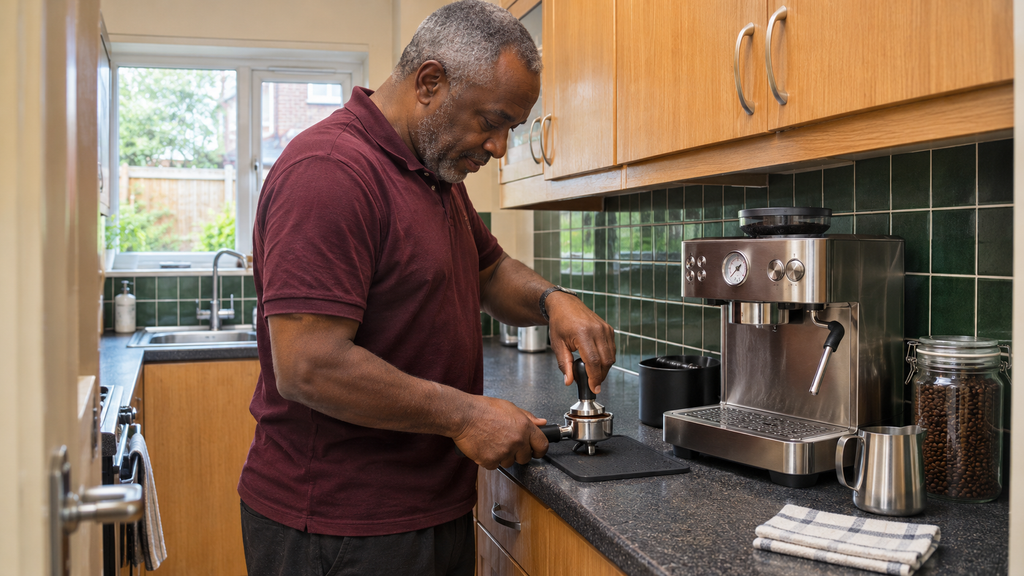
🏆 Final Verdict: Which Premium Espresso Machine Should You Buy?
For most people comparing Premium Espresso Machines for a small UK kitchen, the Sage Bambino Plus SES500BSS is our top pick. Its narrow footprint and assisted milk texturing make it particularly practical, provided you have space for a grinder or plan to use suitable ground coffee.
The Sage Barista Express BES875UK is the better choice if you want grinding built into the machine. Choose the Gaggia Classic White RI9481/13 for traditional hands-on brewing, but confirm the exact boiler version first.
For convenient milk drinks and multiple coffee styles, consider the Ninja Luxe Café Pro ES701UK or Premier ES601UK, remembering that both need more worktop width. The Fellow Espresso Series 1 serves enthusiasts who value pressure and flow control and can accommodate its depth. The Breville Barista Max VCF126 offers a grinder-equipped option for budget-aware buyers.
The right Premium Espresso Machines don’t simply offer more features: they fit your kitchen, your routine and the coffee you actually enjoy making.