Why Does My Fridge Freezer Keep Icing Up?
Why Does My Fridge Freezer Keep Icing Up and How Can You Stop It?
If you are asking Why Does My Fridge Freezer Keep Icing Up, the most likely causes are a damaged door seal, blocked air vents, warm air entering the appliance, an incorrect temperature setting or a fault within the automatic defrost system.
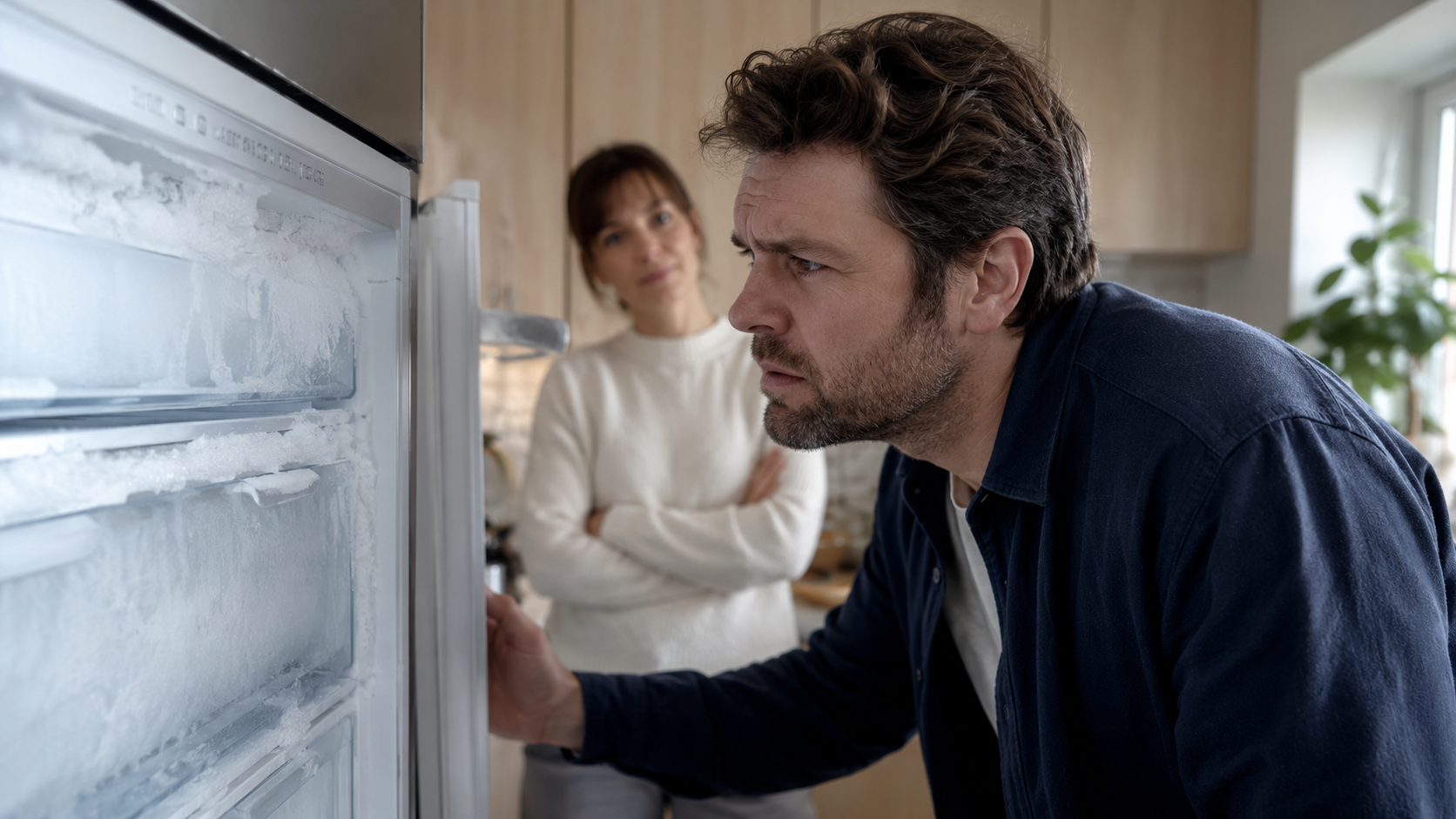
A small amount of frost is normal in some freezer compartments, particularly after the door has been opened several times. Thick sheets of ice, frozen drawers and repeated frost around the rear panel are not normal.
Persistent ice build-up reduces storage space, restricts airflow and can make the appliance work harder than necessary. It may also cause food to freeze unevenly or the fridge section to become warmer.
⚡ Quick Answer
Why Does My Fridge Freezer Keep Icing Up? First, check that both doors close properly, inspect the rubber seals and move food away from the internal vents. Keep the freezer at approximately -18°C and defrost any heavy ice safely. If the frost returns quickly, the fan, sensor, heater or automatic defrost system may need professional inspection.
❄️ Is Some Frost Inside a Fridge Freezer Normal?
A thin layer of frost can be normal, particularly in a manual-defrost freezer.
Moisture enters whenever the door opens. When warm air reaches the cold interior, that moisture freezes onto shelves, walls and food packaging.
For many households, Why Does My Fridge Freezer Keep Icing Up becomes a concern when light frost develops into thick ice that restricts drawers and storage space.
The frost should remain light and manageable.
Warning signs of a genuine problem include:
- Thick ice across the rear panel
- Drawers becoming difficult to open
- Frost surrounding the air vents
- Ice forming around the door
- Food packaging freezing together
- Frost returning soon after defrosting
- The fridge compartment becoming too warm
If you repeatedly remove large amounts of ice, Why Does My Fridge Freezer Keep Icing Up needs more investigation than a routine defrost.
🚪 Is the Freezer Door Closing Properly?
A door left slightly open is one of the most common causes of repeated frost.
Even a narrow gap allows warm, humid air to enter continuously. The moisture freezes as soon as it reaches the cold interior.
When checking Why Does My Fridge Freezer Keep Icing Up, make sure no packaging or misaligned drawer is preventing the door from sealing completely.
Check whether:
- A drawer is not fully pushed in
- Packaging is caught near the door
- A food bag is resting against the seal
- Ice is preventing the door from closing
- The appliance is overloaded
- The door has dropped out of alignment
Close the freezer gently and look around the edge for visible gaps.
Some doors should pull themselves closed when released from a small angle. If yours remains open, the appliance may not be level or the hinges may need attention.
When Why Does My Fridge Freezer Keep Icing Up begins after a large food shop, an obstruction around the door is often responsible.
🧽 Could the Door Seal Be Damaged?
The rubber seal, also called the gasket, keeps warm air outside the freezer.
A damaged, dirty or warped seal can allow moisture to enter even when the door appears closed.
Inspect the entire seal for:
- Cracks
- Splits
- Loose corners
- Hardened rubber
- Warped sections
- Food residue
- Sticky spills
- Gaps between the seal and cabinet
Clean it with warm water and a soft cloth.
Avoid harsh chemicals that may damage the rubber.
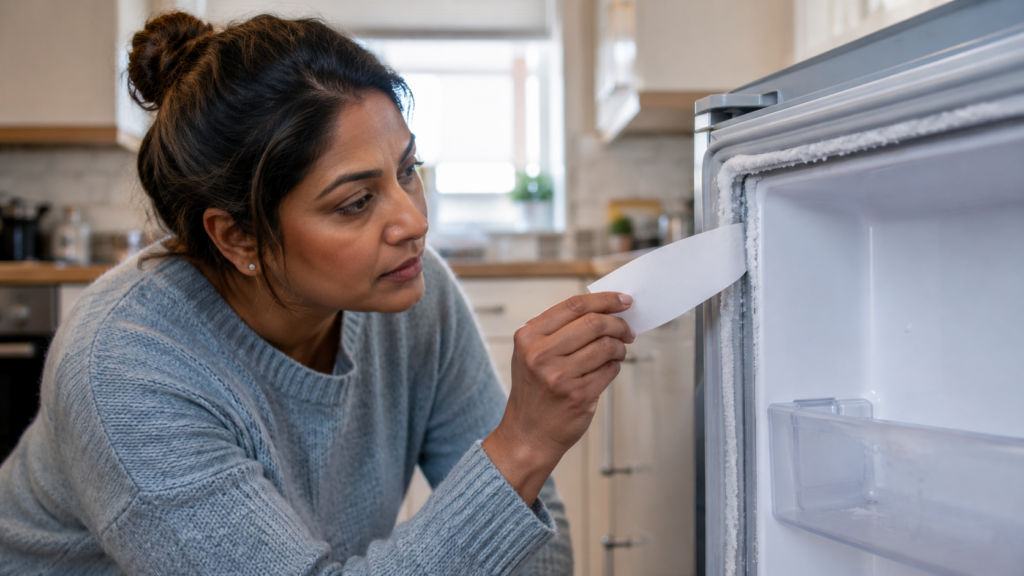
You can also perform a paper test:
- Place a sheet of paper between the seal and the cabinet.
- Close the door.
- Pull the paper gently.
- Repeat the test around the full door edge.
The paper should meet noticeable resistance.
If it slides out easily in one area, the seal may not be gripping properly. A weak gasket is a common answer to Why Does My Fridge Freezer Keep Icing Up, especially when frost forms mainly around the door.
🌡️ Is the Temperature Set Too Cold?
The freezer should normally operate at around -18°C.
Setting it much colder does not necessarily preserve food better. It may increase energy use and contribute to heavier frost in appliances already suffering from moisture or airflow problems.
For the safest everyday settings, read What Temperature Should A Fridge Freezer Be UK before making further thermostat adjustments.
Check the actual temperature with a freezer-safe thermometer.
Do not rely entirely on a numbered dial. On many models, a higher number means stronger cooling rather than a specific temperature.
Make one small adjustment at a time and allow several hours for the appliance to stabilise.
If the controls have accidentally been changed to a fast-freeze or maximum-cooling mode, switch back to the normal setting once newly added food has frozen.
An excessively cold setting may not fully explain Why Does My Fridge Freezer Keep Icing Up, but it can make an existing frost problem worse.
🌬️ Are the Internal Air Vents Blocked?
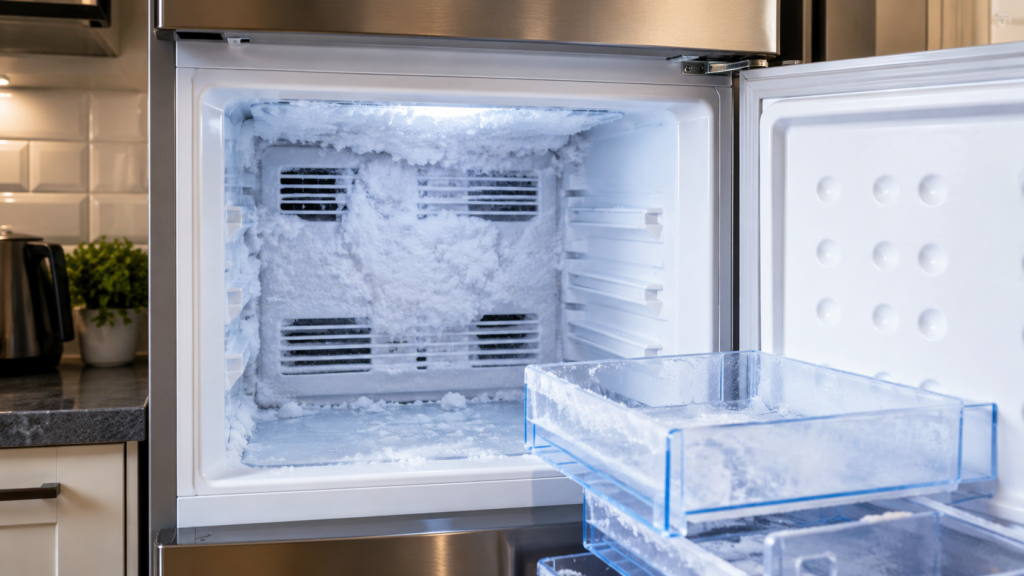
Frost-free fridge freezers use fans and vents to circulate cold air.
If food or ice blocks these vents, airflow becomes uneven. Moisture may freeze around the outlet while other areas receive insufficient cooling.
In frost-free appliances, Why Does My Fridge Freezer Keep Icing Up may be explained by blocked vents trapping cold air and moisture around the rear panel.
Look for vents:
- On the rear panel
- Near the top of the freezer
- Between freezer drawers
- At the back of the fridge compartment
Move bags, boxes and containers away from them.
Leave a small gap between stored food and the internal walls. Avoid packing soft freezer bags tightly against the rear panel.
Blocked vents can cause:
- Thick ice around the rear wall
- Noisy fan operation
- Uneven temperatures
- Frozen drawers
- A warmer fridge section
- Longer compressor cycles
For many modern appliances, Why Does My Fridge Freezer Keep Icing Up is closely linked to restricted airflow.
📦 Is the Freezer Overfilled?
A well-stocked freezer usually operates efficiently, but overfilling it can block airflow and prevent drawers from closing correctly.
In a tightly packed freezer, Why Does My Fridge Freezer Keep Icing Up may be answered by poor airflow and a door that cannot close as firmly as it should.
Food should not be packed so tightly that:
- Air cannot move between items
- Bags press against the rear vents
- Drawers cannot slide fully shut
- Packaging touches the door
- The seal cannot sit flat
Reorganise the freezer and remove expired or unnecessary food.
Use stackable containers where practical, but avoid filling every available gap.
Check that each drawer moves freely before closing the door.
If Why Does My Fridge Freezer Keep Icing Up became noticeable after adding a large amount of food, overcrowding may be part of the problem.
🥘 Are Warm Foods Being Placed Inside?
Warm food releases steam.
When that steam enters a freezing compartment, it turns into frost and ice.
Allow cooked food to cool until it is no longer steaming before placing it inside. Transfer it into sealed freezer-safe containers rather than freezing an uncovered pan.
Our guide Can You Put Hot Food In A Fridge Freezer explains how to cool and store cooked food without introducing unnecessary moisture.
Avoid leaving food at room temperature for longer than necessary.
Several warm containers added at once can create a noticeable temporary frost layer, particularly in a small freezer.
If the ice appears after batch cooking, Why Does My Fridge Freezer Keep Icing Up may be explained by repeated moisture entering with warm food.
🔄 Is the Door Being Opened Too Often?
Every door opening allows warm air into the freezer.
Frequent openings may be unavoidable in a busy household, but leaving the door open while searching for food can create far more frost than brief access.
Try to:
- Decide what you need before opening the door
- Label containers clearly
- Keep frequently used items near the front
- Organise food by category
- Avoid holding the door open during meal preparation
Children may also leave the freezer slightly open without noticing.
If frost is worse during busy periods, holidays or family gatherings, frequent door use may explain Why Does My Fridge Freezer Keep Icing Up.
🧊 Has Ice Formed Around the Fan?
The internal fan circulates cold air through a frost-free appliance.
If ice builds around the fan blades or housing, you may hear:
- Scraping
- Clicking
- Buzzing
- Rattling
- A fan repeatedly starting and stopping
The freezer may remain cold while the fridge section becomes warmer because air is no longer moving correctly between compartments.
Do not remove internal panels unless you are qualified to work on the appliance.
A complete defrost may temporarily free an iced fan, but the underlying cause still needs attention if the problem returns.
When unusual fan noise accompanies Why Does My Fridge Freezer Keep Icing Up, a defrost-system fault becomes more likely.
⚙️ Could the Automatic Defrost System Be Faulty?
A frost-free fridge freezer periodically warms the evaporator coils to melt developing ice.
The resulting water flows through a drain and into a tray near the compressor, where it normally evaporates.
If ice repeatedly returns after a full defrost, Why Does My Fridge Freezer Keep Icing Up is more likely to involve a faulty heater, sensor or control component.
The automatic defrost system may include:
- A defrost heater
- A temperature sensor
- A thermal fuse
- A timer
- An electronic control board
- A drainage channel
If one component fails, frost continues building behind the rear panel.
Eventually, the ice may block the vents and fan.
Possible signs include:
- Thick frost across the rear freezer panel
- Ice returning shortly after a full defrost
- Reduced airflow
- A noisy or obstructed fan
- The freezer staying cold while the fridge warms
- Water appearing after ice melts
A failed defrost component is one of the more serious answers to Why Does My Fridge Freezer Keep Icing Up and usually requires professional testing.
💧 Could a Blocked Drain Be Contributing?
Water created during the defrost cycle should leave through a drainage channel.
If the drain becomes blocked by food particles, dirt or ice, water may remain inside and refreeze.
When ice collects beneath the bottom drawer, Why Does My Fridge Freezer Keep Icing Up may be linked to defrost water freezing inside a blocked drainage channel.
You may notice:
- Ice beneath the bottom drawer
- A frozen sheet across the freezer floor
- Water leaking from the appliance
- Ice around the drainage opening
- Frost returning after cleaning
If ice is accompanied by water beneath the drawers, Why Is My Fridge Freezer Leaking Water covers the most common drainage faults and checks.
A blocked drain is particularly likely when the heaviest ice appears at the bottom rather than around the upper vents.
Defrosting the appliance fully may clear an ice blockage.
Do not force sharp objects into the drain, as this can damage the tube.
If Why Does My Fridge Freezer Keep Icing Up is accompanied by water beneath the drawers, inspect the drainage system carefully.
📏 Is the Appliance Level?
An uneven fridge freezer may prevent the doors from closing correctly.
It can also affect how defrost water travels towards the drainage outlet.
Use a spirit level to check the appliance from:
- Left to right
- Front to back
Depending on the manufacturer, the appliance may need to sit level or tilt very slightly backwards.
Adjust the front feet carefully and confirm that the doors close naturally.
Uneven flooring is common in older homes and compact kitchens, especially after an appliance has been moved.
A poorly positioned appliance is an overlooked cause of Why Does My Fridge Freezer Keep Icing Up.
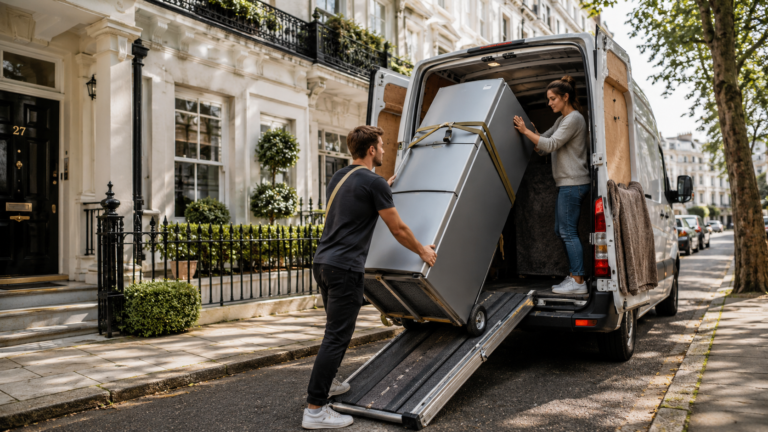
🚚 Did the Problem Start After Moving the Fridge Freezer?
Moving the appliance can disturb its position, door alignment and internal drainage.
After relocation, check:
- Whether the appliance is level
- Whether the doors close evenly
- Whether drawers are correctly fitted
- Whether packaging has shifted
- Whether the seal has twisted
- Whether the rear ventilation space is adequate
Allow the appliance to stabilise after transport before repeatedly changing the temperature controls.
If the appliance was recently transported, read How Long Should You Leave A Fridge Freezer Before Plugging It In before restarting it.
If it was transported on its side, it should be left upright before switching it on.
When Why Does My Fridge Freezer Keep Icing Up starts immediately after moving house or rearranging the kitchen, installation should be checked before assuming there is a failed component.
🧼 Should You Defrost the Fridge Freezer?
A full manual defrost is often the best first step when ice has become excessive.
Before starting:
- Remove all food.
- Switch off the appliance.
- Unplug it safely.
- Place towels around the base.
- Leave both doors open.
- Allow all ice to melt naturally.
- Dry the interior completely.
Do not use knives, screwdrivers or other sharp tools to remove ice.
Avoid pouring boiling water onto the interior and do not use a hairdryer near water.
If you need to leave the appliance off during a full defrost, Can You Switch Off A Fridge Freezer Without Damaging It explains the safest method.
Once fully defrosted, restart the appliance and allow it to reach the correct temperature before restocking it.
If Why Does My Fridge Freezer Keep Icing Up returns within days or weeks, the defrost system, sensor or seal may need repair.
🛠️ When Should You Call an Engineer?
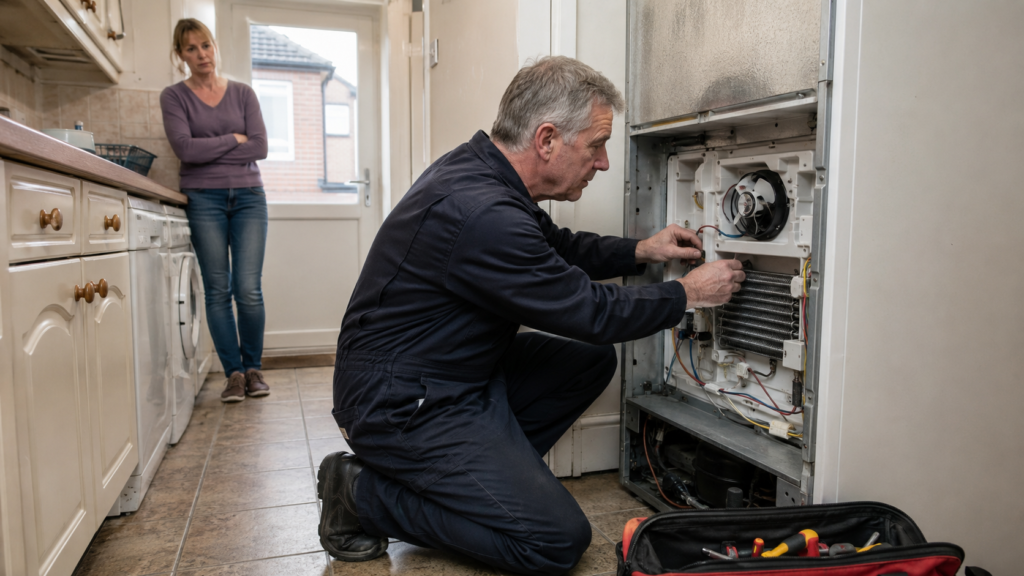
Professional help is sensible when the ice returns quickly after a complete defrost.
You should arrange an inspection if:
- Frost covers the rear panel again within days
- The internal fan makes scraping noises
- The fridge section is becoming too warm
- The freezer temperature is unstable
- The door seal is damaged
- Water repeatedly freezes beneath the drawers
- The appliance runs almost constantly
- The controls do not respond normally
An engineer can test the defrost heater, sensor, thermal fuse, fan and control board.
These parts should not be replaced through guesswork. Testing the system properly is the safest way to identify Why Does My Fridge Freezer Keep Icing Up when the usual checks have not worked.
If icing is accompanied by poor cooling elsewhere, Why Is My Fridge Freezer Not Cold Enough covers the most likely airflow and component faults.
💷 Is an Icing Fridge Freezer Worth Repairing?
Many icing faults are repairable.
A replacement seal, sensor, fan or defrost heater may cost far less than buying a new appliance.
Repair is usually worth considering when:
- The appliance is otherwise reliable
- The fault has appeared recently
- The compressor is working normally
- The cabinet and doors are in good condition
- The repair quote is reasonable
Replacement may make more sense if the fridge freezer is old, inefficient and already has several problems.
Before deciding, compare:
- The repair cost
- The age of the appliance
- Its energy efficiency
- The price of a suitable replacement
- Whether previous faults have occurred
Do not assume Why Does My Fridge Freezer Keep Icing Up automatically means the appliance has reached the end of its life.
If replacement becomes more practical, our guide to the Best Fridge Freezers For Small Kitchens UK highlights suitable options for compact homes.
✅ Quick Troubleshooting Checklist
Work through these checks in order:
✅ Confirm the freezer is set to around -18°C.
✅ Check that both doors close fully.
✅ Remove packaging blocking the drawers.
✅ Clean and inspect the door seals.
✅ Perform the paper test around the gasket.
✅ Move food away from internal vents.
✅ Reduce overcrowding.
✅ Avoid placing steaming food inside.
✅ Listen for scraping or clicking from the fan.
✅ Look for ice beneath the bottom drawer.
✅ Check that the appliance is level.
✅ Defrost all heavy ice safely.
✅ Monitor how quickly the frost returns.
✅ Call an engineer if the problem continues.
Following this order gives you the clearest way to investigate Why Does My Fridge Freezer Keep Icing Up without replacing parts unnecessarily.
🏆 Final Verdict
So, Why Does My Fridge Freezer Keep Icing Up?
The most common reasons are warm air entering through a poorly closed door, a damaged seal, blocked vents, overcrowding or frequent door opening.
Start by checking the door, seal and temperature setting. Move food away from the rear panel and make sure the freezer is not packed so tightly that airflow is restricted.
A complete defrost may restore normal operation if ice has built up around the vents or fan.
However, if thick frost returns shortly afterwards, the problem is more likely to involve the defrost heater, sensor, fan or drainage system.
For many households, Why Does My Fridge Freezer Keep Icing Up can be solved through better airflow and a secure door seal. Repeated ice after a proper defrost is the point where professional testing becomes worthwhile.
Frequently Asked Questions
Why Does My Fridge Freezer Keep Icing Up after defrosting?
If the ice returns quickly, the automatic defrost heater, sensor, fan or drainage system may be faulty.
Why is there ice behind the freezer drawers?
Ice behind the drawers is often caused by blocked airflow, excess moisture or a failure in the automatic defrost cycle.
Can a damaged door seal cause heavy frost?
Yes. A poor seal allows warm, humid air to enter continuously, creating repeated ice around the door and interior walls.
Can an overfilled freezer cause icing?
Yes. Overfilling can block vents, prevent drawers from closing and restrict cold-air circulation.
Why is ice forming beneath the bottom drawer?
A blocked or frozen drain may cause defrost water to collect and refreeze across the freezer floor.
Should I remove freezer ice with a knife?
No. Sharp tools can puncture the lining or damage refrigerant pipes. Allow the ice to melt naturally during a full defrost.
Why Does My Fridge Freezer Keep Icing Up even at the correct temperature?
The cause may be a damaged seal, blocked vent, faulty fan, failed sensor or defective automatic defrost component.
The Food Standards Agency provides official guidance on safe fridge and freezer temperatures and correct chilled-food storage.