
Why Is My Fridge Freezer Leaking Water?
Why Is My Fridge Freezer Leaking Water and What Should You Check First?
If you are asking Why Is My Fridge Freezer Leaking Water, the cause is often a blocked drain hole, damaged door seal, overflowing drip tray, loose water connection or excess condensation. Some leaks are easy to fix at home, while others point to a part that needs replacing.
Water around a fridge freezer can damage flooring, create unpleasant smells and eventually affect nearby cabinets. In small kitchens, even a minor leak can quickly become difficult to ignore because there is less space for water to spread unnoticed.
⚡ Quick Answer
Why Is My Fridge Freezer Leaking Water? First, check whether the water is coming from inside the fridge, underneath the appliance or from the rear. Clear the internal drain hole, inspect the door seals, check the drip tray and look for loose water connections. If the leak continues, the appliance may need professional attention.
💧 Where Is the Water Coming From?
The location of the water provides the best clue.
Before moving the appliance, dry the floor completely and wait to see where moisture reappears.
When checking Why Is My Fridge Freezer Leaking Water, dry each area first so you can identify whether the moisture starts inside, underneath or behind the appliance.
Check for water:
- Inside the fridge
- Beneath the salad drawer
- Under the front edge
- Behind the appliance
- Around a water dispenser
- Near the freezer door
- Along the side panels
If water collects beneath the salad drawer, the internal drain is the most likely cause.
If the puddle appears underneath or behind the appliance, the drip tray, drain tube or water supply may be responsible.
Working out exactly where the leak begins makes Why Is My Fridge Freezer Leaking Water much easier to diagnose.
🧼 Is the Drain Hole Blocked?
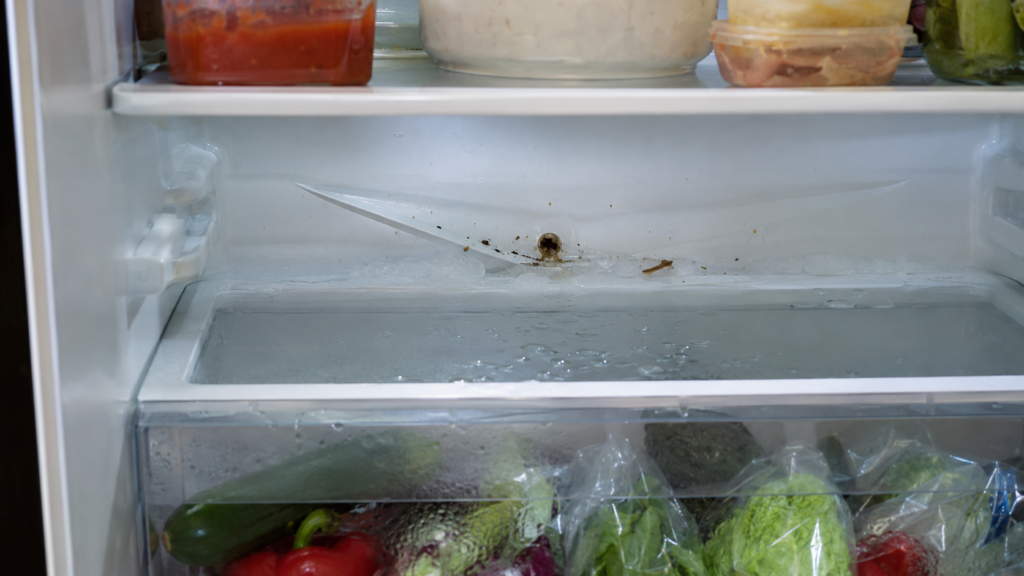
A blocked drain hole is one of the most common causes of water inside a fridge.
During normal operation, small amounts of moisture form on the cold rear wall. This water should run into a channel, pass through a drain hole and travel to a tray near the compressor.
Food particles, crumbs, packaging and ice can block the opening.
When this happens, water may:
- Pool beneath the salad drawer
- Run across the bottom shelf
- Freeze around the rear channel
- Produce unpleasant smells
- Leak through the fridge door
Remove the salad drawer and inspect the channel at the back.
If you can see standing water or debris, clean the area carefully with warm water and a soft cloth.
A flexible cleaning tool supplied with the appliance can help. Avoid using sharp metal objects because they may damage the drain.
For many households, Why Is My Fridge Freezer Leaking Water is answered by clearing this small drainage point.
🧊 Has Ice Blocked the Drain?
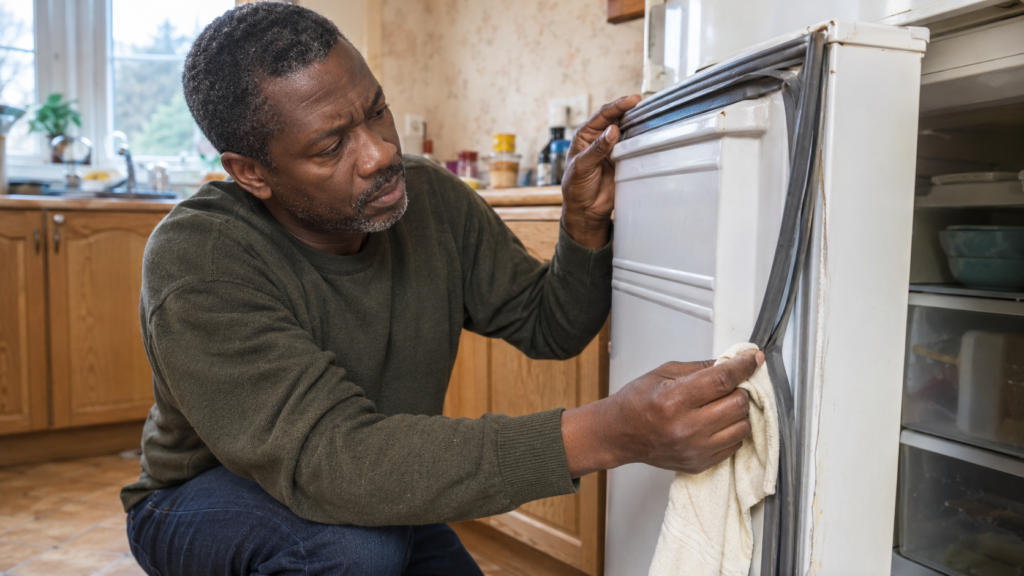
The drain can also become blocked by ice rather than food.
This may happen if the fridge is set too cold, food is pressed against the back wall or the appliance has an airflow problem.
Signs include:
- Ice around the drainage channel
- Water appearing after the ice melts
- Frost on the rear panel
- Food freezing near the back
- A drain hole that looks clear but does not empty
Switching the appliance off and allowing it to defrost may clear the blockage.
Remove food first and store it safely. Place towels around the base and leave the doors open until the ice has melted naturally.
Do not pour boiling water directly into the drain and do not chip away at the ice with a knife.
If the blockage returns soon after defrosting, Why Is My Fridge Freezer Leaking Water may be connected to a temperature control or defrost-system fault.
If ice keeps returning around the drainage channel, Why Does My Fridge Freezer Keep Icing Up explains the most likely causes and practical checks.
📦 Is Water Collecting Beneath the Salad Drawer?
Water beneath the salad drawer almost always points towards an internal drainage problem.
Condensation naturally runs down the back wall, but it should not remain inside the fridge.
Remove the drawer and check for:
- Standing water
- Food residue
- Mould
- Ice
- A blocked drainage groove
- Cracked plastic around the channel
Clean the drawer and the surrounding area with warm soapy water.
Dry everything before replacing the drawer.
If water repeatedly returns, monitor how quickly it appears. A slow return suggests a partial blockage, while a large amount appearing quickly may indicate excess condensation or a more serious drainage issue.
When Why Is My Fridge Freezer Leaking Water is limited to the inside base of the fridge, the drain should be your first focus.
🚪 Could the Door Seal Be Damaged?
A damaged or dirty door seal can allow warm, moist air to enter the appliance.
That moisture condenses on cold surfaces and may eventually collect as water.
Inspect the rubber seal around both doors.
Look for:
- Cracks
- Splits
- Warping
- Loose corners
- Sticky residue
- Food trapped in the folds
- Sections that do not sit flat
Clean the seal with warm water and a soft cloth.
You can test the grip with a piece of paper. Close the door over the paper and gently pull it. If it slides out without resistance, the seal may not be closing tightly.
A weak seal can make Why Is My Fridge Freezer Leaking Water seem like a plumbing issue when the real problem is condensation.
🌫️ Is Excess Condensation Causing the Leak?
Condensation forms when warm air meets cold surfaces.
In humid kitchens, Why Is My Fridge Freezer Leaking Water may be explained by excess condensation building faster than the drainage system can remove it.
A small amount is normal, but excessive moisture can overwhelm the drainage system.
This may happen when:
- The door is opened frequently
- The door is left ajar
- Warm food is placed inside
- The kitchen is humid
- The seal is damaged
- Food blocks internal airflow
- The appliance is heavily overfilled
Try to keep door openings brief and allow hot food to cool before placing it in the fridge.
Do not push containers tightly against the rear wall.
If Why Is My Fridge Freezer Leaking Water becomes worse during hot weather or after frequent door use, condensation is a likely factor.
🌡️ Is the Temperature Set Correctly?
The fridge section should usually be kept between 3°C and 5°C.
If it is too warm, condensation may increase. If it is too cold, ice may form around the drain and later melt into the compartment.
Use a fridge thermometer rather than relying entirely on the numbered control dial.
Place it on the middle shelf and leave it for several hours.
Avoid adjusting the thermostat repeatedly. Make one small change, then allow time for the temperature to stabilise.
An incorrect setting may not be the first answer to Why Is My Fridge Freezer Leaking Water, but it can contribute to both excess condensation and frozen drainage channels.
For the safest everyday settings, read What Temperature Should A Fridge Freezer Be UK before making further thermostat adjustments.
🥘 Are Warm Foods Being Put Inside?
Placing hot food directly into the fridge creates steam.
That steam turns into condensation when it touches cold surfaces.
A large uncovered pan or several warm containers can produce enough moisture to create visible water.
Allow food to cool until it is no longer steaming, then transfer it into sealed containers.
Do not leave cooked food at room temperature for longer than necessary.
Covering food also helps reduce moisture and stops strong smells spreading throughout the fridge.
If the leaking appears after batch cooking or storing several warm dishes, Why Is My Fridge Freezer Leaking Water may be linked to temporary excess condensation.
Our guide Can You Put Hot Food In A Fridge Freezer explains how to cool and store cooked food safely without creating unnecessary condensation.
🌬️ Are the Air Vents Blocked?
Modern fridge freezers often rely on internal vents to circulate cold air.
If these vents are blocked, temperatures can become uneven and condensation can form in the wrong places.
Large containers, food bags and tightly packed shelves may all restrict airflow.
Check for vents at the back or top of the fridge compartment.
Move food away from them and leave small gaps between containers.
Poor airflow can lead to:
- Water droplets on shelves
- Ice near the back
- Warm areas near the door
- Longer compressor cycles
- Repeated internal moisture
When airflow is restricted, Why Is My Fridge Freezer Leaking Water may be caused by storage habits rather than a failed component.
📏 Is the Fridge Freezer Level?
A fridge freezer should sit level or tilt very slightly backwards, depending on the manufacturer’s instructions.
If the appliance leans forwards, water may not flow correctly towards the drain. The doors may also fail to close by themselves.
Place a spirit level on top of the appliance.
Check it from:
- Left to right
- Front to back
Adjust the feet if necessary.
In a compact kitchen, uneven flooring or recent appliance movement can easily alter the position.
A poorly levelled appliance is an often-overlooked answer to Why Is My Fridge Freezer Leaking Water, especially when the leak began after installation or moving house.
🧺 Is the Drip Tray Overflowing?
Most fridge freezers have a drip tray near the compressor.
Water from the internal drain flows into this tray and normally evaporates because of the heat produced by the appliance.
For leaks appearing beneath the appliance, Why Is My Fridge Freezer Leaking Water may be answered by a cracked, displaced or overflowing drip tray.
The tray may overflow if:
- It is cracked
- It has moved out of position
- The drain sends through too much water
- The evaporation process is not working properly
- Debris has collected inside it
The tray is usually accessed from the rear or lower section of the appliance.
Before inspecting it, switch off the fridge freezer and unplug it.
Pull the appliance forward carefully without damaging the floor.
If you are unsure how to reach the tray safely, check the instruction manual or contact an engineer.
A damaged drip tray can explain Why Is My Fridge Freezer Leaking Water when the puddle appears underneath the appliance rather than inside it.
🔧 Could the Drain Tube Be Loose or Cracked?
The internal drain connects to a tube that carries water towards the drip tray.
When water appears behind the appliance, Why Is My Fridge Freezer Leaking Water may be caused by a loose, split or poorly connected drain tube.
If this tube becomes loose, blocked or damaged, water may leak behind or beneath the fridge freezer.
Possible signs include:
- A puddle at the rear
- Water missing the drip tray
- Dampness around the compressor area
- Water appearing after defrosting
- No visible blockage inside the fridge
Inspecting the rear drainage system often requires moving the appliance.
Do not touch electrical parts or hot compressor components.
If the tube is difficult to access, professional help is safer.
For rear leaks, Why Is My Fridge Freezer Leaking Water is often answered by checking whether the drain tube is still securely connected.
🚰 Does the Appliance Have a Water Dispenser?
Fridge freezers with water dispensers or ice makers have additional components that can leak.
These may include:
- Water inlet hoses
- Push-fit connectors
- Internal reservoirs
- Water filters
- Inlet valves
- Dispenser pipes
Check behind the appliance for dampness around the water supply.
A loose connector may release only a small amount of water at first, making the leak difficult to spot.
Turn off the water supply before tightening or disconnecting anything.
If the hose is cracked, swollen or damaged, replace it rather than attempting a temporary repair.
On plumbed-in models, Why Is My Fridge Freezer Leaking Water may have nothing to do with the refrigeration system itself.
🧯 What Should You Do Immediately?
If you find a significant leak:
- Keep water away from electrical sockets.
- Switch off the appliance if it is safe to do so.
- Unplug it with dry hands.
- Turn off the water supply on plumbed models.
- Move food to another fridge or cool box.
- Dry the floor thoroughly.
- Avoid repeatedly restarting the appliance.
Water and electricity are a dangerous combination.
If the plug, socket or cable is wet, do not touch it. Isolate the electricity supply from a safe location and arrange professional help.
Taking these steps quickly reduces damage while you investigate Why Is My Fridge Freezer Leaking Water.
⚙️ Could the Defrost System Be Faulty?
Frost-free fridge freezers periodically warm the evaporator coils to prevent excessive ice from building up.
If the defrost heater, sensor or timer fails, ice can accumulate behind the internal panel. When that ice eventually melts, water may escape into the fridge compartment or onto the floor.
Possible signs include:
- Heavy frost behind the rear panel
- Water appearing after a period of normal use
- The freezer becoming unusually cold
- The fridge section warming up
- Repeated leaks after defrosting
- The internal fan becoming noisy
This type of fault is harder to diagnose safely at home.
If Why Is My Fridge Freezer Leaking Water keeps returning after the drain has been cleared, the defrost system may need testing by an appliance engineer.
If the leak is accompanied by poor cooling, Why Is My Fridge Freezer Not Cold Enough covers the most common temperature and airflow faults.
🧊 Could a Freezer Door Be Left Slightly Open?
A freezer door that does not close properly allows warm air to enter.
That warm air freezes around the door frame, drawers or internal vents. When the ice later melts, water may run underneath the appliance.
If frost and water appear around the freezer door, Why Is My Fridge Freezer Leaking Water may be caused by warm air entering through an incomplete seal.
Check whether:
- A drawer is stopping the door closing
- Packaging is trapped in the seal
- The door has dropped out of alignment
- The seal is damaged
- Frost is preventing a tight closure
Remove any obstruction and clean the seal.
If the door does not stay shut, check that the appliance is level and that the hinges are secure.
In some cases, Why Is My Fridge Freezer Leaking Water begins with something as simple as a freezer bag preventing the door from sealing properly.
🧽 How Should You Clean a Blocked Drain Safely?
Start by switching off and unplugging the fridge freezer.
Remove the salad drawer and any food stored near the rear drainage channel.
Use:
- Warm water
- A soft cloth
- A flexible drain-cleaning tool
- A cotton bud for surface debris
- Towels to absorb standing water
Gently remove visible dirt, then flush a small amount of warm water into the drain.
The water should disappear freely.
Avoid forcing rigid objects into the hole. You could puncture the drain tube or push the blockage deeper.
Cleaning the drainage channel regularly can prevent Why Is My Fridge Freezer Leaking Water from becoming a recurring problem.
🚚 Did the Leak Start After Moving the Appliance?
A fridge freezer can begin leaking after being moved if the drip tray, drain tube or water connection shifts out of position.
The appliance may also sit unevenly in its new location.
After moving it, check:
- Whether it is level
- Whether the doors close properly
- Whether the rear tubing is secure
- Whether the drip tray has moved
- Whether a water hose has become loose
If the appliance was transported on its side, it should also be left upright before being switched on.
If Why Is My Fridge Freezer Leaking Water only started after relocation, installation should be checked before assuming there is a major internal fault.
If the appliance was recently transported, read How Long Should You Leave A Fridge Freezer Before Plugging It In before restarting it.
⚠️ When Should You Call an Engineer?
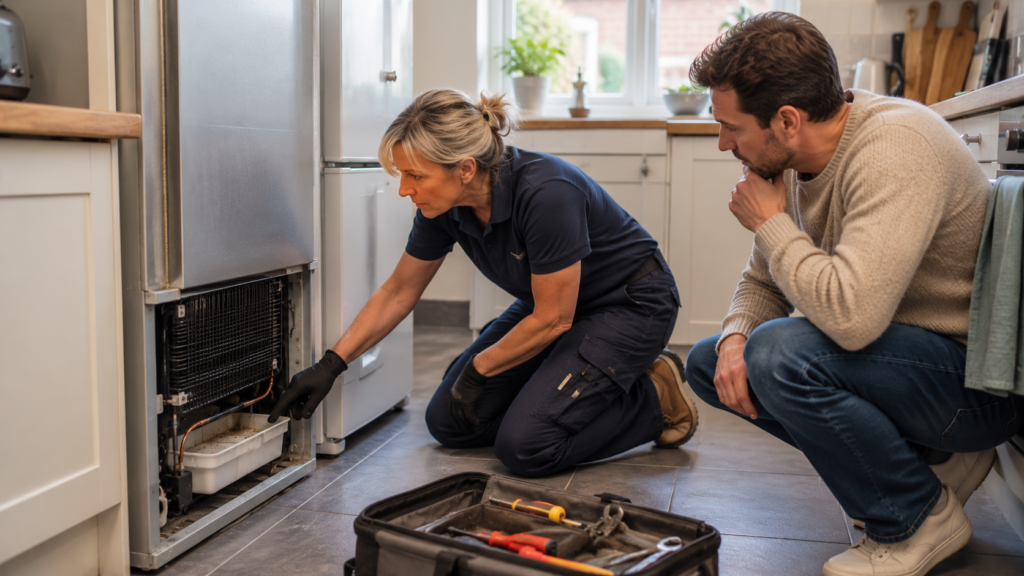
Arrange professional help if:
- The leak continues after clearing the drain
- Water appears near electrical components
- The drip tray is cracked
- The drain tube is damaged
- The appliance has a plumbed water leak
- Frost repeatedly builds up behind the panel
- The compressor area is wet
- The appliance is not cooling properly
Do not remove sealed rear panels unless you are qualified to work on refrigeration appliances.
An engineer can test the defrost system, inspect hidden drainage parts and confirm whether the leak is caused by a faulty component.
For persistent cases of Why Is My Fridge Freezer Leaking Water, professional diagnosis is often faster and safer than repeated temporary fixes.
💷 Is a Leaking Fridge Freezer Worth Repairing?
Many leaks are inexpensive to fix.
A blocked drain, dirty seal or displaced drip tray may cost very little to resolve.
Repair is usually worthwhile when the appliance is otherwise reliable and the fault involves:
- A drain tube
- A door seal
- A drip tray
- A water hose
- A defrost sensor
- A minor internal blockage
Replacement may make more sense if the appliance is old, inefficient and already suffering from several faults.
Compare the repair quote with the price of a suitable replacement.
Do not replace the appliance before identifying the cause. Why Is My Fridge Freezer Leaking Water is often a much smaller problem than it first appears.
If replacement becomes more practical, our guide to the Best Fridge Freezers For Small Kitchens UK highlights suitable options for compact homes.
✅ Quick Troubleshooting Checklist
Work through these checks in order:
✅ Dry the floor and locate the source.
✅ Check beneath the salad drawer.
✅ Clear the drainage hole.
✅ Look for ice around the drain.
✅ Inspect and clean the door seals.
✅ Confirm the temperature is between 3°C and 5°C.
✅ Avoid placing warm uncovered food inside.
✅ Clear blocked air vents.
✅ Check the appliance is level.
✅ Inspect the drip tray.
✅ Check rear hoses and drain tubes.
✅ Turn off the water supply on plumbed models.
✅ Call an engineer if the leak continues.
Following this order is the quickest way to investigate Why Is My Fridge Freezer Leaking Water without overlooking the most common causes.
🏆 Final Verdict
So, Why Is My Fridge Freezer Leaking Water?
The most common cause is a blocked internal drain hole, especially when water collects beneath the salad drawer.
Other likely causes include a damaged door seal, excess condensation, ice around the drainage channel, an overflowing drip tray, a loose drain tube or a leaking water connection.
Start by identifying exactly where the water appears. Clear the internal drain, check the temperature, inspect the seals and make sure the appliance is level.
If the leak comes from the rear, involves a plumbed water connection or continues after basic cleaning, arrange professional help.
In most cases, Why Is My Fridge Freezer Leaking Water can be solved without replacing the appliance, particularly when the problem is caught early.
To compare alternative storage layouts before replacing the appliance, read Fridge Freezer vs Separate Fridge And Freezer.
Frequently Asked Questions
Why Is My Fridge Freezer Leaking Water from underneath?
The most likely causes are an overflowing drip tray, loose drain tube, cracked tray or leaking water connection.
Why is water collecting under the salad drawer?
A blocked or frozen drain hole is usually responsible. Clear the rear drainage channel and remove any visible debris.
Can a damaged door seal cause a fridge leak?
Yes. Warm air entering through a poor seal creates excess condensation, which can overwhelm the drainage system.
Why does my fridge leak after defrosting?
Melting ice may reveal a blocked drain, displaced drip tray or damaged drain tube.
Can an overfilled fridge freezer leak water?
Yes. Overfilling can block vents, disrupt airflow and increase condensation around the rear wall.
Is a leaking fridge freezer dangerous?
It can be if water reaches electrical sockets, plugs or cables. Switch off the appliance if it is safe and keep water away from electrical components.
Why Is My Fridge Freezer Leaking Water after being moved?
The appliance may be uneven, the drip tray may have shifted or a rear hose may have become loose during transport.
The Food Standards Agency provides official guidance on safe fridge temperatures and correct chilled-food storage.