Why Is My Fridge Freezer Freezing Food?
Why Is My Fridge Freezer Freezing Food and How Can You Stop It?
If you are asking Why Is My Fridge Freezer Freezing Food, the problem is usually caused by an incorrect temperature setting, food touching the cold back wall, blocked air vents, poor airflow or a faulty thermostat or sensor. In many cases, the issue can be fixed without replacing the appliance.
Food freezing in the fridge section is more than an inconvenience. It can ruin fresh vegetables, split milk, damage yoghurt and shorten the life of delicate ingredients. In this guide, we will explain Why Is My Fridge Freezer Freezing Food, the checks you can carry out safely at home and when the problem may need professional attention.
⚡ Quick Answer
Why Is My Fridge Freezer Freezing Food? Start by checking that the fridge is set between 3°C and 5°C, then move food away from the back wall and clear any blocked vents. If food continues to freeze despite the correct setting and good airflow, the thermostat, sensor or internal fan may need checking.
🌡️ Check the Temperature First
Before changing anything, confirm the actual fridge temperature with a separate appliance thermometer.
The ideal fridge temperature is usually between:
- ✅ 3°C and 5°C
- ✅ Around 4°C for everyday use
If the reading is close to 0°C, the appliance is too cold.
Place the thermometer on the middle shelf, away from the door and back wall, then leave it for several hours or overnight.
This matters because a numbered dial does not necessarily show the real temperature. On many appliances, a higher number means stronger cooling rather than a specific number of degrees.
If you are trying to understand Why Is My Fridge Freezer Freezing Food, a reliable temperature reading is the best place to start.
💡 Good to know: Food near the back wall may freeze even when the average fridge temperature looks normal.
If you are unsure whether the appliance is running too cold, our guide What Temperature Should A Fridge Freezer Be UK explains the safest fridge and freezer settings.
🎛️ Is the Thermostat Set Too Cold?
An incorrectly adjusted thermostat is one of the most common causes.
The dial may have been knocked during cleaning, moving shelves or putting away shopping.
On many models:
- A lower number means warmer
- A higher number means colder
However, this varies between manufacturers, so check the manual before changing it.
Try moving the setting one level warmer, then wait at least 6–12 hours before checking the temperature again.
Avoid making several adjustments in quick succession.
If the fridge is currently set to its coldest level, reducing the cooling slightly may solve Why Is My Fridge Freezer Freezing Food without any further work.
🧊 Is Food Touching the Back Wall?
The back wall is often one of the coldest parts of the fridge.
In compact appliances, Why Is My Fridge Freezer Freezing Food is often answered by moving containers just a few centimetres away from the rear panel.
Food placed directly against it may partially freeze even when the rest of the compartment is at the correct temperature.
Common items affected include:
- Lettuce
- Cucumbers
- Milk
- Yoghurt
- Soft fruit
- Leftovers
- Drinks
Pull containers and packaging a few centimetres forward.
Leave a visible gap between food and the rear surface so cold air can circulate.
This is especially important in compact fridge freezers, where limited shelf depth makes it easy to push groceries too far back.
For many households, Why Is My Fridge Freezer Freezing Food is simply the result of food being stored in the coldest zone.
🥬 Why Do Vegetables Freeze So Easily?
Fresh vegetables contain a lot of water, which makes them particularly sensitive to low temperatures.
For many households, Why Is My Fridge Freezer Freezing Food becomes most noticeable when delicate vegetables develop ice crystals or turn watery after thawing.
Leafy greens, peppers, cucumbers and tomatoes can develop:
- Ice crystals
- Soft patches
- Watery texture
- Darkened leaves
- Loss of flavour
Store vegetables in the salad drawer where possible.
This area is designed to provide a slightly more stable environment than the back of the main shelves.
Do not overpack the drawer, as tightly compressed vegetables may still freeze if cold air cannot circulate properly.
If you are asking Why Is My Fridge Freezer Freezing Food because lettuce or cucumbers are regularly affected, their position inside the fridge may be the main problem.
🌬️ Are the Air Vents Blocked?
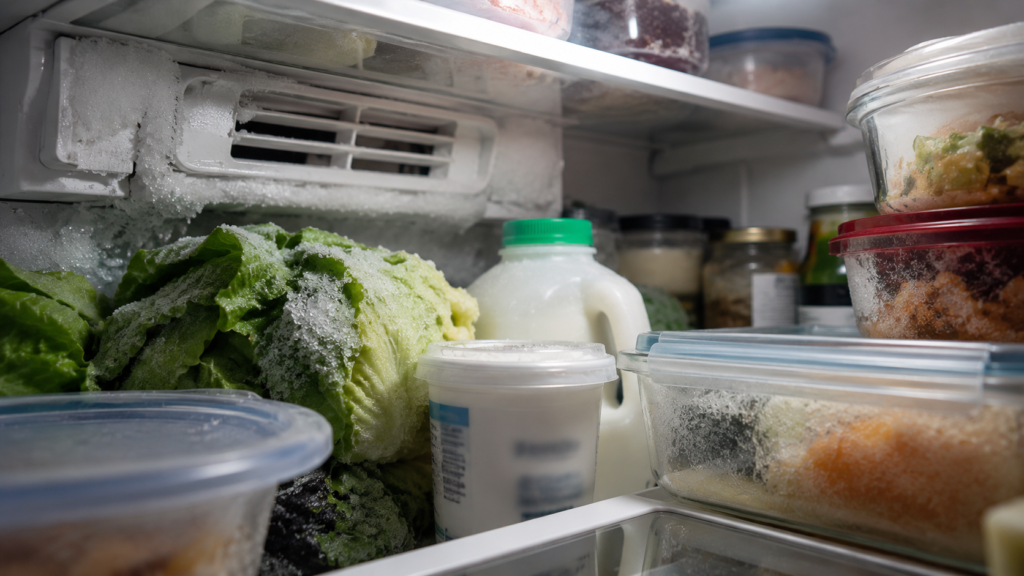
Many modern fridge freezers use vents and fans to distribute cold air.
If large containers, food bags or cartons block these vents, cold air may become concentrated in one area.
This can create:
- Frozen food near the vent
- Warmer areas elsewhere
- Uneven shelf temperatures
- Longer compressor cycles
- Poor overall airflow
Check the back and upper sections of the fridge for visible vents.
Move food away from them and avoid stacking large items directly underneath.
A blocked vent can make Why Is My Fridge Freezer Freezing Food feel like a thermostat problem when the real issue is uneven air distribution.
📦 Is the Fridge Overfilled?
An overfilled fridge restricts airflow.
Cold air needs space to move around food, shelves and containers. When every gap is packed, some items may sit in very cold pockets while others remain warmer.
Try removing unnecessary items and reorganising the shelves.
Leave small gaps between:
- Food containers
- Bottles
- Cartons
- Meal-prep tubs
- Packaged vegetables
Avoid pressing flexible bags against the back wall or vents.
If the problem appears after a large supermarket shop, overcrowding may explain Why Is My Fridge Freezer Freezing Food.
A reasonably stocked fridge generally maintains temperature more evenly than one that is either completely empty or tightly packed.
🚪 Could the Door Seal Be Causing the Problem?
A damaged door seal usually makes a fridge too warm, but it can also contribute to uneven cooling.
When investigating Why Is My Fridge Freezer Freezing Food, check whether a weak door seal is making the compressor run for longer than necessary.
If warm air enters through a poor seal, the compressor may run for longer to compensate. This can make the coldest areas inside the fridge excessively cold.
Inspect the seal for:
- Cracks
- Splits
- Warping
- Grease
- Food residue
- Loose sections
Clean it with warm water and a soft cloth.
You can also use the paper test:
- Place a sheet of paper between the seal and the cabinet.
- Close the door.
- Gently pull the paper.
If it slides out without resistance, the seal may not be gripping properly.
A weak seal may not be the first thing you think of when diagnosing Why Is My Fridge Freezer Freezing Food, but it can make the cooling system behave unpredictably.
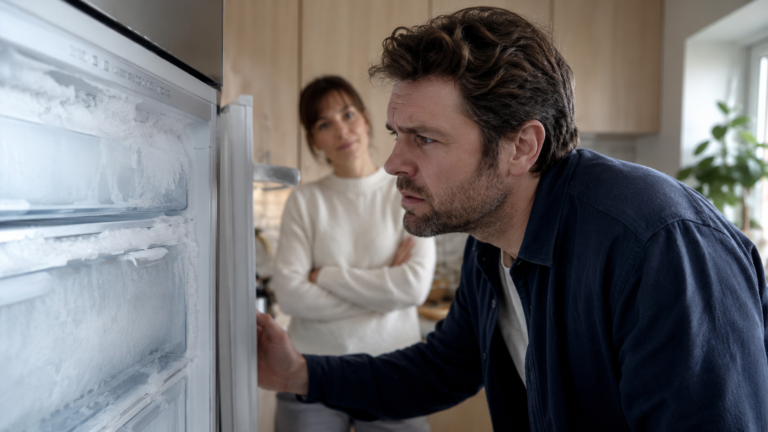
❄️ Is Frost Building Up Around the Vents?
Heavy frost can interfere with normal airflow.
If ice forms around internal vents or behind the rear panel, cold air may be directed unevenly into the fridge.
Look for:
- Frost around vents
- Ice on the back wall
- Freezer drawers sticking
- Water collecting in the fridge
- Repeated ice after defrosting
If the appliance is not frost-free, it may simply need defrosting.
If it is a frost-free model and ice keeps returning, there may be a fault with:
- The defrost heater
- The defrost sensor
- The internal fan
- The drainage system
Do not remove ice with knives or sharp tools.
That can damage the lining or puncture refrigerant pipes.
🥛 Why Does Milk Freeze in the Fridge?
Milk often freezes when it is stored too close to the back wall, a cold vent or the bottom rear section of the fridge.
The main shelf may be much colder than the door.
Try moving milk:
- Away from the back wall
- Onto a middle shelf
- Away from visible vents
- Into the door only if the fridge remains consistently below 5°C
Milk stored in the door experiences more temperature variation, so the middle shelf is often a better compromise.
If milk is freezing while other food remains normal, location is more likely than a major appliance fault.
This is another common example of Why Is My Fridge Freezer Freezing Food being linked to shelf position rather than the overall thermostat setting.
🔄 Has the Appliance Recently Been Moved or Restarted?
A fridge freezer may behave differently for several hours after being moved, defrosted or switched back on.
During the cooling period, temperatures can fluctuate before stabilising.
This may happen after:
- Moving house
- Rearranging the kitchen
- Deep cleaning
- Defrosting
- A power cut
- Switching the appliance off for storage
Allow the appliance time to settle before repeatedly changing the thermostat.
Keep the doors closed as much as possible and avoid filling it with warm food immediately.
If Why Is My Fridge Freezer Freezing Food only started after a move or restart, give it at least 12–24 hours to reach stable operating conditions.
If the fridge freezer was recently transported, our guide How Long Should You Leave A Fridge Freezer Before Plugging It In explains how long it should settle before being switched on.
🔥 Can Room Temperature Affect the Fridge?
Yes.
A fridge freezer in a very cold room may behave differently from one in a normal heated kitchen.
This can happen in:
- Garages
- Utility rooms
- Unheated extensions
- Conservatories
- Outbuildings
Some appliances are not designed to operate below a certain ambient temperature.
In unusual conditions, the thermostat and compressor may not cycle normally, which can contribute to uneven cooling.
Very hot rooms can also make the compressor run for longer.
For anyone asking Why Is My Fridge Freezer Freezing Food, it is worth checking whether the appliance is being used within the manufacturer’s stated climate class.
If your appliance is installed in an unheated space, read Can You Put A Fridge Freezer In A Garage to understand how low surrounding temperatures can affect cooling behaviour.
🛠️ Could the Thermostat or Sensor Be Faulty?
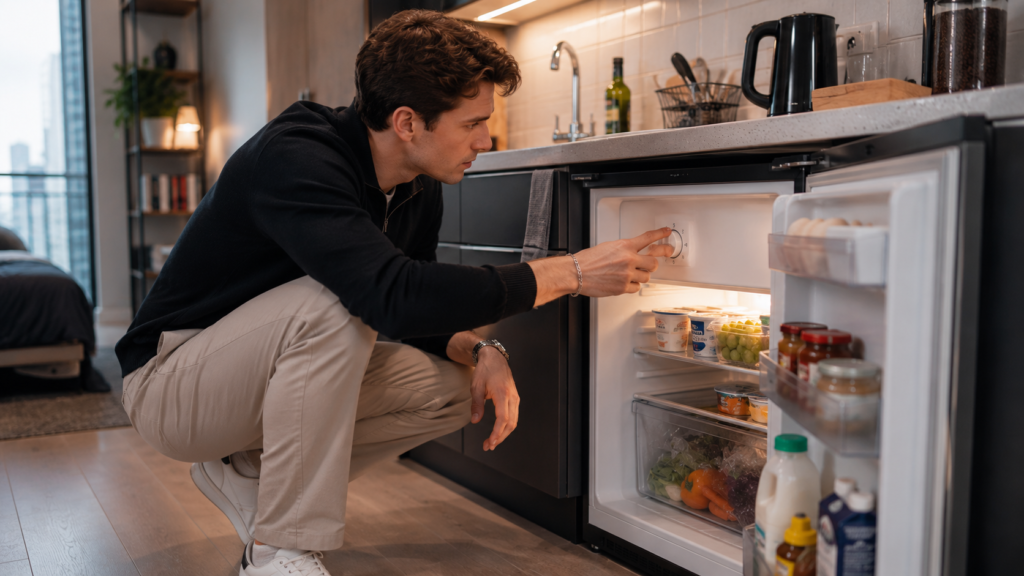
If the temperature setting is correct but food still freezes, the thermostat or temperature sensor may not be reading the compartment accurately.
These components tell the fridge freezer when to start and stop cooling. If either one develops a fault, the compressor may continue running for too long.
Possible signs include:
- The fridge staying close to 0°C
- Food freezing on several shelves
- The compressor running almost constantly
- The temperature changing without adjustments
- The display showing a normal reading while food freezes
This is where Why Is My Fridge Freezer Freezing Food may need professional diagnosis rather than another thermostat adjustment.
A repair engineer can test whether the control system is responding correctly and replace the faulty part if necessary.
If the appliance is also struggling to maintain safe temperatures elsewhere, our guide Why Is My Fridge Freezer Not Cold Enough covers the most common cooling faults and checks.
🌀 Could the Internal Fan Be the Problem?
Fan-assisted fridge freezers use an internal fan to move cold air evenly around the cabinet.
If the fan is damaged, obstructed or running incorrectly, some areas may receive far more cold air than others.
You may notice:
- Food freezing near one side
- Warm spots on another shelf
- Unusual fan noises
- Frost around the air outlet
- Temperature changing between shelves
Do not try to dismantle the fan housing yourself.
Instead, check for visible ice or food blocking the vent. If the fan sounds noisy or fails to run, professional attention may be needed.
For some appliances, Why Is My Fridge Freezer Freezing Food is caused by poor air distribution rather than the cooling system being too powerful overall.
🧼 Should You Defrost the Appliance?
A full defrost can sometimes restore normal airflow, particularly if ice has formed around hidden vents.
Before defrosting:
- Remove all food.
- Switch the appliance off.
- Unplug it safely.
- Place towels around the base.
- Leave the doors open.
- Allow ice to melt naturally.
Do not use boiling water, hairdryers or sharp tools.
Once the appliance is fully dry, switch it back on and allow it to reach the correct temperature before restocking.
If food begins freezing again shortly afterwards, the problem may be linked to the defrost system or temperature controls.
Repeated icing is a useful clue when investigating Why Is My Fridge Freezer Freezing Food.
If you need to leave the appliance off during a full defrost, read Can You Switch Off A Fridge Freezer Without Damaging It for the safest way to prepare and restart it.
📍 Where Should Different Foods Be Stored?
Correct food placement can make a noticeable difference.
Learning where to store each ingredient can often resolve Why Is My Fridge Freezer Freezing Food without requiring a repair or further thermostat changes.
Upper shelves
Best for:
- Cooked food
- Leftovers
- Yoghurt
- Cheese
- Desserts
Middle shelves
Best for:
- Milk
- Dairy products
- Ready meals
- Opened jars
Lower shelves
Best for:
- Raw meat
- Raw fish
- Poultry in sealed containers
Salad drawers
Best for:
- Lettuce
- Vegetables
- Fruit
- Fresh herbs
Door shelves
Best for:
- Sauces
- Condiments
- Soft drinks
- Butter
Keeping delicate food away from the cold back wall can solve Why Is My Fridge Freezer Freezing Food without changing the appliance settings at all.
⚠️ When Should You Call an Engineer?
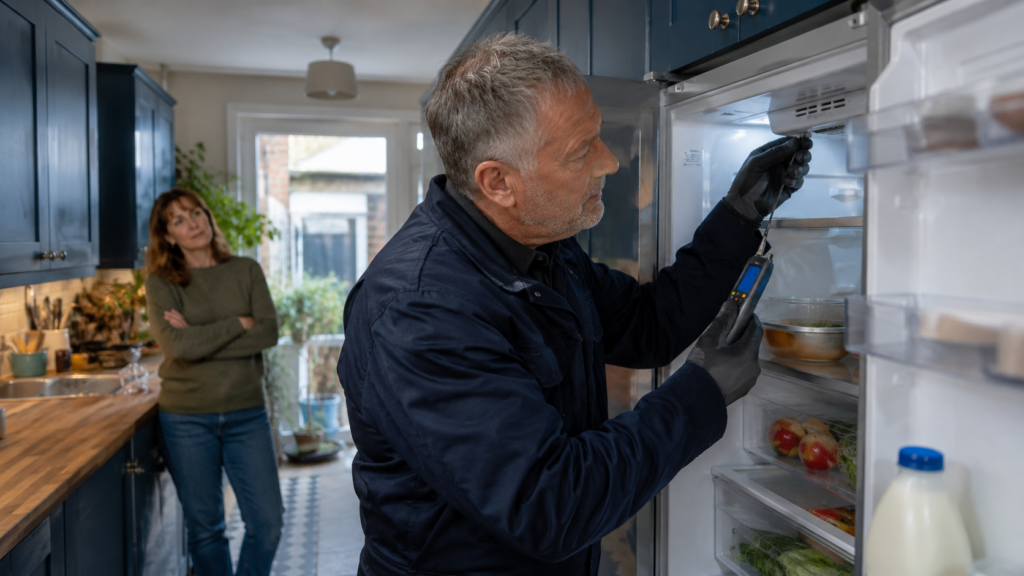
Arrange professional help if the basic checks do not solve the problem.
This is especially important if:
- Food freezes throughout the fridge
- The temperature remains close to 0°C
- The compressor runs continuously
- Frost returns after defrosting
- The controls do not respond
- The fan makes unusual noises
- The appliance is freezing food and warming elsewhere
These symptoms may point to a faulty thermostat, sensor, fan, control board or defrost system.
Before booking a repair, record the temperature and note exactly where food is freezing.
That information can make Why Is My Fridge Freezer Freezing Food easier for an engineer to diagnose.
💷 Is It Worth Repairing?
Many freezing problems are relatively straightforward to fix.
A repair may be worthwhile if the issue involves:
- A thermostat
- A temperature sensor
- A fan
- A door seal
- A blocked vent
- A defrost component
Replacement may make more sense if the appliance is very old and the repair involves the compressor or control board.
Consider:
- The age of the fridge freezer
- The repair quote
- Its energy efficiency
- Whether other faults have appeared
- The cost of a replacement model
Do not assume Why Is My Fridge Freezer Freezing Food automatically means the appliance is finished. A simple part may restore normal temperature control.
If replacing the appliance makes more financial sense, our guide to the Best Fridge Freezers For Small Kitchens UK highlights practical models for compact homes.
✅ Quick Troubleshooting Checklist
Work through these checks in order:
✅ Measure the fridge temperature.
✅ Aim for 3°C to 5°C.
✅ Move food away from the back wall.
✅ Clear blocked vents.
✅ Reduce overcrowding.
✅ Check the thermostat setting.
✅ Clean the door seals.
✅ Look for frost around vents.
✅ Allow time after moving or restarting.
✅ Check the room temperature.
✅ Defrost the appliance if necessary.
✅ Contact an engineer if the problem continues.
Following this checklist is the quickest way to narrow down Why Is My Fridge Freezer Freezing Food without making unnecessary changes.
🏆 Final Verdict
So, Why Is My Fridge Freezer Freezing Food?
The most common causes are an overly cold setting, food touching the back wall, blocked vents, overcrowding or uneven airflow.
Start by checking the temperature with a thermometer and aim for around 4°C. Move delicate food forward, clear the vents and give the appliance several hours to stabilise after any adjustment.
If food continues freezing across several shelves, there may be a fault with the thermostat, sensor, fan or defrost system.
For most small kitchens and flats, better food placement and improved airflow will solve the problem. If you are still asking Why Is My Fridge Freezer Freezing Food after completing the basic checks, arrange professional advice before more food is wasted.
If you are reconsidering how much chilled and frozen storage you need, our comparison Fridge Freezer vs Separate Fridge And Freezer explains the advantages of each arrangement.
Frequently Asked Questions
Why Is My Fridge Freezer Freezing Food even on a low setting?
The problem may be caused by a faulty thermostat or sensor, blocked airflow or food touching a very cold part of the fridge.
Why does food freeze at the back of the fridge?
The back wall is often colder than the rest of the compartment. Move food forward and leave a gap for air circulation.
Can an overfilled fridge freeze food?
Yes. Overfilling can block airflow and create unusually cold areas around vents and shelves.
Why does lettuce freeze in the salad drawer?
The fridge may be set too cold, or cold air may be entering the drawer unevenly. Check the thermometer and avoid overpacking it.
Can a damaged door seal make food freeze?
It can. Warm air entering through a poor seal may cause the compressor to run longer, making the coldest areas too cold.
Should I defrost the fridge freezer?
A full defrost may help if frost is blocking vents or affecting airflow. If ice quickly returns, there may be an internal fault.
Why Is My Fridge Freezer Freezing Food after I moved it?
The appliance may still be stabilising after transport or restarting. Leave it running with the doors closed and monitor the temperature for 12–24 hours.
The Food Standards Agency provides official guidance on safe fridge temperatures and storing chilled food correctly at home.