OLED vs QLED TVs: Which Is Better for Bright Rooms?
Which Display Technology Actually Works Better When Your Living Room Gets Lots of Daylight?
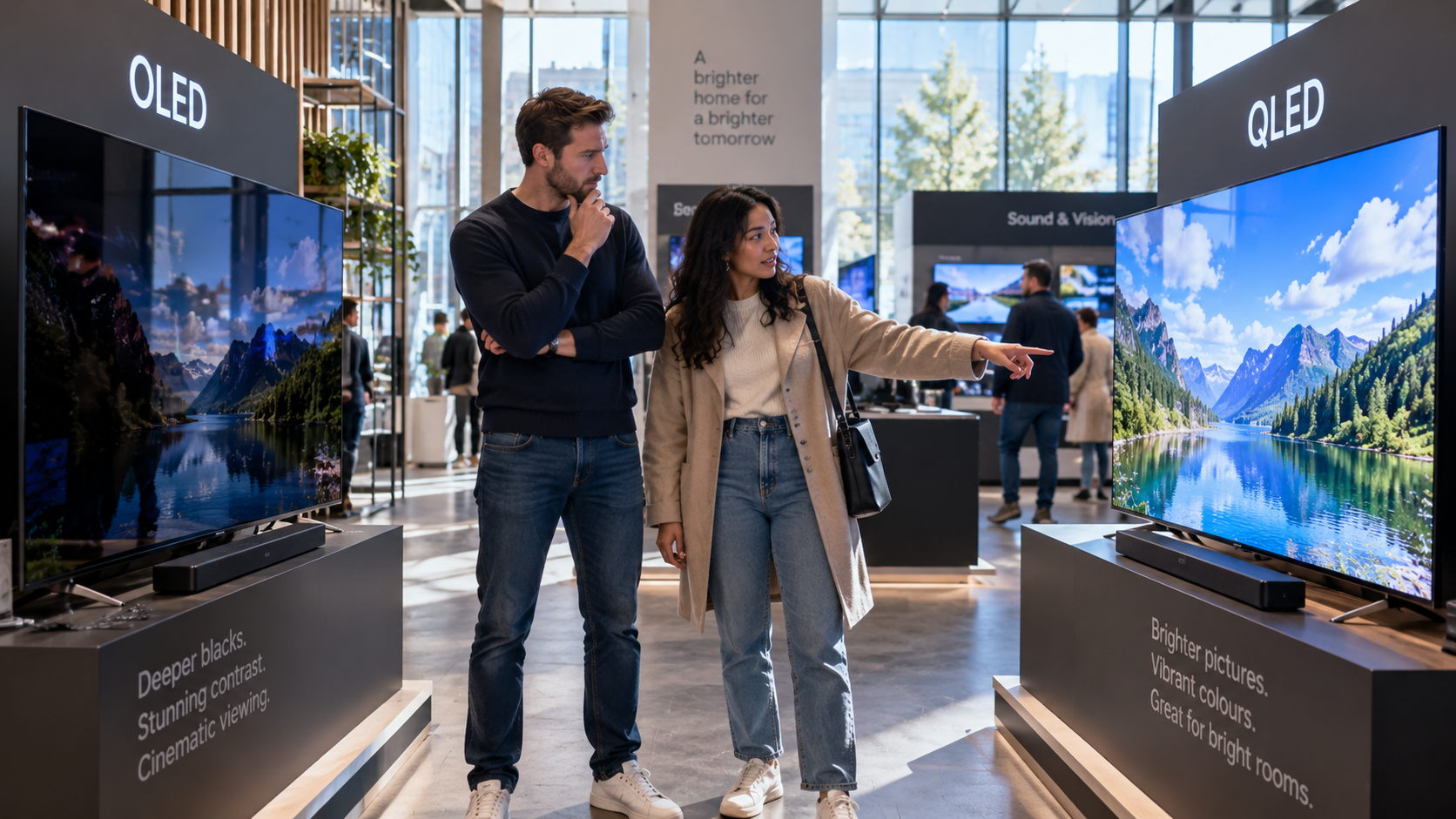
Choosing between OLED vs QLED TVs becomes much more important when your living room is bright, because the strengths and weaknesses of each display technology become easier to notice once sunlight, large windows and daytime viewing enter the equation. OLED is famous for perfect blacks, excellent contrast and impressive cinematic performance, while QLED is usually associated with higher brightness and stronger daytime visibility, but those headline differences do not tell the whole story.
A modern OLED can still perform very well in a bright room, particularly if it has strong reflection handling, while a good QLED can produce extremely punchy HDR and vivid daytime images without struggling against ambient light. For smaller UK living rooms, where furniture placement may leave the television opposite a window or near patio doors, the OLED vs QLED TVs decision should therefore be based on your actual room rather than simply choosing whichever technology is considered more premium. This guide explains brightness, reflections, black levels, contrast, HDR, colour, viewing angles, gaming, screen size and room positioning so you can decide which technology makes more sense for the way your home is actually used.
⚡ Quick Answer: OLED vs QLED TVs
When comparing OLED vs QLED TVs for a bright living room:
- QLED is usually the safer choice for very bright daytime rooms because many QLED televisions can reach higher overall brightness.
- OLED is usually better for dark-room films and evening viewing because individual pixels can switch off completely, producing true black.
- OLED often has better viewing angles, which can matter in small rooms where people sit off-centre.
- QLED can be better at fighting strong daylight, especially when paired with good anti-reflection treatment.
- OLED can still work well in a bright room if the screen is not directly opposite a large window.
- HDR performance depends on more than technology alone; panel brightness, processing and tone mapping still matter.
- For mixed daytime and evening use, the decision between OLED vs QLED TVs should come down to the specific television and your room layout rather than the panel label alone.
If your room receives strong sunlight for much of the day, we would generally lean towards QLED. If evening films, dark scenes and premium contrast matter more, OLED remains extremely difficult to beat.
What Is OLED?
OLED stands for Organic Light-Emitting Diode.
The key difference is that every pixel in an OLED television produces its own light.
There is no conventional backlight sitting behind the screen.
When an OLED pixel needs to display black, it can switch off completely.
That gives OLED one of the strongest advantages in the OLED vs QLED TVs comparison: true black.
Why True Black Matters
Imagine a night scene showing a bright street lamp against a black sky.
On an OLED television, the pixels creating the black sky can switch off while nearby pixels remain brightly illuminated.
That allows very strong contrast between light and dark areas.
On a conventional LCD-based television, the backlight still has to illuminate sections of the panel.
That can make black areas appear slightly grey or produce visible blooming around bright objects, depending on the backlight system.
This is why OLED is often praised for:
- Films
- Dark television dramas
- Sci-fi
- Horror
- Evening viewing
- Cinema-style setups
In the OLED vs QLED TVs debate, OLED’s black-level performance remains one of its clearest advantages.
What Is QLED?
QLED stands for Quantum Dot Light-Emitting Diode, although consumer QLED televisions are still fundamentally LCD televisions using a backlight.
The Quantum Dot layer is used to improve colour reproduction and brightness.
Different QLED televisions use different backlight systems.
Some use relatively basic edge lighting.
Others use full-array local dimming.
More advanced models may use Mini LED backlights with a large number of independently controlled dimming zones.
That means there is a much wider performance range within QLED than the name alone might suggest.
Why QLED Works Well in Bright Rooms
The biggest advantage of QLED in the OLED vs QLED TVs comparison is brightness.
A good QLED television can produce a very bright image.
That makes it easier for the picture to compete with:
- Direct sunlight
- Large windows
- Bright ceiling lights
- Open-plan kitchens
- Conservatory-style spaces
- Rooms with pale reflective walls
If your television is watched mostly during the day, this additional brightness can make the picture appear clearer and more vibrant.
OLED vs QLED TVs for Brightness
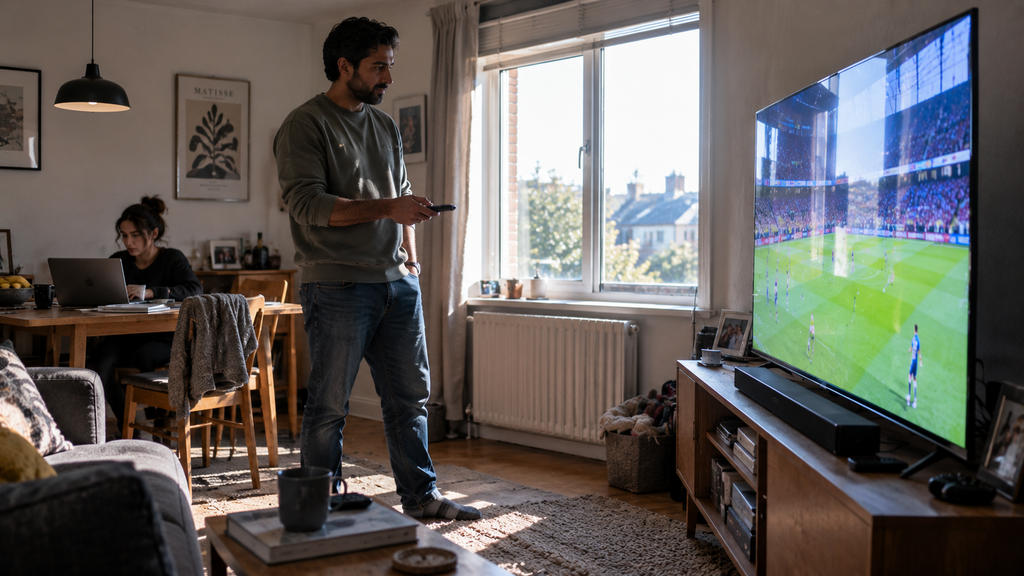
Brightness is probably the most important factor when comparing OLED vs QLED TVs for a bright living room.
QLED generally wins.
A high-quality QLED television can reach significantly higher peak brightness than many OLED televisions.
That helps both general daytime visibility and HDR highlights.
Why Higher Brightness Helps
Ambient light reduces perceived contrast.
Imagine watching television with bright sunlight filling the room.
The darkest areas of the screen are no longer being viewed in complete darkness.
Reflections and surrounding light effectively raise the perceived black level.
A brighter television can compensate by pushing highlights and mid-tones harder.
That is why a bright QLED screen can look extremely impressive during the day.
OLED Has Improved Considerably
That does not mean OLED is dim.
Modern OLED televisions can be significantly brighter than earlier generations.
Premium OLED models now use improved panel designs and processing to increase brightness, particularly in HDR highlights.
For many normal living rooms, modern OLED brightness is completely adequate.
The OLED vs QLED TVs difference becomes most important when the room is genuinely difficult:
- Large south-facing windows
- Direct sun on the screen
- Patio doors opposite the TV
- Very bright open-plan spaces
In those environments, QLED retains an advantage.
OLED vs QLED TVs for Reflections
Brightness and reflections are connected, but they are not the same thing.
A television can be extremely bright and still have distracting reflections.
Likewise, a slightly less bright television with excellent anti-reflection treatment may remain easier to watch.
That is why OLED vs QLED TVs should also be compared based on screen coating.
Glossy Screens
Many premium televisions use glossy or semi-gloss screens.
These can make colours and contrast look excellent in controlled lighting.
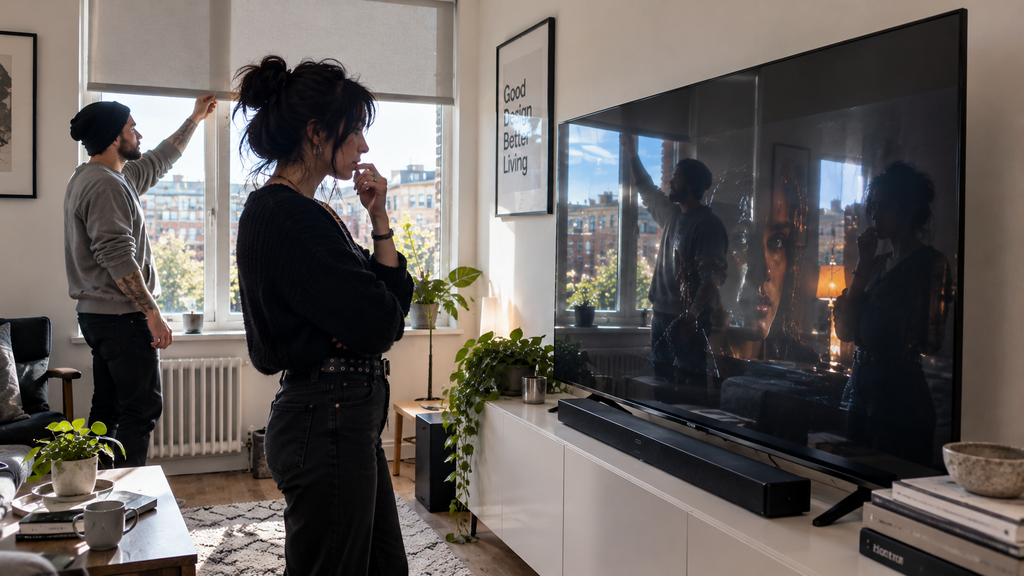
However, they can also behave like mirrors when positioned opposite a window.
You may see:
- The window
- Lamps
- Furniture
- People moving around the room
- Bright outdoor scenery
superimposed over dark scenes.
This is especially noticeable with OLED because dark scenes can be genuinely black.
A bright reflection against that black background becomes very obvious.
Anti-Reflection Treatments
Some premium televisions use specialised anti-reflection coatings.
These are designed to diffuse or reduce reflected light.
A good anti-reflection coating can make a significant difference regardless of whether the television is OLED or QLED.
So when comparing OLED vs QLED TVs, do not only ask:
“Which technology is brighter?”
Also ask:
“How reflective is this particular screen?”
That can have a bigger impact on everyday daytime viewing than many specification-sheet differences.
OLED vs QLED TVs for Black Levels
OLED wins here.
Because each pixel can switch itself off, black can genuinely appear black.
That gives OLED effectively pixel-level control over contrast.
Why QLED Cannot Produce Exactly the Same Black
QLED televisions still require a backlight.
Higher-end QLED televisions use local dimming to darken parts of that backlight.
The more dimming zones available, the more precisely the television can control light.
Mini LED QLED televisions can have hundreds or even thousands of dimming zones.
That can produce excellent black levels.
But one dimming zone may still illuminate many thousands of pixels.
OLED controls every pixel individually.
That remains a fundamental technical advantage.
Does This Matter in a Bright Room?
Less than it does in darkness.
This is one of the most important things to understand about OLED vs QLED TVs.
In a dark room, OLED’s perfect blacks can look dramatic.
In bright daylight, ambient light reduces how much of that black-level advantage you perceive.
That is one reason QLED can look surprisingly competitive during daytime viewing even though its theoretical black level is worse.
OLED vs QLED TVs for Contrast
OLED has effectively infinite native contrast because black pixels can switch off completely.
That gives films and dark scenes tremendous depth.
Bright objects can appear directly beside completely black pixels.
QLED Contrast Depends on the Backlight
QLED performance varies dramatically.
A basic edge-lit QLED may have relatively ordinary contrast.
A premium Mini LED QLED with sophisticated local dimming can look dramatically better.
This is why the OLED vs QLED TVs question should never be reduced to:
OLED good. QLED bad.
or:
QLED bright. OLED dim.
The specific television matters.
OLED vs QLED TVs for HDR
HDR is another area where each technology has a different advantage.
OLED offers exceptional contrast.
QLED can offer exceptional brightness.
A great HDR image ideally wants both.
OLED HDR Strength
OLED is excellent at scenes containing bright highlights against dark backgrounds.
Examples include:
- Stars in a night sky
- Fireworks
- Street lights
- Neon signs
- Candles
- Reflections on water
Because neighbouring pixels can remain completely black, small bright objects can look extremely intense.
QLED HDR Strength
QLED can often produce brighter large areas.
Examples include:
- Snow-covered landscapes
- Bright skies
- Sunlit sport
- Desert scenes
- Daytime documentaries
In these scenes, a powerful QLED backlight can make the image look spectacular.
When comparing OLED vs QLED TVs for HDR, the content you watch matters.
OLED vs QLED TVs for Colour
Both technologies can produce excellent colour.
QLED’s Quantum Dot layer is specifically designed to improve colour volume, especially at higher brightness levels.
That can make QLED particularly impressive in bright HDR scenes.
OLED can also produce extremely accurate, rich colour.
Its perfect black levels often make colours appear more saturated because of the surrounding contrast.
Bright-Room Colour
In a very bright room, QLED’s ability to maintain colour at higher brightness levels can be particularly useful.
That is another reason the OLED vs QLED TVs decision often leans towards QLED for daytime-heavy households.
OLED vs QLED TVs for Viewing Angles
OLED generally wins.
Because OLED pixels emit their own light, picture quality tends to remain more consistent when viewed from the side.
This matters more than people realise in small living rooms.
Small Rooms Often Have Awkward Seating
You might have:
- One person on the main sofa
- Another person in an armchair
- Someone watching from the dining table
- Children sitting on the floor
Not everyone will be directly in front of the television.
In those situations, OLED’s wider viewing angles can be a genuine advantage.
Some QLED panels lose contrast or colour accuracy as you move off-axis.
Premium models may use technology to improve viewing angles, but performance varies.
OLED vs QLED TVs for Sport
Sport is interesting because the answer depends on when you watch.
Football, rugby, tennis and Formula 1 are often watched during daylight.
That gives QLED an advantage because of its brightness.
However, OLED’s fast pixel response also provides excellent motion clarity.
So the OLED vs QLED TVs choice for sport becomes:
- Bright daytime sport → QLED advantage
- Evening sport → much closer
- Motion clarity → OLED can be excellent
- Large bright room → QLED often safer
OLED vs QLED TVs for Gaming
OLED is one of the strongest display technologies for gaming.
The individual pixels respond extremely quickly.
That helps reduce motion blur and gives games a very responsive appearance.
Many modern OLED televisions also include:
- 120Hz panels
- 144Hz support
- VRR
- ALLM
- G-Sync
- FreeSync
- HDMI 2.1
QLED Gaming Can Also Be Excellent
Premium QLED televisions can offer similarly strong gaming features.
Some even support refresh rates above 144Hz.
They also have the brightness advantage for daytime gaming.
So when comparing OLED vs QLED TVs for gaming, the panel technology itself should not be the only consideration.
Check:
- Refresh rate
- Number of HDMI 2.1 ports
- VRR range
- Input lag
- Console compatibility
- PC gaming support
OLED vs QLED TVs for Small Living Rooms
For Small Living Solutions readers, physical size matters alongside display technology.
OLED televisions are increasingly available from around 42 inches upwards.
QLED is available across a much wider size range.
If your room is genuinely compact, you may find more choice among QLED televisions at:
- 32 inches
- 40 inches
- 43 inches
- 50 inches
OLED tends to become much more common from around 48–55 inches.
This means your OLED vs QLED TVs decision may sometimes be determined by room size before picture technology.
If 43 inches is the largest television your furniture comfortably supports, QLED may simply provide far more options.
If you can comfortably accommodate 48 or 55 inches, OLED becomes much easier to consider.
If 43 inches suits your room better than a larger OLED, our Best 43-Inch 4K TVs UK guide includes QLED and conventional 4K alternatives for compact living rooms.
The Bright-Room Question Comes Down to Your Window
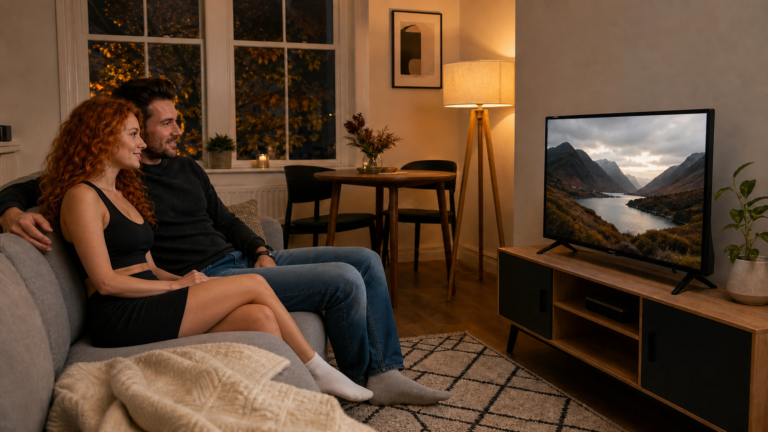
Before choosing between OLED vs QLED TVs, stand where your television will go during the brightest part of the day.
Look at the room.
Where is the main window?
Where does sunlight fall?
Would the television face the window directly?
Could curtains or blinds reduce the glare?
This simple check can tell you more than reading twenty specification sheets.
A bright room does not automatically require QLED.
A badly positioned television can create reflection problems regardless of technology.
And a well-positioned OLED can perform beautifully even in a room that receives plenty of daylight.
When QLED Is the Better Choice
For a genuinely bright living room, OLED vs QLED TVs often comes down to how much ambient light the television has to fight against during normal use.
QLED is usually the safer option when the room receives strong daylight for long periods.
That is especially true if you regularly watch television in the afternoon rather than mainly in the evening.
Choose QLED If Your Room Is Very Bright
QLED makes particular sense when you have:
- Large south-facing windows
- Patio or balcony doors near the television
- Direct sunlight entering the room
- Pale walls that reflect a lot of light
- A television opposite a large window
- Daytime sport or family viewing
- An open-plan kitchen and living area
In these situations, the higher brightness available from many QLED televisions can make the picture easier to see.
That is where the OLED vs QLED TVs comparison starts leaning strongly towards QLED.
If excessive sunlight also makes the room uncomfortable during summer, our How to Cool a Studio Flat Without Air Conditioning UK guide covers practical ways to reduce heat and direct solar gain.
QLED Is Particularly Good for Daytime Sport
Sport is often bright by nature.
Football pitches, tennis courts, Formula 1 tracks and outdoor events contain large areas of bright colour.
A strong QLED television can maintain a vivid picture even when the room itself is brightly lit.
For viewers who watch a lot of weekend sport during daylight hours, that can be more valuable than OLED’s superior black levels.
QLED Gives You More Screen-Size Choice
Another practical advantage is availability.
QLED televisions are sold in a much wider range of sizes.
You can find QLED models around:
- 32 inches
- 40 inches
- 43 inches
- 50 inches
- 55 inches
- Much larger sizes
OLED is much more concentrated around 42 inches and above.
For compact homes, this can make QLED easier to fit into the room.
That is an important practical difference when comparing OLED vs QLED TVs for smaller UK living rooms.
For a larger screen without committing specifically to OLED, see our Best 50-Inch TVs UK comparison for QLED and LED alternatives suited to smaller living rooms.
When OLED Is the Better Choice
OLED becomes more attractive when your viewing habits favour films, evening television and darker content.
If you normally watch television after work with the curtains partly closed, OLED’s biggest strengths become much easier to appreciate.
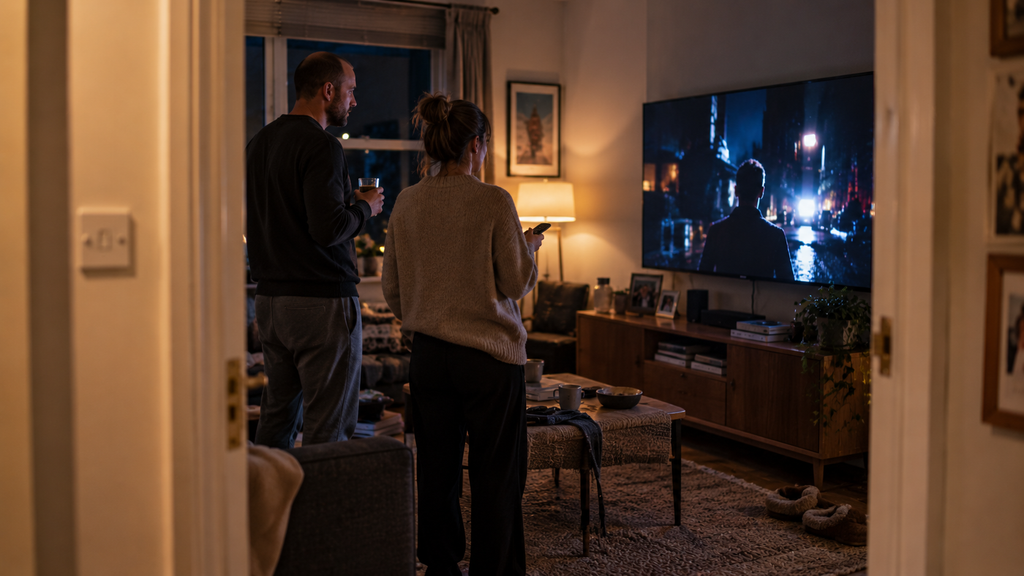
If OLED sounds like the better fit for your room, compare our Best OLED TVs UK for Small Living Rooms guide for compact 48-inch and carefully selected 55-inch models.
Choose OLED If You Value Dark-Room Picture Quality
OLED is particularly compelling for:
- Films
- Prestige television dramas
- Sci-fi
- Horror
- Dark documentaries
- Night-time gaming
- Streaming in the evening
In these situations, the OLED vs QLED TVs comparison shifts towards OLED because true black and pixel-level contrast become much more visible.
OLED Works Brilliantly in Small Evening Rooms
Small living rooms can actually suit OLED very well.
You do not need an enormous television to benefit from OLED contrast.
A 42-inch or 48-inch OLED viewed from a relatively short distance can produce a very immersive picture.
The room itself also tends to become darker more easily than a huge open-plan living area.
That can help OLED show its strengths.
If you are unsure how screen size changes the value of extra resolution, our HD Ready vs Full HD vs 4K guide explains how viewing distance and screen size affect what you can actually see.
OLED Is Excellent for Off-Centre Seating
If your room layout forces some viewers to sit to the side of the screen, OLED can also be particularly useful.
Wide viewing angles mean the image tends to remain more consistent away from the centre.
In awkwardly shaped small rooms, that can matter more than maximum brightness.
For a manufacturer comparison of brightness, black levels and room suitability, read Samsung UK’s QLED vs OLED guide.
What If You Watch TV During Both Day and Night?
This is probably the most realistic scenario.
Most households do not use their television exclusively in bright daylight or complete darkness.
You might watch:
- Children’s programmes during the day
- Sport in the afternoon
- News around dinner
- Films at night
In that situation, the OLED vs QLED TVs decision becomes much closer.
If most of your viewing comes from streaming services, our Best WiFi Router for Streaming in Small Flats UK guide can help if buffering or weak wireless coverage affects picture quality.
Mixed-Use Room: Slight QLED Advantage
If the room remains bright for much of the day, we would lean slightly towards QLED.
The extra brightness gives you more flexibility.
You may sacrifice some black-level performance in the evening, but a good QLED can still provide excellent contrast.
Mixed-Use Room With Controllable Light: OLED Becomes Attractive
If you have:
- Proper curtains
- Blackout blinds
- Adjustable shutters
- No direct sunlight on the screen
then OLED becomes far easier to recommend.
The ability to control the room means you can reduce reflections during the day and enjoy OLED’s superior dark-room performance later.
That is why OLED vs QLED TVs should always be considered alongside the room itself.
How Much Does TV Position Matter?
A lot.
You can buy an excellent television and still create a poor viewing experience by putting it in the wrong place.
Avoid Placing the TV Directly Opposite a Window
This is one of the most common mistakes.
A large window directly opposite the screen can create reflections across both OLED and QLED displays.
Even a very bright QLED may struggle if sunlight hits the screen directly.
Side Lighting Is Usually Easier to Manage
A window to the side of the television is often less problematic.
You can use blinds or curtains to control the strongest light while keeping the room bright.
This can make OLED vs QLED TVs a much closer decision.
Consider Wall-Mounting Angle
If reflections are unavoidable, a slight change in viewing angle may help.
A suitable wall mount can sometimes angle the television away from the strongest reflection source.
Do not assume the screen has to sit completely flat against the wall.
Curtains, Blinds and Room Control Can Change the Answer
One of the cheapest ways to improve television picture quality is not buying a better TV.
It is improving control over the room.
A simple blind can completely change the OLED vs QLED TVs decision.
If strong daylight is the only reason you are avoiding OLED, being able to reduce that light may allow you to choose the technology you actually prefer.
Blackout Blinds
Blackout blinds are particularly effective in:
- Bedrooms
- Small lounges
- Cinema-focused rooms
- South-facing rooms
They can turn a difficult daytime viewing environment into something much closer to evening conditions.
Sheer Curtains
Sheer curtains do not completely block daylight.
However, they can soften direct sunlight and reduce harsh reflections.
This can be enough to make an OLED screen much easier to watch.
OLED vs QLED TVs for Burn-In
Burn-in is one of the most discussed OLED concerns.
It happens when static image elements remain on screen for very long periods and eventually leave a permanent visible trace.
Modern OLED televisions use several protective technologies to reduce this risk.
These can include:
- Pixel shifting
- Logo dimming
- Screen savers
- Pixel cleaning
- Automatic brightness adjustments
For normal mixed television use, burn-in is far less of a concern than it used to be.
However, the OLED vs QLED TVs comparison still favours QLED if your television regularly displays static content for extremely long periods.
When Burn-In Could Matter More
Examples include:
- News channels left on all day
- Sports channels with permanent score graphics
- Using the television as a PC monitor
- Digital signage
- Games with static HUD elements for very long sessions
QLED does not use self-emissive OLED pixels, so permanent image retention is much less of a concern.
For normal films, streaming and varied family viewing, we would not automatically avoid OLED because of burn-in.
OLED vs QLED TVs for Energy Use
Energy consumption varies by model, size and content.
OLED power usage can change depending on how much of the screen is bright.
A mostly dark film scene can use less power than an extremely bright image.
QLED televisions use a backlight, so their power characteristics are different.
High-brightness QLED televisions can also consume significant power when operating at maximum brightness.
When comparing OLED vs QLED TVs, check the actual energy label for the specific model rather than assuming one technology is always cheaper to run.
OLED vs QLED TVs for Lifespan
Both technologies can last many years under normal household use.
QLED uses mature LCD technology and does not have the same organic-pixel ageing characteristics as OLED.
OLED pixels do gradually age, but modern televisions include management systems designed to maintain consistent performance.
For most households, lifespan should not be the deciding factor between OLED vs QLED TVs.
Picture quality, room brightness, size and price are much more likely to affect your experience.
What About Mini LED QLED?
This is where the comparison becomes much more interesting.
Mini LED is an advanced form of LCD backlighting.
Instead of using a relatively small number of large LEDs behind the panel, Mini LED televisions use many smaller LEDs.
That allows more local dimming zones.
Mini LED Narrows the OLED Advantage
A good Mini LED QLED can produce:
- Very high brightness
- Strong black levels
- Excellent HDR
- Better local dimming
- Strong daytime performance
It still cannot control every individual pixel like OLED.
However, premium Mini LED televisions can get surprisingly close in perceived contrast while remaining much brighter.
For a very bright living room, this can make Mini LED QLED one of the strongest alternatives to OLED.
OLED vs QLED TVs for Price
QLED generally offers more choice across different budgets.
You can buy inexpensive QLED televisions as well as very expensive Mini LED models.
OLED tends to start at a higher price.
That means the OLED vs QLED TVs comparison is not always like-for-like.
An inexpensive QLED should not be expected to perform like a premium OLED.
Likewise, a flagship Mini LED QLED can cost as much as or more than an OLED.
Think About What You Are Paying For
If your priority is:
Maximum picture quality at night: OLED often offers better value.
Maximum brightness during the day: QLED often makes more sense.
Lowest purchase price: QLED generally gives you more options.
Premium gaming: both technologies can be excellent.
OLED vs QLED TVs for Small Flats
Small flats introduce a few extra considerations.
QLED Advantages
QLED gives you more compact screen sizes.
That can make it easier to find something that fits a narrow TV unit or small wall.
OLED Advantages
OLED gives you excellent viewing angles.
That can be useful when seating positions are close together but not directly centred.
OLED panels are also often extremely thin, which can make them look less visually bulky when wall-mounted.
So for small flats, OLED vs QLED TVs is not simply about brightness.
Physical dimensions and layout matter too.
Which Technology Is Better for Different Rooms?
Bright South-Facing Living Room
Winner: QLED
Strong daylight and direct sun favour higher brightness.
Dark Cinema-Style Living Room
Winner: OLED
Perfect blacks and contrast become much more visible.
Small Flat With Curtains
Winner: OLED or QLED
If you can control the light, either technology can work extremely well.
Open-Plan Kitchen-Living Room
Winner: QLED
These spaces are often bright and used heavily during the day.
Bedroom
Winner: OLED
Bedrooms are usually easier to darken, making OLED’s black levels particularly useful.
Gaming Room
Winner: Depends on the model
OLED offers fantastic response times, but high-end QLED televisions can also offer excellent refresh rates and brightness.
⚠️ Common OLED vs QLED TVs Mistakes
Assuming OLED Is Automatically Better
OLED has exceptional picture quality, but that does not make it ideal for every bright room.
Assuming QLED Means Premium
QLED covers a huge range of televisions.
A basic QLED and a premium Mini LED QLED can perform very differently.
Ignoring Reflections
A reflective screen can ruin daytime viewing regardless of panel technology.
Buying Based Only on Peak Brightness
Brightness matters, but so do black levels, processing, screen coating and viewing angles.
Ignoring the Room Layout
The OLED vs QLED TVs decision should be made after looking at where the windows, sofa and television actually sit.
Buying Too Large a Screen
A brighter or more expensive television is not useful if the screen overwhelms the room.
❓ OLED vs QLED TVs FAQs
Which Is Better: OLED or QLED?
Neither technology is better in every situation.
OLED usually wins for black levels, contrast and viewing angles.
QLED usually wins for maximum brightness and bright-room visibility.
Is OLED Bad in a Bright Room?
No.
Modern OLED televisions can work very well in bright rooms.
Problems are more likely when direct sunlight or strong reflections hit the screen.
Is QLED Better for Daytime Viewing?
Generally, yes.
Higher brightness gives many QLED televisions an advantage during bright daytime viewing.
Is OLED Better at Night?
Yes.
OLED’s ability to produce true black becomes particularly impressive in darker rooms.
Does QLED Have Better Colour Than OLED?
Both can produce excellent colour.
QLED can maintain very strong colour at high brightness, while OLED benefits from exceptional contrast.
Which Is Better for Sport?
For daytime sport, QLED often has the edge because of brightness.
OLED offers excellent motion response and performs brilliantly for evening sport.
Which Is Better for Gaming?
Both can be excellent.
OLED usually provides faster pixel response, while premium QLED televisions can offer very high brightness and equally strong refresh-rate features.
Does OLED Burn In?
Permanent image retention is possible, but modern OLED televisions include protection systems designed to reduce the risk.
Normal varied viewing is much less concerning than leaving the same static content displayed for extremely long periods.
Does QLED Burn In?
Permanent burn-in is far less of a concern with QLED because it uses LCD technology rather than self-emissive OLED pixels.
Is Mini LED Better Than OLED?
Not universally.
Mini LED can offer much higher brightness and impressive local dimming.
OLED still offers pixel-level black control and excellent viewing angles.
Which Is Better for a Small Living Room?
That depends on light levels.
For a dark or controllable small room, OLED can be outstanding.
For a very bright small room, QLED may be more practical.
✅ Final Verdict: OLED vs QLED TVs
For a bright living room, QLED is usually the safer overall choice in the OLED vs QLED TVs comparison.
Its higher potential brightness helps the picture remain punchy when daylight fills the room, and QLED is available across a much wider range of screen sizes and prices.
However, that does not mean OLED should be dismissed.
If your room has curtains or blinds, the television is not directly opposite a large window and much of your serious viewing happens in the evening, OLED can deliver the stronger overall picture.
Its perfect blacks, pixel-level contrast, excellent viewing angles and extremely fast response make it especially compelling for films and gaming.
For OLED vs QLED TVs, our practical recommendation is simple:
- Very bright room with lots of daytime viewing: choose QLED.
- Dark or controllable room: choose OLED.
- Mixed-use room: compare the specific models and their reflection handling.
- Movie-first setup: favour OLED.
- Daytime sport-first setup: favour QLED.
- Awkward off-centre seating: favour OLED.
- Maximum screen-size choice: favour QLED.
The biggest mistake is choosing between OLED vs QLED TVs based only on which technology sounds more premium.
Your room determines which advantages you will actually see.
Look at the windows, check where daylight falls, think about when you normally watch television and consider whether you can control the light.
Once you do that, the OLED vs QLED TVs decision becomes much easier.