Automatic Detergent Dosing: How Does It Work in a Washing Machine?
A Smarter Way to Measure Detergent Without Doing It Every Time
Automatic Detergent Dosing sounds like a small convenience, but it can change one of the most repetitive parts of doing laundry. Instead of reaching for the detergent bottle, guessing how much liquid to pour and then doing the same thing again on the next wash, a compatible washing machine stores detergent inside a dedicated reservoir and dispenses an appropriate amount automatically.
In a compact kitchen or utility corner, that can also reduce the number of bottles sitting around the machine. The clever part is not simply the storage tank. Automatic Detergent Dosing can use information such as load size, selected programme, fabric type, soil level and water hardness — depending on the machine — to decide how much detergent is needed. The result is a system designed to make washing more consistent, reduce habitual over-dosing and make everyday laundry a little less hands-on.
If you are ready to compare machines that use this technology, our Best Auto Dosing Washing Machines UK guide ranks the strongest options for compact kitchens.
⚡ Quick Answer: What Is Automatic Detergent Dosing?
Automatic Detergent Dosing is a washing-machine feature that stores liquid detergent inside the appliance and dispenses it automatically during a wash.
Instead of adding detergent to the drawer for every cycle, you normally:
- Fill the detergent reservoir.
- Load the washing machine.
- Choose a programme.
- Let the machine calculate or apply the appropriate dose.
- Refill the reservoir when it runs low.
Some Automatic Detergent Dosing systems can also store and dispense fabric softener.
More advanced systems may take account of the weight of the laundry, water hardness, programme selection, level of soiling or fabric characteristics. The exact method varies between manufacturers.
The practical benefit is simple: you stop manually measuring detergent every time you wash.
🧴 Where Is the Detergent Stored?
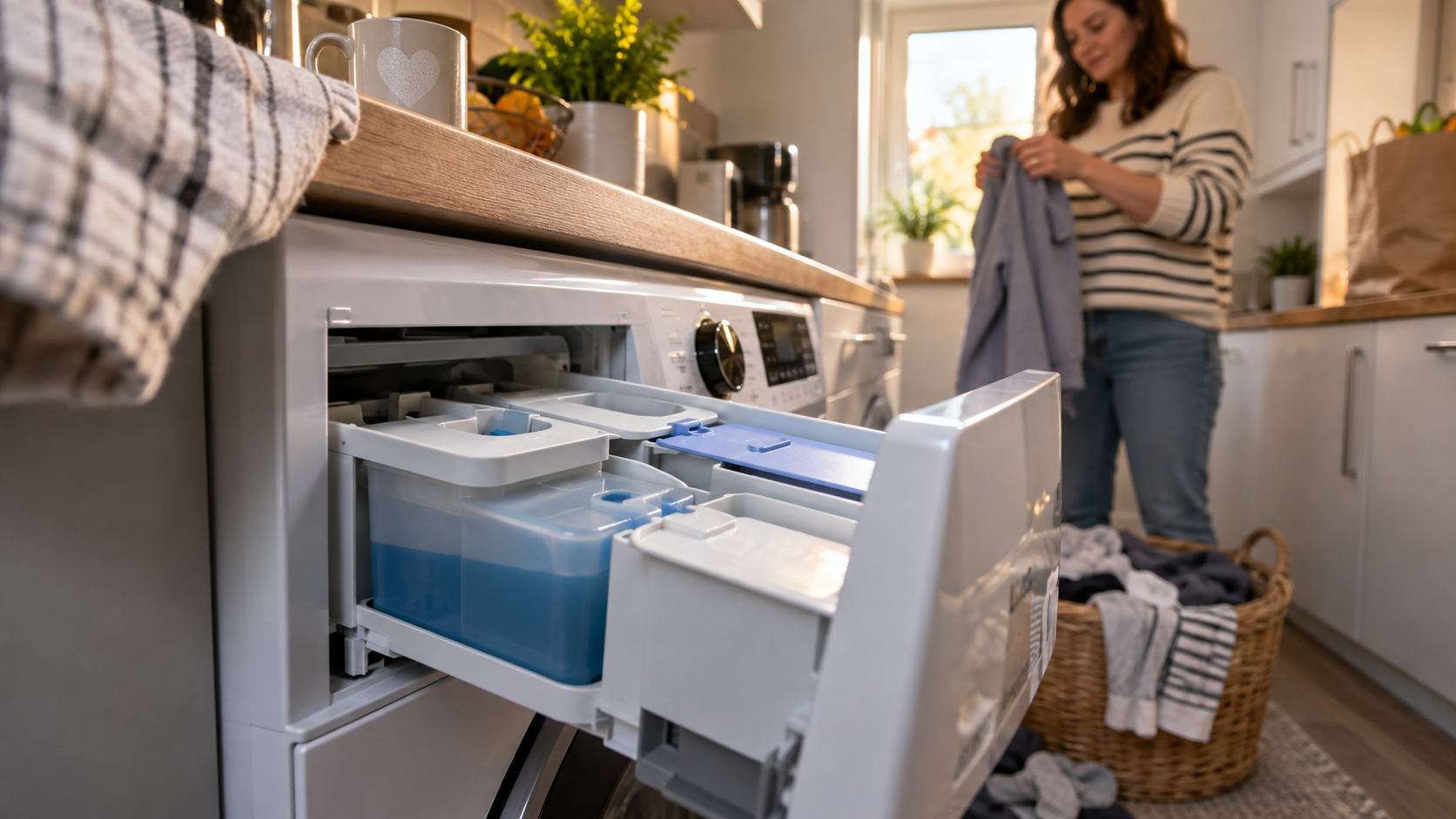
With Automatic Detergent Dosing, the detergent is usually stored in a larger internal compartment rather than the small section of the drawer used for a single wash.
Depending on the machine, the reservoir may be:
- built into the detergent drawer
- located behind a separate flap
- divided into detergent and softener sections
- designed for one detergent plus conditioner
- configurable to hold two different detergents
- designed around proprietary cartridges
Once filled, the reservoir can supply multiple washes.
That is one of the biggest differences between Automatic Detergent Dosing and a conventional detergent drawer.
A normal drawer is essentially a one-wash container.
An Automatic Dosing reservoir is storage.
The machine draws from it only when needed.
For a small kitchen, that can be useful because the large detergent bottle can go back into a cupboard rather than living permanently beside the washing machine.
⚙️ How Does Automatic Detergent Dosing Work?
Although different brands use different names and sensors, the basic process behind Automatic Detergent Dosing is fairly straightforward.
Bosch’s official i-DOS Intelligent Dosing guide explains how its system uses factors including laundry volume, fabric type, degree of soiling and water hardness when automatically dosing detergent.
Step 1: You Fill the Reservoir
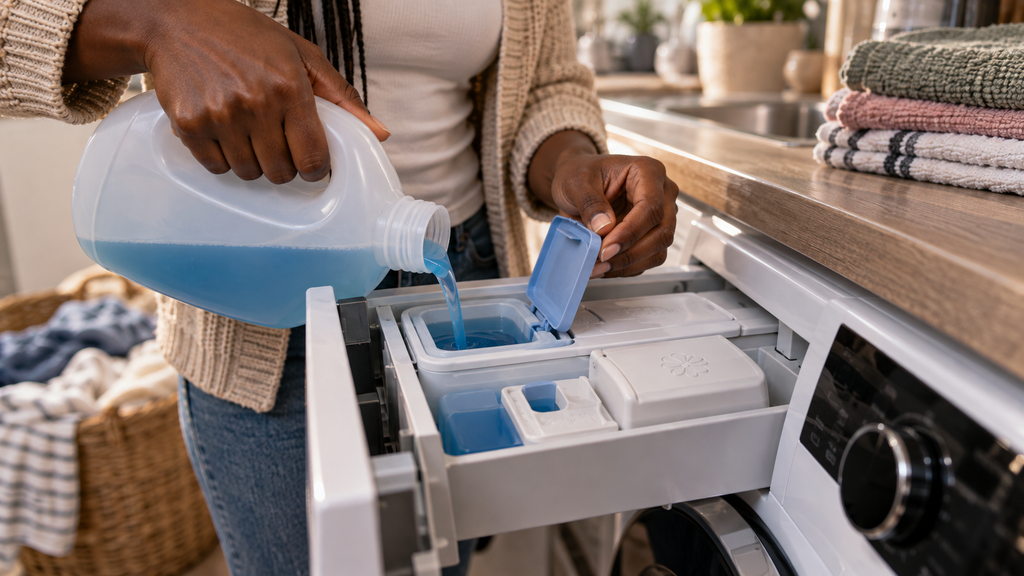
The first step is filling the dedicated detergent tank.
Some machines have one tank.
Others have separate compartments for:
- detergent
- fabric softener
A few systems use two detergent phases or allow one compartment to be reconfigured.
The machine then stores that liquid ready for future washes.
Step 2: The Machine Assesses the Wash
When you start a programme, Automatic Detergent Dosing needs some way to decide how much product should be released.
Depending on the machine, that decision can consider:
- laundry weight
- selected programme
- fabric type
- soil level
- water hardness
- concentration of detergent
- previous settings
Not every washing machine measures every one of those factors.
That is important.
Automatic Detergent Dosing is a category of technology rather than one universal system shared by every manufacturer.
Step 3: The Machine Releases Detergent
A pump or dispensing mechanism moves liquid from the reservoir into the wash system.
The amount is controlled by the machine rather than by you pouring detergent directly into the drawer.
That is the part of Automatic Detergent Dosing that removes the everyday guesswork.
Step 4: Some Systems Adjust During the Cycle
More advanced systems may vary dosing according to what the sensors detect or according to programme settings.
Others calculate a dose at the beginning and dispense according to preset parameters.
Either way, the aim of Automatic Detergent Dosing is to provide a more consistent quantity than an unmeasured splash from a detergent bottle.
⚖️ How Does the Machine Know How Much Detergent to Use?
This is the interesting part.
Automatic Detergent Dosing does not necessarily “see” dirty clothes in the same way a person does.
Instead, the washing machine uses a combination of settings, sensors and stored information.
🧺 Load Weight
Many modern washing machines can estimate the weight of the laundry.
A small load generally needs less detergent than a full drum.
Automatic Detergent Dosing can use that information when calculating the quantity required.
This is useful because one of the most common manual-dosing habits is using roughly the same amount regardless of whether the drum is half full or packed.
👕 Fabric or Programme Type
A cotton programme may be treated differently from delicates, wool or sportswear.
The selected cycle gives Automatic Dosing useful information about what is being washed and how the programme will operate.
Some machines also combine this with fabric-sensing technology.
🟤 Soil Level
Some washing machines allow you to select how dirty the laundry is.
Others may use sensors as part of their wash system.
More heavily soiled clothing can require a different dose from lightly worn clothes.
Automatic Detergent Dosing can take this into account on compatible machines.
💧 Water Hardness
Hard water can require more detergent than soft water.
On some machines, you enter the water-hardness setting during setup.
Automatic Detergent Dosing can then factor that into future washes.
This is one reason initial setup matters.
If the machine has been told the wrong water-hardness level, the dosing recommendation may not be as accurate as it could be.
🧪 Does Automatic Detergent Dosing Measure Detergent Concentration?
Some systems allow the dosing level to be calibrated according to the detergent being used.
That matters because liquid detergents do not all have the same concentration.
A highly concentrated detergent may need far less liquid than a weaker formula.
Depending on the washing machine, Automatic Detergent Dosing may let you:
- enter a recommended millilitre dose
- choose a concentration level
- scan or select the detergent in an app
- manually increase or decrease the default dose
This is an important point because Automatic Detergent Dosing is not magic.
The machine still needs correct information about the detergent if the manufacturer expects that information to be configured.
🫧 Does It Also Dose Fabric Softener?
Sometimes.
Many Automatic Detergent Dosing machines have a second reservoir for fabric softener.
Others let the second tank hold either:
- fabric softener
- another detergent
That can be useful if your household alternates between two laundry liquids.
For example, you might want:
- standard detergent in one tank
- sensitive detergent in another
The exact flexibility depends on the appliance.
If automatic softener dosing matters to you, check the machine specification rather than assuming every Automatic Detergent Dosing system handles both liquids.
🔄 Is Every Auto-Dosing System the Same?
No.
This is where the subject becomes confusing because manufacturers use different brand names for similar ideas.
Examples include systems marketed as:
- i-DOS
- Auto Dispense
- ezDispense
- TwinDos
- AutoDose
- Smart Dosing
They all sit within the broader idea of Automatic Detergent Dosing, but they do not necessarily work in exactly the same way.
Some use standard liquid detergent.
Some offer flexible dual reservoirs.
Some use branded cartridge systems.
Some calculate according to load weight.
Some combine load information with water hardness or soil settings.
So when comparing Automatic Detergent Dosing systems, look beyond the name.
The important questions are:
- What does it store?
- What does it measure?
- Can you adjust the dose?
- Can you disable it?
- Can you use your preferred detergent?
- How easy is the system to clean?
🧼 Can You Still Use Powder Detergent?
Usually, yes — but generally not inside a liquid Automatic Detergent Dosing reservoir.
Many machines retain a manual detergent compartment.
That means you can switch off Automatic Dosing for a particular wash and add powder manually.
This can be helpful for:
- specialist powders
- occasional stain-removal products
- white washes
- detergents unsuitable for the automatic reservoir
The important thing is to follow the washing-machine instructions.
Do not pour powder into a tank intended only for liquid detergent.
🟢 Can You Use Laundry Pods?
In many machines, pods can still be used when Automatic Detergent Dosing is switched off.
Laundry capsules are normally placed directly in the drum rather than inside an auto-dose reservoir.
If you prefer pods for certain washes, Automatic Detergent Dosing does not necessarily lock you out of using them.
You simply need to use the correct manual mode for that cycle.
Again, check the manufacturer’s instructions because programme and detergent compatibility can vary.
⏸ Can You Turn Automatic Detergent Dosing Off?
Usually.
A good Automatic Detergent Dosing system should not force automatic liquid dosing into every single wash.
There are plenty of situations where manual dosing may make more sense.
For example:
- wool detergent
- sports detergent
- whitening powder
- laundry pods
- specialist stain products
- fragrance-free detergent for one family member
Many machines allow Automatic Detergent Dosing to be disabled from the control panel or app.
You then use the manual compartment or another approved dosing method.
That flexibility makes the technology far more practical.
💷 Does Automatic Detergent Dosing Save Detergent?
It can — particularly if you currently tend to over-pour.
Manual detergent dosing is surprisingly imprecise.
People often:
- fill the cap without measuring
- add extra detergent for reassurance
- use the same quantity for every load
- ignore water hardness
- add more because clothes are heavily soiled
More detergent does not automatically mean cleaner clothes.
Automatic Detergent Dosing aims to use a more appropriate amount for the load and programme.
If you previously over-dosed regularly, that can reduce detergent consumption.
But Automatic Detergent Dosing will not necessarily transform your laundry budget if you were already measuring accurately.
💰 Does Automatic Detergent Dosing Save Money?
Potentially, but the answer depends on your habits.
There are two opposing factors.
Possible Saving
Automatic Detergent Dosing can reduce wasted detergent if you previously used too much.
Over many washes, that can add up.
Possible Extra Cost
A washing machine with Automatic Detergent Dosing may cost more to buy than a basic model.
Some proprietary detergent systems may also cost more than supermarket liquid.
So the financial case should not be reduced to “auto dosing saves money”.
The strongest reason to choose Automatic Detergent Dosing is usually convenience and consistency.
Any detergent saving is a useful secondary benefit.
👚 Can Too Much Detergent Cause Problems?
Using excessive detergent can create problems.
It may lead to:
- excess foam
- detergent residue
- additional rinsing
- product build-up
- stiff-feeling laundry
- residue inside the machine
That is one reason Automatic Dosing can be useful.
The aim is not to use as little detergent as possible.
The aim is to use an appropriate amount.
That distinction matters.
👃 Can Too Little Detergent Be a Problem?
Yes.
Automatic Detergent Dosing is not about permanently minimising the dose.
Too little detergent may leave:
- stains
- oils
- odours
- body soils
insufficiently removed.
That is why correct setup matters.
If your machine allows water hardness, detergent concentration or dose level to be adjusted, do not automatically choose the lowest possible setting.
Automatic Detergent Dosing works best when the machine has accurate information.
🚿 Does Auto Dosing Use More Water?
Not inherently.
Automatic Detergent Dosing controls detergent, not the entire water-management system.
Modern washing machines separately determine water use according to programme design, load sensing and efficiency settings.
In fact, excessive manual detergent can sometimes create extra foam that the machine may need to deal with.
But you should not buy an Automatic Detergent Dosing machine on the assumption that the dosing feature itself guarantees lower water consumption.
Check the appliance’s actual energy label and programme data.
🧴 How Often Do You Need to Refill the Reservoir?
That depends on:
- tank size
- load frequency
- detergent concentration
- dosing level
- household size
For many users, the key advantage of Automatic Detergent Dosing is that refilling changes from an every-wash task into an occasional job.
Some systems can hold enough detergent for weeks of normal household use.
But manufacturer estimates are always based on assumptions about load size and dose.
A family running several large washes every day will refill more often than someone doing three smaller loads each week.
🚨 How Do You Know When It Needs Refilling?
Automatic Detergent Dosing machines normally provide some form of warning.
Depending on the model, this might be:
- an indicator light
- a display message
- an app notification
- a reservoir-level indicator
Do not wait until clothes start emerging dirty before checking the tank.
If the machine says the reservoir is low, refill it.
Simple as that.
🧽 Does Automatic Detergent Dosing Need Cleaning?
Yes.
This is one of the most important parts of owning an auto-dosing machine.
Automatic Detergent Dosing involves:
- liquid detergent
- tanks
- pumps
- channels
- hoses
Liquid detergent can thicken, dry or leave residue over time.
That means the system may need periodic cleaning or maintenance.
Follow the washing machine’s own instructions because cleaning procedures vary significantly.
Some systems have dedicated maintenance programmes.
Others require the reservoir or drawer to be removed and rinsed.
If you leave Automatic Detergent Dosing unused for a long period, cleaning becomes particularly important because stagnant detergent can become more difficult to move through the system.
🧹 How Do You Keep an Auto-Dosing System Healthy?
A few simple habits help.
Use Suitable Detergent
Only put products into the reservoir that the manufacturer says are compatible.
Do Not Mix Random Detergents
If you want to change detergent type, follow the cleaning or emptying procedure first where required.
Mixing incompatible formulas inside the Automatic Detergent Dosing tank is not a clever shortcut.
Clean When Prompted
If the machine asks for an Automatic Detergent Dosing maintenance cycle, do it.
Ignoring repeated warnings can allow residue to build up.
Do Not Leave Detergent Sitting for Months
If the washing machine will be unused for an extended period, check the manual for storage and cleaning guidance.
🏠 Why Automatic Detergent Dosing Makes Sense in a Small Kitchen
Automatic Dosing is not technically a space-saving feature.
The washing machine itself does not suddenly become smaller.
But it can improve how a compact laundry area feels.
If detergent lives inside the machine, you may not need a large bottle sitting:
- on the worktop
- beside the washer
- on top of the machine
- on an open shelf
That matters more in a small kitchen than it does in a huge utility room.
Removing even one or two bulky laundry products from sight can make a cramped area feel more organised.
Automatic Detergent Dosing also reduces the need to pull detergent out of a crowded cupboard for every single wash.
It is a small quality-of-life improvement rather than a dramatic space transformation.
If appliance size is just as important as detergent automation, our Best Washing Machines for Small Flats UK guide compares compact washers designed around smaller homes.
🧺 Is Automatic Detergent Dosing Useful for Families?
It can be particularly useful for households doing lots of washing.
The more cycles you run, the more often you would otherwise measure detergent.
A family washing:
- school uniform
- towels
- bedding
- sports kit
- everyday clothing
may use the washing machine almost every day.
Automatic Detergent Dosing turns one repeated task into an occasional refill.
The benefit is not enormous on any individual wash.
The convenience accumulates.
👤 What About a One-Person Household?
Automatic Detergent Dosing can still be useful, but it is less essential.
If you run only a couple of washes per week and already measure detergent accurately, manually pouring detergent is hardly a major burden.
In that situation, do not buy an expensive washing machine solely because it has Automatic Detergent Dosing.
Consider the whole appliance:
- dimensions
- energy efficiency
- drum size
- noise
- programme quality
- price
Automatic Detergent Dosing should be a useful feature, not the only reason the machine makes sense.
👶 Is Auto Dosing Useful With Children?
Potentially.
Families with young children often produce irregular laundry loads.
One wash might contain lightly worn clothes, while the next has:
- food stains
- muddy trousers
- bedding
- towels
Automatic Detergent Dosing can reduce the temptation to simply add an enormous amount of detergent whenever a load looks dirty.
However, stain treatment is still separate.
A difficult stain may need pretreatment regardless of how clever the Automatic Detergent Dosing system is.
🌿 Can You Use Eco Detergent?
Often yes, provided it is compatible with the machine.
Automatic Dosing does not inherently require one type of conventional detergent.
But the liquid must normally be suitable for automatic washing machines and compatible with the reservoir.
If you use a concentrated eco detergent, you may need to adjust the configured dose.
Check:
- manufacturer guidance
- detergent dosage instructions
- water hardness
The machine cannot compensate perfectly for a detergent concentration it has never been told about.
🔁 What Happens When You Change Detergent?
Do not automatically pour a new detergent on top of whatever remains in the tank.
Different formulas can have different:
- concentrations
- viscosities
- ingredients
- dosing recommendations
Depending on the washing machine, you may need to:
- use up the existing detergent;
- empty the reservoir;
- clean the Automatic Detergent Dosing system;
- refill with the new detergent;
- update the dose setting.
That sounds more complicated than it is.
You just do not want several unrelated liquids slowly becoming one mysterious mixture inside the tank.
🛠 What Can Go Wrong With Automatic Detergent Dosing?
Automatic Detergent Dosing adds pumps, reservoirs and control systems that a completely basic washing machine does not have.
Possible issues include:
- dried detergent
- blocked channels
- incorrect dose settings
- empty reservoirs
- sensors or pumps developing faults
- incompatible detergent
- maintenance warnings
This does not mean Automatic Detergent Dosing is unreliable.
It simply means added convenience comes with added components.
If simplicity and minimum maintenance are your absolute priorities, a traditional detergent drawer is mechanically simpler.
⚠️ Common Automatic Detergent Dosing Mistakes
1. Filling the Wrong Compartment
Detergent and softener reservoirs are not interchangeable unless the machine specifically allows them to be configured that way.
2. Ignoring Water Hardness
If your machine asks for water hardness, set it correctly.
Automatic Detergent Dosing can only make a good decision using good information.
3. Assuming More Detergent Means Cleaner Clothes
It does not.
Automatic Detergent Dosing is designed to reduce that kind of guesswork.
4. Putting Powder Into a Liquid Reservoir
Do not do this unless your manual explicitly says the compartment accepts powder.
5. Never Cleaning the System
Automatic Detergent Dosing still needs maintenance.
6. Forgetting You Changed Detergent
If the new liquid has a different recommended dose, update the machine where necessary.
7. Using Automatic Dosing for Every Specialist Wash
Sometimes manual detergent is more appropriate.
Switching Automatic Detergent Dosing off for one cycle is completely normal.
✅ Advantages of Automatic Detergent Dosing
Automatic Detergent Dosing has several genuine benefits.
Convenience
You do not measure detergent for every wash.
Consistency
The machine uses a controlled dose rather than an unmeasured pour.
Less Clutter
Large detergent bottles can stay in a cupboard between refills.
For kitchens where every centimetre matters, our Best Narrow Washing Machines for Small Spaces UK guide explores machines designed for tighter layouts and restricted appliance spaces.
Potentially Less Waste
Households that habitually over-dose may use less detergent.
Easier Frequent Washing
The convenience becomes more noticeable in homes running laundry regularly.
If indoor laundry is contributing to excess moisture, our How to Reduce Damp in a Studio Flat guide covers practical ways to manage condensation and humidity in smaller homes.
❌ Disadvantages of Automatic Detergent Dosing
It is not automatically better for everyone.
Higher Purchase Price
Automatic Detergent Dosing tends to appear on more feature-rich machines.
Extra Maintenance
Reservoirs and dosing channels need cleaning.
More Components
Pumps and sensors add complexity.
Detergent Restrictions
Some systems are more flexible than others.
Less Valuable for Infrequent Washing
If you wash twice a week, manually measuring detergent may not bother you at all.

🤔 Is Automatic Detergent Dosing Worth It?
For the right household, yes.
Automatic Detergent Dosing makes the strongest case when:
- you wash frequently
- you tend to over-dose detergent
- several people use the machine
- you value convenience
- you dislike detergent bottles around the kitchen
- you already want a washing machine that includes the feature
It makes a weaker case when:
- you wash infrequently
- you already measure detergent carefully
- you constantly switch between specialist detergents
- the auto-dose model costs significantly more than an otherwise suitable machine
- you prefer the simplest possible appliance
The best way to think about Automatic Detergent Dosing is not as a revolutionary washing technology.
It is automation.
It removes a repetitive decision from the routine.
Whether that is worth paying for depends on how much you value that convenience.
🧠 Automatic Detergent Dosing vs Manual Dosing
| Feature | Automatic Detergent Dosing | Manual Dosing |
|---|---|---|
| Add detergent every wash | No | Yes |
| Dose consistency | High when configured correctly | Depends on user |
| Can reduce habitual over-dosing | Yes | Only if measured carefully |
| Specialist detergent flexibility | Varies | Excellent |
| Maintenance | Reservoir/system cleaning | Drawer cleaning |
| Mechanical simplicity | More complex | Simpler |
| Convenience | High | Basic |
| Upfront machine cost | Often higher | Available at all price levels |
Neither method automatically produces cleaner clothes.
A correctly measured manual dose can work perfectly well.
Automatic Detergent Dosing is primarily about making correct dosing easier and more consistent.
❓ FAQs
What Is Automatic Detergent Dosing?
Automatic Detergent Dosing is a washing-machine feature that stores liquid detergent inside a reservoir and automatically dispenses an appropriate amount during a wash cycle.
How Does Automatic Detergent Dosing Know How Much to Use?
Depending on the machine, Automatic Detergent Dosing can consider load weight, programme type, fabric characteristics, soil settings, water hardness and configured detergent concentration.
Not every machine measures all of these.
Does Automatic Detergent Dosing Work With Fabric Softener?
Some systems do.
Machines with a second reservoir may automatically dispense softener or allow the second compartment to be configured for another detergent.
Can I Use Any Detergent With Automatic Detergent Dosing?
Usually you can use compatible liquid detergent, but exact requirements vary.
Always check the washing-machine instructions before filling the Detergent Dosing reservoir.
Can You Use Powder With Automatic Detergent Dosing?
Powder normally goes into a manual compartment rather than the liquid Automatic Detergent Dosing tank.
Switch automatic dispensing off for that cycle where required.
Can You Use Pods in an Auto-Dosing Washing Machine?
Often yes.
The Automatic Dosing system can normally be disabled, allowing a compatible laundry pod to be used according to the manufacturer’s instructions.
Can I Turn Automatic Detergent Dosing Off?
On most machines, yes.
This is useful when using specialist detergent, powder or pods.
Does Automatic Detergent Dosing Save Money?
It can reduce detergent waste if you normally use too much, but the machine itself may cost more.
Convenience is usually the stronger reason to choose Automatic Detergent Dosing.
Does Automatic Detergent Dosing Need Cleaning?
Yes.
Reservoirs, channels and pumps can accumulate detergent residue.
Follow the manufacturer’s Automatic Dosing maintenance instructions.
How Often Do You Refill Automatic Detergent Dosing?
It depends on reservoir size, dose level and washing frequency.
The main advantage is that you normally refill occasionally rather than adding detergent for every wash.
Is Automatic Detergent Dosing Good for a Small Kitchen?
It can be.
Automatic Detergent Dosing does not make the washing machine smaller, but it can reduce detergent clutter around the machine because the liquid is stored internally.
Is Automatic Detergent Dosing Worth Paying Extra For?
It is most worthwhile for households that wash frequently and value convenience.
For compact homes where clothes take a long time to dry indoors, our Best Small Dehumidifiers for Studio Flats UK guide compares space-conscious options for controlling excess moisture.
If you rarely wash or already measure detergent accurately, Automatic Dosing may be less important than dimensions, efficiency or price.
If physical appliance depth is a bigger priority than extra smart features, our Are Slimline Washing Machines Worth It UK guide explains the practical advantages and compromises of reduced-depth washers.
✅ Final Verdict
Automatic Detergent Dosing takes a simple household task — measuring detergent — and turns it into something the washing machine largely handles for you.
You fill a larger reservoir, configure the system where necessary and let the machine dispense detergent across multiple washes.
Depending on the model, Automatic Detergent Dosing may use load weight, programme selection, water hardness, fabric information or soil settings to determine how much liquid is appropriate.
The biggest benefits are:
- convenience
- consistent dosing
- potentially less detergent waste
- fewer detergent bottles sitting around a small kitchen
The compromises are:
- a higher machine price in some cases
- extra maintenance
- more complicated internal components
- varying flexibility between detergent systems
For households running several washes each week, Automatic Dosing can be one of those features that quickly becomes normal once you have it.
If your small home also lacks space for a separate tumble dryer, our Best Washer Dryers for Small Flats UK guide compares two-in-one laundry appliances for compact layouts.
For someone washing only occasionally, it is useful rather than essential.
The important thing is not to assume every system works identically.
Check what the machine stores, what it measures, whether you can adjust the dose, whether you can switch Automatic Dosing off and how the reservoir needs to be maintained.
Automatic Detergent Dosing will not transform what a washing machine fundamentally does.
It simply makes one repetitive part of laundry more automatic — and in a busy or compact home, that can be surprisingly worthwhile.