
Can You Put a Fridge Freezer Next to an Oven? 7 Things to Know
Can You Put a Fridge Freezer Next to an Oven Safely?
Can You Put a Fridge Freezer Next to an Oven? Yes, it may be possible, but it is not the ideal kitchen layout. The fridge freezer must be protected from excessive heat, given the ventilation clearance required by its manufacturer and positioned so that both appliance doors can open safely.
An oven produces heat while cooking, whereas a fridge freezer works continuously to remove heat from its interior. Placing the two appliances directly beside one another can make the fridge freezer work harder, particularly if there is no cabinet panel, insulation or ventilation gap between them.
The safest arrangement is usually to separate the appliances. Where a compact kitchen makes this impossible, a suitable divider panel and careful installation can reduce the amount of heat transferred to the fridge freezer.
The answer to Can You Put a Fridge Freezer Next to an Oven becomes more cautious when there is no cabinet or protective divider between them.
⚡ Quick Answer
Can You Put a Fridge Freezer Next to an Oven? Yes, provided the installation instructions for both appliances allow it. Leave the required ventilation space, use a heat-resistant cabinet or insulation panel where appropriate, and avoid allowing the fridge freezer to touch the oven housing directly.
When deciding Can You Put a Fridge Freezer Next to an Oven, the exact appliance manuals should always take priority over general spacing advice.
Why Is an Oven Beside a Fridge Freezer a Concern?
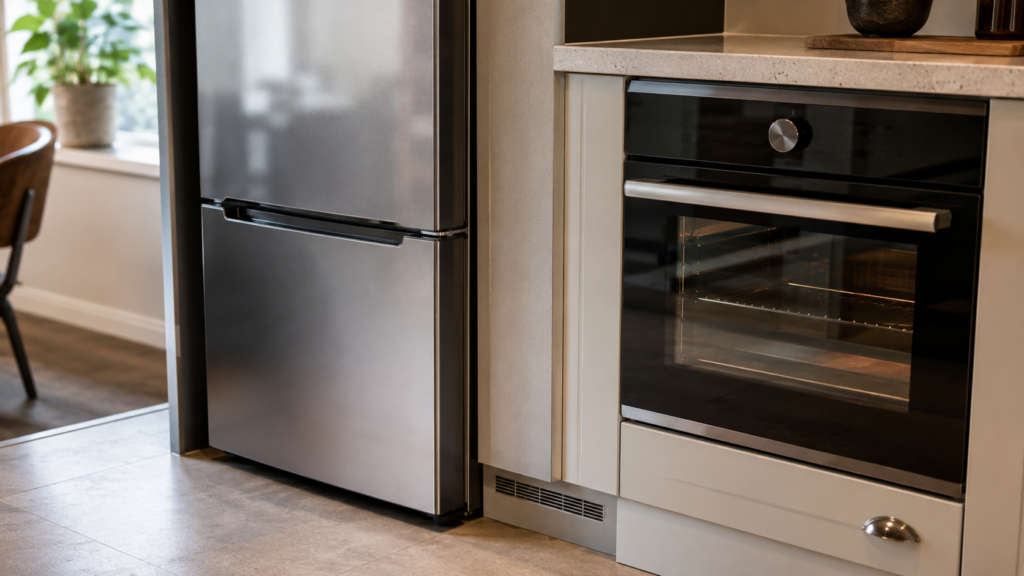
The two appliances are designed to perform opposite jobs.
An oven creates and retains high temperatures. A fridge freezer uses a compressor and cooling system to keep food cold while releasing absorbed heat into the surrounding room.
If heat from the oven reaches the side of the fridge freezer, the refrigeration system may need to run for longer to maintain the selected internal temperature.
Possible effects include:
- Increased compressor operation
- Higher electricity consumption
- More noticeable operating noise
- Warmer exterior panels
- Less stable internal temperatures
- Additional strain during prolonged cooking
- Faster deterioration of nearby cabinet finishes
Samsung advises that placing a refrigerator near a heat source such as an oven or radiator can affect its ability to remain cool and force its compressor to work harder. Bosch similarly recommends avoiding heat sources where possible and using suitable insulation or separation when they cannot be avoided. citeturn941130search2turn941130search19
This does not mean that every side-by-side installation will immediately damage the appliance. Modern built-in ovens are insulated, and many kitchen layouts use protective cabinets between appliances.
However, Can You Put a Fridge Freezer Next to an Oven safely depends on the installation details rather than their appearance from the front.
🔥 How Much Heat Does a Built-In Oven Release?
A built-in oven is designed to contain most of the heat created during cooking, but it does not remain completely cold on the outside.
Warm air may escape through:
- Cooling vents
- The area above the oven door
- The rear of the housing
- Gaps around the cabinet
- The side panels
- The space beneath the worktop
The oven’s internal cooling fan may continue running after cooking has finished. This helps protect the controls and surrounding cabinetry while the appliance cools.
A correctly installed oven should sit inside a cabinet that meets the manufacturer’s heat-resistance and ventilation requirements. The oven should not simply be pushed into an improvised opening beside the fridge freezer.
If the cabinet becomes excessively hot, smells scorched or shows signs of discolouration, stop using the oven and have the installation checked.
When asking Can You Put a Fridge Freezer Next to an Oven, remember that the oven cabinet is part of the safety arrangement.
↔️ How Much Space Should Be Between Them?
There is no universal gap that applies to every oven and fridge freezer.
The correct separation depends on:
- The fridge freezer’s ventilation system
- Where the fridge releases heat
- The oven’s insulation
- The oven-housing design
- Whether a divider panel is fitted
- Manufacturer installation requirements
- The thickness and material of the cabinet
Some manufacturer guidance recommends avoiding heat sources entirely. Where this is not possible, Bosch advises minimising heat transfer with a suitable insulation plate or maintaining at least 30mm from a cooker in the relevant installation guidance. citeturn941130search8turn941130search19
That figure should not be treated as a universal rule for every appliance.
Some modern fridge freezers need only a small side clearance, while others require several centimetres. Samsung notes that the required gap varies by model and advises checking the specific user manual. citeturn941130search21
Therefore, the best answer to Can You Put a Fridge Freezer Next to an Oven is to check both manuals before finalising the kitchen design.
Before finalising the layout, check how much space you should leave around a fridge freezer for ventilation and safe operation.
🧱 Should There Be a Cabinet Panel Between Them?
A full-height cabinet side panel is usually preferable to leaving the appliances directly exposed to one another.
When considering Can You Put a Fridge Freezer Next to an Oven, a proper cabinet panel can provide valuable physical and thermal separation.
The panel can:
- Create physical separation
- Reduce direct radiant heat
- Protect the fridge freezer’s side wall
- Provide a finished kitchen appearance
- Support surrounding cabinetry
- Reduce vibration between appliances
A standard decorative end panel may offer some protection, but it is not automatically a specialist heat shield.
Its suitability depends on:
- The material
- The panel thickness
- The oven manufacturer’s requirements
- The distance from the oven housing
- Whether additional insulation is required
If the oven and fridge freezer are installed inside separate tall cabinets, the combined cabinet sides may provide more separation than a freestanding fridge placed directly beside an exposed oven unit.
However, Can You Put a Fridge Freezer Next to an Oven using only a thin panel cannot be answered without checking the exact appliance specifications.
🛡️ Do You Need an Insulation Panel?

An insulation panel can be useful where the appliances must sit close together.
Suitable materials may include:
- A purpose-made appliance insulation panel
- Heat-resistant cabinet board
- Foil-faced insulation designed for kitchen use
- A manufacturer-approved heat shield
- An insulated oven-housing side panel
Do not place improvised materials such as cardboard, foam packaging or household foil between the appliances.
These may:
- Trap heat
- Restrict ventilation
- Create a fire risk
- Absorb moisture
- Move out of position
- Damage the appliance finish
The insulation must be appropriate for the temperatures involved and installed without blocking vents or preventing either appliance from being removed.
A kitchen fitter or appliance installer can advise whether the existing cabinet panel is sufficient.
Where the oven manufacturer already requires a specific housing specification, changing or adding materials without checking the instructions may create a different problem.
For this reason, Can You Put a Fridge Freezer Next to an Oven should be treated as an installation question, not simply a furniture-layout decision.
🌬️ Do Not Block the Fridge Freezer’s Ventilation
Protecting the fridge freezer from the oven will not help if its own ventilation is blocked.
Adequate airflow remains essential when deciding Can You Put a Fridge Freezer Next to an Oven in a compact fitted kitchen.
A fridge freezer releases heat through different areas depending on its design. These can include:
- The rear condenser
- The exterior side walls
- The top of the appliance
- A lower front grille
- Hidden channels around an integrated cabinet
Samsung recommends allowing ventilation space around fridge freezers and notes that model-specific requirements must be checked. Its broader buying guidance suggests allowing several centimetres around an appliance where possible, while LG advises maintaining clearance between the fridge freezer and surrounding walls. citeturn941130search16turn941130search18
Do not assume that fitting an insulation panel means the fridge freezer can be enclosed tightly.
When assessing Can You Put a Fridge Freezer Next to an Oven, check:
- Side clearance
- Rear clearance
- Space above the appliance
- Lower ventilation openings
- Door-hinge clearance
- Access for cleaning
- The ability to pull the appliance forward
A narrow visible gap may look untidy, but it can be necessary for safe airflow.
Restricted airflow can also contribute to temperature problems, so it is useful to understand why a fridge freezer keeps icing up.
🚪 Check Both Appliance Doors
The fridge freezer and oven doors must be able to open without colliding.
Potential problems include:
- The fridge handle hitting the oven
- The fridge door blocking the oven controls
- The oven door preventing access to freezer drawers
- Two open doors obstructing the kitchen walkway
- Heat from an open oven reaching the fridge door seal
- Difficulty removing fridge shelves or drawers
A fridge freezer door may need to open beyond 90 degrees before internal drawers can be removed completely.
The oven door may also project significantly into the room when open, creating a hazard in a narrow galley kitchen.
Before approving the layout, open both appliance doors on a kitchen plan or measure their full swing.
The question Can You Put a Fridge Freezer Next to an Oven is not only about heat; the layout must also remain practical during everyday cooking.
⚡ Will the Fridge Freezer Use More Electricity?
It can use more electricity if the oven repeatedly heats the air and surfaces around it.
The fridge freezer’s thermostat responds to rising internal temperatures by running the compressor. If heat enters through the cabinet or door seals, the compressor may operate for longer.
The effect will depend on:
- How often the oven is used
- The oven’s insulation
- The room temperature
- Ventilation around the fridge
- The gap between the appliances
- Whether a divider is installed
- The fridge freezer’s efficiency
- How often its door is opened
The difference may be small in a well-designed installation. It may become more noticeable if the oven is used daily, the kitchen is poorly ventilated or the fridge freezer is already tightly enclosed.
Samsung states that excessive surrounding heat can make the refrigerator work harder and reduce cooling efficiency. citeturn941130search2turn941130search9
This is another reason why Can You Put a Fridge Freezer Next to an Oven should be considered before the cabinets and worktops are installed.
Our guide to how much electricity a fridge freezer uses explains the other factors that affect its running costs.
🌡️ Signs the Fridge Freezer Is Getting Too Hot
Some warmth around a fridge freezer can be normal, particularly on models that release heat through their side panels.
There are several other possible reasons why a fridge freezer may not be cold enough, so check the wider symptoms before assuming the oven is solely responsible.
Warning signs include:
- The side beside the oven becoming extremely hot
- The compressor running almost continuously
- Food not staying sufficiently cold
- Frozen food becoming soft
- Unusual clicking or humming
- Condensation around nearby cabinets
- The door seal becoming distorted
- The appliance displaying a temperature warning
- Electricity use increasing unexpectedly
Check the internal temperature with a suitable fridge thermometer rather than judging it only by touching the exterior.
If the appliance struggles mainly after the oven has been used, the surrounding heat or installation layout may be contributing.
In that situation, reconsidering Can You Put a Fridge Freezer Next to an Oven may reveal that additional insulation, ventilation or separation is required.
You should also confirm what temperature a fridge freezer should be in the UK before deciding whether the appliance is overheating.
🏠 What Is the Safest Kitchen Layout?
The safest layout separates the fridge freezer from the oven wherever the room allows.
A tall storage cupboard, worktop section or narrow pull-out unit between them can provide useful thermal separation while improving the overall kitchen layout.
This type of separation provides a safer answer to Can You Put a Fridge Freezer Next to an Oven than placing both appliance cabinets in direct contact.
Better arrangements include:
- A tall cupboard between the appliances
- A worktop and base cabinet between them
- The fridge freezer on the opposite wall
- The oven inside a separate tall housing
- A purpose-made insulated divider
- A small pantry unit between the heat source and fridge
When planning Can You Put a Fridge Freezer Next to an Oven, even a modest amount of separation can reduce direct heat transfer and make both appliances easier to access.
In a very small kitchen, separating them completely may be unrealistic. The priority should then be following both installation manuals, maintaining ventilation and using suitable cabinet materials.
Choosing one of the best fridge freezers for small kitchens UK may make it easier to create a safer gap between the appliances.
🧰 When Should You Use a Professional Installer?
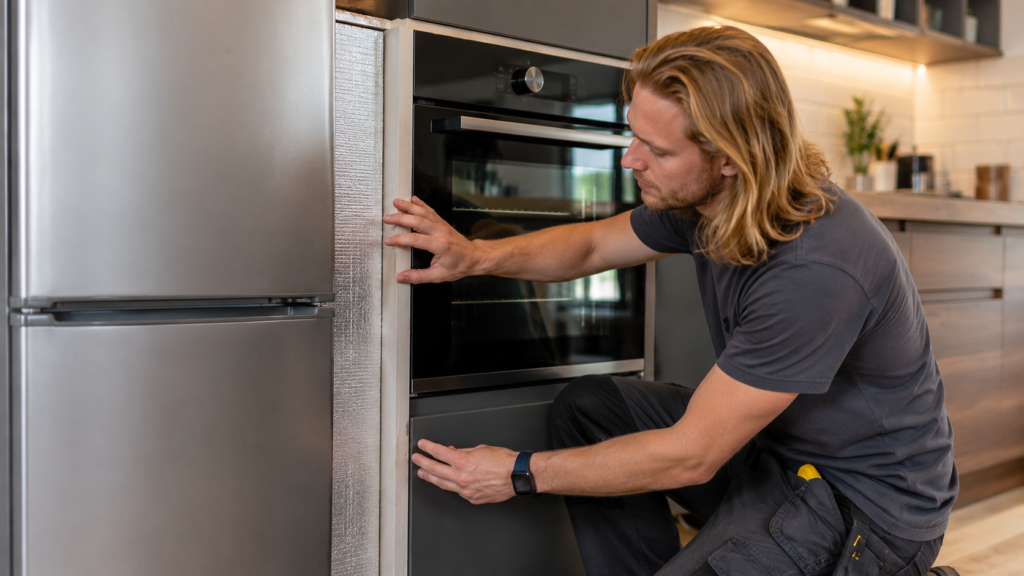
Professional help is sensible when:
- The appliances will sit directly beside one another
- A new insulation panel is required
- The oven housing is being altered
- Electrical sockets must be relocated
- Ventilation openings need to be added
- The fridge freezer is being enclosed
- You are unsure whether the cabinet material is heat resistant
A qualified kitchen fitter can assess the physical layout, while a competent electrician can check the oven supply, sockets and appliance connections.
Do not extend cables, move electrical outlets or modify appliance housings without understanding the manufacturer’s requirements.
For many homeowners, the practical answer to Can You Put a Fridge Freezer Next to an Oven depends on whether the existing kitchen can be adapted safely.
🔌 Keep the Electrical Connections Separate and Accessible
The oven and fridge freezer should be connected according to their individual electrical requirements.
A built-in oven may use a dedicated circuit or fused connection, while a fridge freezer usually connects through a standard accessible socket.
Avoid:
- Trapping plugs behind hot appliance housings
- Crushing the fridge freezer cable
- Running cables across oven ventilation openings
- Using overloaded extension leads
- Positioning sockets where they cannot be reached
- Allowing cables to touch hot surfaces
The fridge freezer should ideally have a socket that can be isolated without removing the oven.
Electrical access is another factor when deciding Can You Put a Fridge Freezer Next to an Oven in a compact fitted kitchen.
🧊 What About an Integrated Fridge Freezer?
An integrated fridge freezer can sometimes sit beside an integrated oven, but both appliances must be housed correctly.
Integrated models rely on ventilation paths built into their cabinets. These commonly include:
- A lower air inlet
- Space behind the appliance
- An upper ventilation outlet
- Correct cabinet dimensions
- Suitable door clearances
The cabinet side between the appliances may provide useful separation, but it must meet the requirements of both manufacturers.
Do not assume that an integrated fridge freezer is automatically protected simply because it is hidden behind a furniture door.
When assessing Can You Put a Fridge Freezer Next to an Oven in an integrated kitchen, the cabinet ventilation design is just as important as the visible gap.
🍳 What About a Freestanding Cooker?
A freestanding cooker can create more concern than a well-insulated built-in oven.
Heat may escape from:
- The oven cavity
- The hob
- Pan sides
- Rear vents
- Open flames on a gas hob
- Hot trays removed from the oven
A fridge freezer should not normally sit directly beside an exposed freestanding cooker without suitable separation.
A heat-resistant side panel or cabinet is particularly important because the fridge freezer may otherwise receive heat from both the oven and hob.
The manufacturer may specify a minimum distance from cookers or other heat sources.
The answer to Can You Put a Fridge Freezer Next to an Oven is therefore more cautious when the heat source is a freestanding cooker rather than a properly housed built-in appliance.
🧹 Leave Access for Cleaning and Maintenance
Food debris, grease and dust can collect in the narrow space between appliances.
The installation should allow you to:
- Pull the fridge freezer forward
- Inspect the power cable
- Clean ventilation openings
- Check for heat damage
- Remove dust from accessible components
- Look for condensation or water leaks
A gap that is too narrow to clean can become unhygienic and may restrict airflow over time.
Maintenance access should be included when deciding Can You Put a Fridge Freezer Next to an Oven, rather than considered only after the kitchen has been fitted.
Once the appliance is positioned safely, our guide on how to organise a fridge freezer in a small kitchen can help you make better use of its internal storage.
✅ Installation Checklist
Before positioning the appliances together, confirm:
- Both manufacturer manuals permit the layout
- The fridge freezer has its required ventilation gaps
- The oven is installed inside suitable housing
- A cabinet panel or approved insulation separates them
- Neither appliance blocks the other’s vents
- Both doors can open fully
- Internal fridge drawers can be removed
- Electrical cables remain protected
- Sockets are accessible
- The fridge freezer can be pulled out for cleaning
- The surrounding cabinets do not become excessively hot
- The appliance maintains safe internal temperatures
This checklist provides a safer way to answer Can You Put a Fridge Freezer Next to an Oven than relying on a single universal gap measurement.
✅ Final Verdict
So, Can You Put a Fridge Freezer Next to an Oven?
Yes, but separating the appliances is preferable whenever the kitchen layout allows it.
Where they must sit together, follow the installation instructions for both appliances, maintain the fridge freezer’s ventilation clearances and use an appropriate cabinet or insulation panel to reduce heat transfer.
Do not allow the fridge freezer to touch an exposed oven housing directly, and never block ventilation to create a neater-looking fit.
A correctly installed built-in oven with a suitable divider may cause few practical problems. A poorly ventilated fridge freezer beside an unprotected heat source may run for longer, use more electricity and struggle to maintain a stable temperature.
The safest answer to Can You Put a Fridge Freezer Next to an Oven is therefore yes only when the complete installation—not merely the visible gap—has been designed correctly.
Frequently Asked Questions
Following the manufacturer instructions is the most reliable way to resolve Can You Put a Fridge Freezer Next to an Oven safely in your specific kitchen.
Can You Put a Fridge Freezer Next to an Oven without a gap?
You should not normally place them in direct contact. Follow both manufacturer manuals and provide the required ventilation, cabinet separation or approved insulation.
How much space should be between a fridge freezer and an oven?
There is no universal measurement. Some guidance refers to approximately 30mm or a suitable insulation plate, but the exact requirement depends on both appliance models.
Do I need a heat shield between an oven and a fridge freezer?
A suitable insulation or cabinet panel may be needed when the appliances sit close together. It must be heat resistant and must not block ventilation.
Can an integrated fridge freezer go next to an integrated oven?
Yes, when both appliances are installed inside suitable cabinets with the correct ventilation and heat separation. Check the manuals before approving the layout.
Will an oven make a fridge freezer use more electricity?
It can if heat from the oven repeatedly warms the fridge freezer or surrounding air. The compressor may then run for longer to maintain the selected temperature.
Can a fridge freezer go next to a freestanding cooker?
This is less desirable because heat may come from both the oven and hob. Use appropriate separation and follow the minimum-distance guidance from both manufacturers.
How do I know whether my fridge freezer is getting too hot?
Check for continuous compressor operation, poor cooling, temperature warnings or excessive heat on the side facing the oven. Use a fridge thermometer to confirm the internal temperature.
The Bosch fridge installation guidance recommends keeping refrigerators away from heat sources such as cookers wherever possible.