
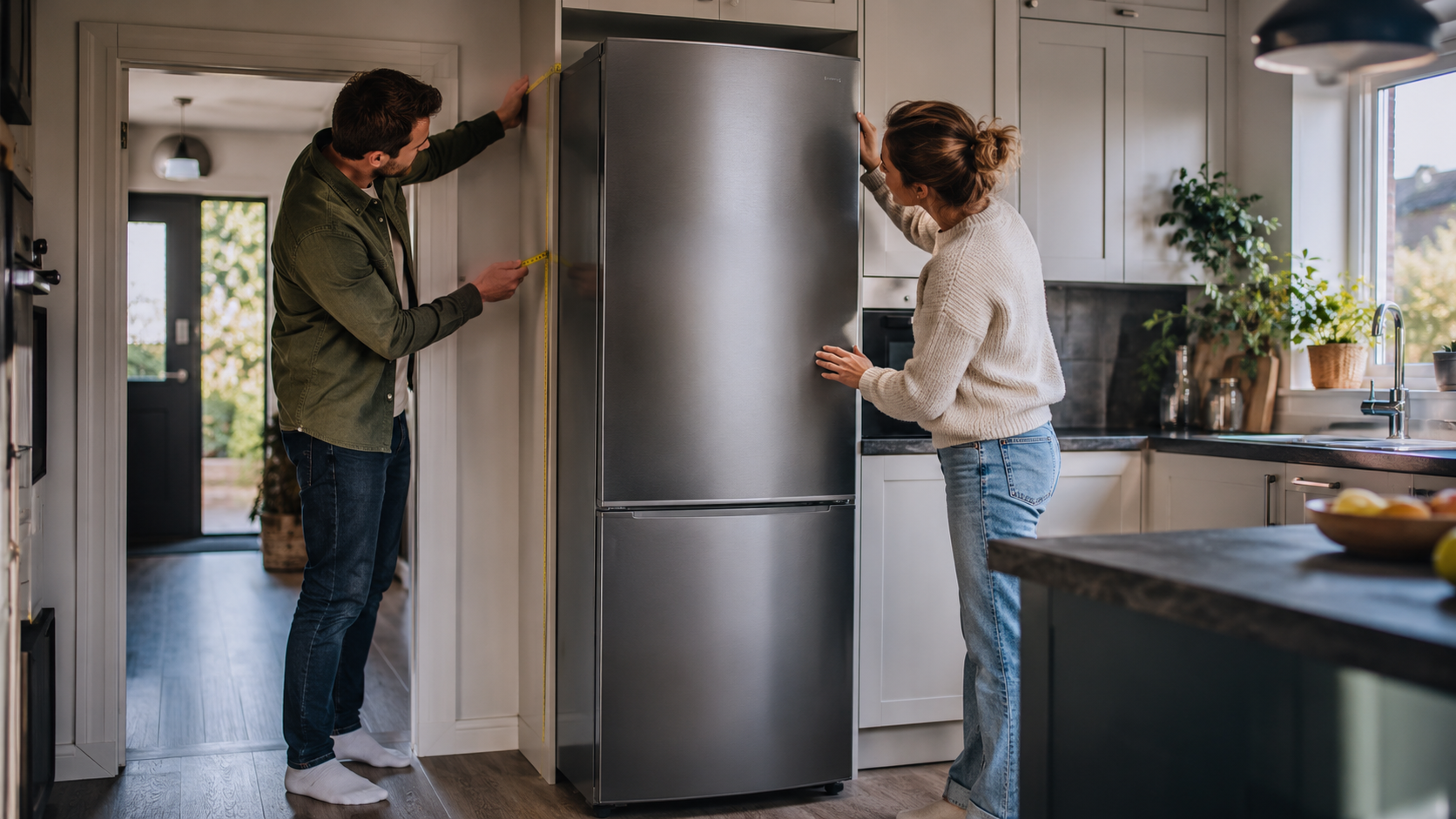
How Much Space Should You Leave Around a Fridge Freezer?
How Much Space Should You Leave Around a Fridge Freezer for Safe Ventilation?
How much space should you leave around a fridge freezer? As a practical starting point, many freestanding models need a few centimetres of clearance behind and beside the appliance, with additional space above where warm air can escape. However, the correct measurements always come from the installation instructions supplied with your exact model.
A fridge freezer should never be forced tightly into a gap simply because its cabinet dimensions appear to fit. The appliance produces heat while cooling your food, and that heat needs somewhere to go. When deciding how much space should you leave around a fridge freezer, you need to consider ventilation, door movement and access for cleaning.
Insufficient airflow can make the compressor work harder, increase electricity consumption and cause the sides or rear of the appliance to feel unusually warm. It may also make the fridge freezer noisier and reduce its ability to maintain a stable internal temperature.
⚡ Quick Answer
How much space should you leave around a fridge freezer? Check the manufacturer’s installation guide first. As a general starting point, allow several centimetres behind the appliance, some clearance at the sides and enough open space above for warm air to escape. You must also leave room for the doors to open fully and for internal drawers to slide out. The correct answer to how much space should you leave around a fridge freezer depends on the exact model and how it releases heat.
Why Does a Fridge Freezer Need Space Around It?
A fridge freezer does not create cold air without producing heat.
The cooling system absorbs heat from inside the appliance and releases it into the surrounding room. Depending on the model, that heat may escape through:
- Coils at the rear
- The back panel
- The exterior side walls
- A ventilation grille
- The area beneath the cabinet
- The space above the appliance
This is why the exterior of a fridge freezer can sometimes feel warm even when it is operating normally.
When the appliance is surrounded by cupboards or pushed directly against a wall, warm air can become trapped. The compressor may then need to run for longer to maintain the selected fridge and freezer temperatures.
Manufacturer guidance varies between models, but appliance makers commonly advise leaving ventilation space around freestanding refrigeration. LG, for example, advises leaving at least a few centimetres around the sides and rear of large fridge freezers so heat can escape.
Understanding how much space should you leave around a fridge freezer is therefore about performance as well as physical fit and understanding how much space should you leave around a fridge freezer can prevent overheating, excessive compressor use and unnecessary noise.
Restricted ventilation can make the compressor work harder, so learn how much electricity a fridge freezer uses before judging its running costs.
📏 How Much Space Should You Leave Behind a Fridge Freezer?
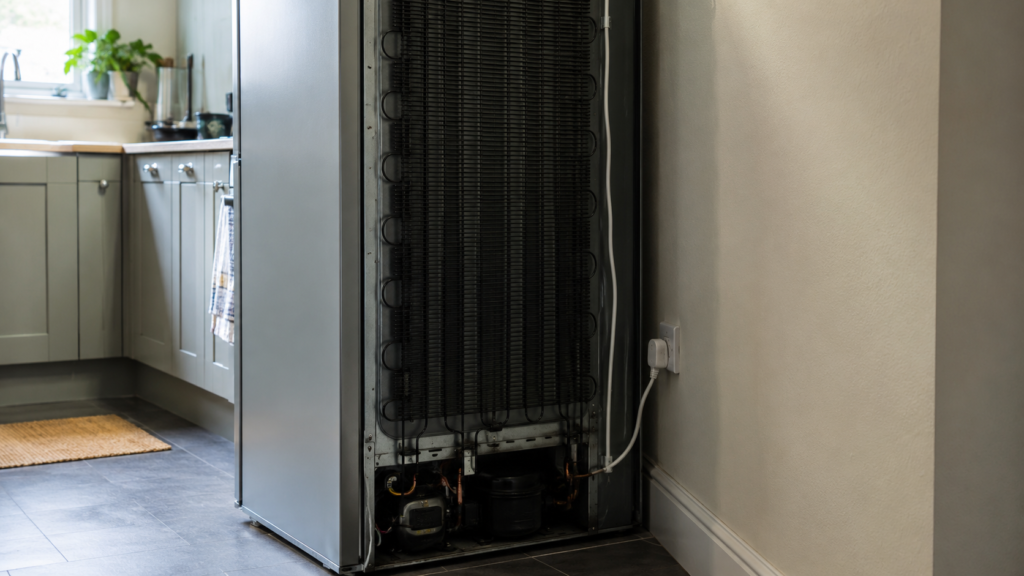
The rear gap is usually one of the most important measurements.
The rear measurement is often the first thing to check when answering how much space should you leave around a fridge freezer.
A practical starting point is to allow approximately 5cm behind a freestanding fridge freezer, unless the manufacturer specifies a different distance.
Some modern models are designed to sit closer to the wall because their cooling system is arranged differently. Others have exposed rear components or ventilation requirements that need more room.
The instruction manual takes priority over any general recommendation.
The space behind the appliance allows:
- Heat to disperse
- Air to circulate around the rear panel
- The power cable to sit without being crushed
- The plug to remain accessible where possible
- Water hoses to avoid kinking on plumbed models
- The appliance to stand without touching pipework or skirting boards
Do not measure only from the visible wall surface.
Skirting boards, sockets, pipes and protruding plugs can all reduce the usable depth. A fridge freezer advertised as 60cm deep may extend considerably further into the room once the ventilation gap, door and handle are included.
When checking how much space should you leave around a fridge freezer, measure from the appliance’s furthest rear point rather than assuming the cabinet is completely flat.
Can a Fridge Freezer Touch the Wall?
It is generally better for a fridge freezer not to sit directly against the wall. When considering how much space should you leave around a fridge freezer, direct contact with the wall should normally be avoided.
Even if the appliance appears to operate normally, direct contact can cause:
- Restricted ventilation
- Increased vibration noise
- Marks on the wall
- Pressure on the power cable
- Rattling against skirting boards
- Difficulty cleaning behind the appliance
A fridge freezer that vibrates against a wall can sound much louder than it really is. Moving it forward slightly may stop buzzing or rattling without any repair being needed.
Some appliances include rear spacers that prevent the cabinet from being pushed too close to the wall. Do not remove these simply to make the appliance fit into a shallow gap.
If the available depth is extremely limited, choose a shallower model rather than ignoring the ventilation instructions.
↔️ How Much Space Should You Leave at the Sides?
Side clearance requirements depend heavily on how the appliance releases heat. Side ventilation is another important part of deciding how much space should you leave around a fridge freezer in a fitted kitchen.
Some fridge freezers disperse warmth through their side walls. These models may feel warm on the outside during normal operation and should not be pressed tightly between cabinets.
As a general starting point, allow around 2.5cm on each side where possible, but always check the exact manufacturer instructions.
Some newer appliances are designed with reduced side-clearance requirements. Others need a wider gap to prevent heat build-up.
Leaving some side space also makes it easier to:
- Level the appliance
- Pull it out for cleaning
- Prevent vibration against cabinets
- Protect nearby cupboard finishes
- Access the plug or socket
- Open the doors without striking surrounding units
A gap that is technically wide enough for the main cabinet may still be too narrow once hinges, handles or door movement are considered.
This is particularly important when deciding how much space should you leave around a fridge freezer in a fitted kitchen.
🚪 Leave Enough Space for the Doors to Open
Ventilation is only one part of the installation. Door clearance is easy to overlook when calculating how much space should you leave around a fridge freezer.
The fridge freezer doors must open far enough for you to use the appliance properly. A door may appear to open adequately at 90 degrees, yet the salad drawer or freezer drawers may still be difficult to remove.
Check whether the open door will collide with:
- A nearby wall
- A kitchen island
- An oven handle
- A radiator
- A cupboard door
- A washing machine
- A doorway
- A window ledge
Many fridge freezer doors need to open beyond 90 degrees before internal shelves and drawers can be removed completely. This door movement must be included when calculating how much space should you leave around a fridge freezer.
This matters when cleaning the appliance, adjusting shelf positions or replacing a damaged drawer.
Reversible doors can help, but the hinges normally need to be changed before the appliance is fully positioned. Door reversal may also require tools, spare hinge covers or assistance from the delivery team.
When measuring how much space should you leave around a fridge freezer, open-door depth and side swing are just as important as ventilation.

⬆️ How Much Space Should You Leave Above a Fridge Freezer?
Warm air naturally rises, so the space above the fridge freezer can form part of its ventilation route. The upper gap can be just as important when working out how much space should you leave around a fridge freezer beneath wall cabinets.
A practical starting point is to leave approximately 2.5cm to 5cm above a freestanding model, provided the manufacturer does not require more.
A large open gap is not always necessary, but tightly enclosing the top beneath a cupboard may trap warm air.
If a wall cabinet is positioned above the appliance, check:
- The manufacturer’s minimum top clearance
- Whether air can escape at the front or sides
- Whether the cabinet overhang blocks ventilation
- Whether the fridge freezer can be pulled out
- Whether the appliance height includes hinges
- Whether the floor is level
Do not rely only on the listed product height.
Height-adjustable feet, uneven floors and hinge covers can affect the final installed measurement. Leave a little additional tolerance rather than choosing an appliance that matches the opening to the exact millimetre.
Knowing how much space should you leave around a fridge freezer before ordering can prevent a frustrating delivery failure.
Should You Put a Cupboard Directly Above It?
A cupboard can sometimes be installed above a fridge freezer, but it should not block the required airflow. The cabinet design therefore affects how much space should you leave around a fridge freezer beneath overhead storage.
The safest approach is to:
- Follow the appliance installation diagram
- Leave the specified top gap
- Avoid enclosing the appliance completely
- Make sure warm air has an escape route
- Keep the cabinet clear of hot external surfaces
- Avoid storing heat-sensitive items directly above it
A shallow cupboard positioned higher above the fridge freezer is generally less restrictive than a deep cabinet fitted closely around the top.
Where the appliance sits inside a purpose-built housing unit, follow the kitchen manufacturer’s ventilation design as well as the fridge freezer instructions.
Freestanding appliances should not automatically be treated like integrated models. Integrated fridge freezers use specially designed ventilation channels, grilles and cabinet gaps.
🧱 Freestanding vs Integrated Fridge Freezer Clearance
Freestanding and integrated appliances have different installation requirements. The answer to how much space should you leave around a fridge freezer changes depending on whether the appliance is freestanding or integrated.
Freestanding fridge freezers
These are designed to stand independently and normally need open ventilation around part of the cabinet.
They should not be enclosed inside a standard kitchen cupboard unless the manufacturer explicitly permits it.
Integrated fridge freezers
These are designed to sit inside a housing cabinet.
The cabinet normally includes:
- A lower ventilation inlet
- Space behind the appliance
- An upper ventilation outlet
- Specific internal cabinet dimensions
- Correctly positioned door hinges
An integrated model can appear tightly enclosed from the front while still having a hidden airflow path behind it.
Do not copy the appearance of an integrated installation with a freestanding appliance. The cooling systems and ventilation arrangements may be different.
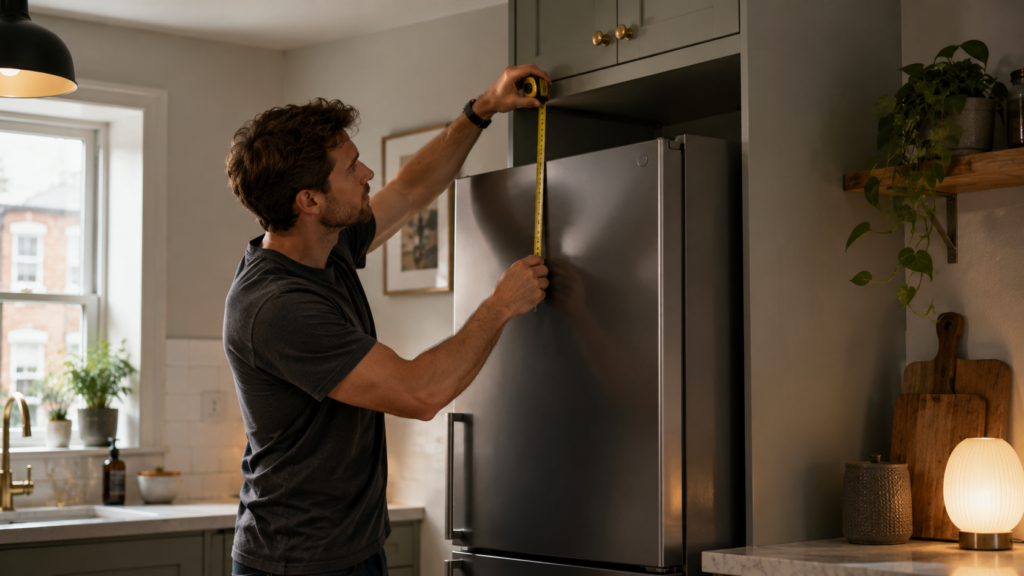
🔥 Keep It Away from Heat Sources
The space around a fridge freezer also protects it from nearby heat.
Avoid placing the appliance directly beside:
- An oven
- A cooker
- A radiator
- A boiler
- A tumble dryer
- A sunny window
- A frequently used portable heater
Heat from another appliance can make the fridge freezer work harder.
Where placement beside an oven cannot be avoided, follow both manufacturers’ installation instructions and consider a suitable insulated divider between the appliances.
You should also avoid positioning a fridge freezer where strong sunlight heats the cabinet for several hours each day.
When assessing how much space should you leave around a fridge freezer, consider the wider environment rather than measuring only the immediate gaps.
What Happens If You Do Not Leave Enough Space?
Poor airflow can contribute to cooling problems, although there are several other reasons why a fridge freezer may not be cold enough.
A fridge freezer squeezed into an unsuitable opening may still switch on and cool initially. Problems can develop gradually rather than appearing immediately.
Possible warning signs include:
- The compressor running for long periods
- Excessive heat around the sides
- Increased humming or vibration
- Food not cooling consistently
- Ice cream becoming soft
- Higher electricity consumption
- Condensation around nearby cupboards
- The appliance repeatedly cycling on and off
- Premature component wear
Some warmth around the cabinet can be normal, particularly when the appliance has just been installed, after a large food shop or during hot weather.
However, excessive heat combined with poor cooling, unusual noise or continuous operation should not be ignored.
Check the ventilation gaps, make sure the doors seal correctly and confirm that the appliance is level.
If airflow or temperature regulation is disrupted, you may also need to investigate why a fridge freezer keeps icing up.
🧹 Leave Enough Space for Cleaning and Maintenance
Ventilation is essential, but access also matters.
Dust, pet hair and food debris can collect behind and beneath a fridge freezer. Over time, this can restrict airflow around exposed components and make the appliance less efficient.
Leaving enough clearance allows you to:
- Pull the appliance forward safely
- Vacuum behind and underneath it
- Inspect the power cable
- Check for water leaks
- Clean accessible ventilation grilles
- Confirm that rear spacers remain correctly positioned
Before moving a fridge freezer, remove loose items from the doors and ask another adult to help if the appliance is heavy.
Do not pull it forward by the doors or handles. Use the cabinet sides and follow the manufacturer’s moving instructions.
Understanding how much space should you leave around a fridge freezer should therefore include enough practical access for occasional cleaning and inspection.
Before installing the appliance in an unheated space, check whether you can safely put a fridge freezer in a garage.
🪵 Does the Floor Affect the Required Clearance?
The floor beneath the appliance should be solid, level and capable of supporting its full loaded weight.
A fridge freezer that leans or rocks may:
- Vibrate against nearby cabinets
- Produce unnecessary noise
- Prevent the doors from sealing properly
- Allow the doors to swing open
- Put uneven pressure on the feet
- Make drawers harder to use
Adjust the levelling feet after positioning the appliance.
Some manufacturers recommend a very slight backwards tilt so the doors close naturally, but this should only be done according to the installation manual.
Thick carpet can restrict airflow beneath certain models and make the appliance unstable. A firm appliance board may help, but it must be strong enough and should not block any lower ventilation openings.
🌡️ Does Room Temperature Change the Space Needed?
The required installation clearances normally remain the same, but room temperature can affect how hard the appliance works.
Correct ventilation helps the appliance maintain the right temperature, so it is also worth checking what temperature a fridge freezer should be in the UK.
A fridge freezer may run for longer in:
- A hot kitchen
- Direct sunlight
- A poorly ventilated utility area
- A room beside a boiler
- A conservatory
- A garage outside its climate rating
Extra room around the cabinet does not override the appliance’s approved operating temperature.
Check the climate class in the manual before installing a fridge freezer in an unusually hot or cold location.
Even when the room is suitable, maintaining the recommended airflow becomes especially important during warm weather.
Room temperature and ventilation become even more important when considering whether you can keep a fridge freezer outside.
✅ Simple Fridge Freezer Clearance Checklist
This checklist makes it easier to calculate how much space should you leave around a fridge freezer before delivery day.
Before ordering or installing the appliance, check the following:
- Read the exact manufacturer’s installation guide
- Measure the opening at several points
- Allow the required rear ventilation gap
- Leave suitable clearance at both sides
- Check the space above the appliance
- Measure the full door swing
- Make sure drawers can be removed
- Include handles and hinges in your measurements
- Avoid crushing the plug or power cable
- Keep the appliance away from heat sources
- Confirm that the floor is level
- Leave enough access for cleaning
These checks provide a much more reliable answer to how much space should you leave around a fridge freezer than relying on cabinet width alone.
Once the appliance is positioned correctly, use our guide on how to organise a fridge freezer in a small kitchen to maximise the available storage.
✅ Final Verdict
So, how much space should you leave around a fridge freezer?
There is no single measurement that applies to every appliance. A sensible general starting point for many freestanding models is around 5cm behind, roughly 2.5cm at the sides and approximately 2.5cm to 5cm above.
However, those figures should never replace the installation instructions for your exact model.
Some fridge freezers can sit closer to a wall, while others need larger ventilation gaps. Door swing, handles, sockets, skirting boards and nearby cupboards can also increase the space needed.
The safest approach is to check the manufacturer’s diagram, measure the full installation area and leave a small amount of extra tolerance. A fridge freezer that fits comfortably will usually run more quietly, remain easier to clean and experience less heat build-up than one forced tightly into a narrow opening.
Once you know how much space should you leave around a fridge freezer, you can compare appliances using their true installed dimensions rather than cabinet size alone.
Frequently Asked Questions
How much space should you leave behind a fridge freezer?
Around 5cm is a useful general starting point for many freestanding models, but the manufacturer may specify a smaller or larger gap. Always follow the exact installation manual.
How much space should you leave at the sides of a fridge freezer?
A general allowance of approximately 2.5cm on each side may provide useful ventilation and prevent vibration. Some models require less, while appliances that release heat through their side walls may need more.
How much space should you leave above a fridge freezer?
Many freestanding models benefit from approximately 2.5cm to 5cm above the cabinet. The exact requirement depends on where the appliance releases heat and whether a cupboard is fitted above it.
Can a fridge freezer be pushed against a wall?
It should not normally be pushed directly against a wall unless the manufacturer specifically permits this. A rear gap protects ventilation, the power cable and accessible components.
Can you put a freestanding fridge freezer inside a cupboard?
Only when the manufacturer explicitly approves that type of installation and the cupboard provides the required ventilation. Freestanding appliances should not be enclosed like integrated fridge freezers.
Why is the side of my fridge freezer warm?
Many modern appliances release heat through their exterior walls. Some warmth can be normal, particularly after installation or during hot weather. Excessive heat combined with poor cooling or constant running should be investigated.
Does a fridge freezer need room for the door to open fully?
Yes. The door must open far enough to access shelves and remove drawers. A cabinet that fits inside the gap may still be unsuitable if a wall or cupboard restricts the door swing.
The Bosch fridge freezer installation guidance explains why sufficient ventilation and correct positioning are important for safe appliance operation.